Showing posts with label Slater Mill. Show all posts

Friday, June 17, 2022

Flat Jane in Pawtucket, Rhode Island (Page 4)


Flat Jane Austen in Rhode Island:

In which she learns of the Industrial Revolution and gets a peek into the future

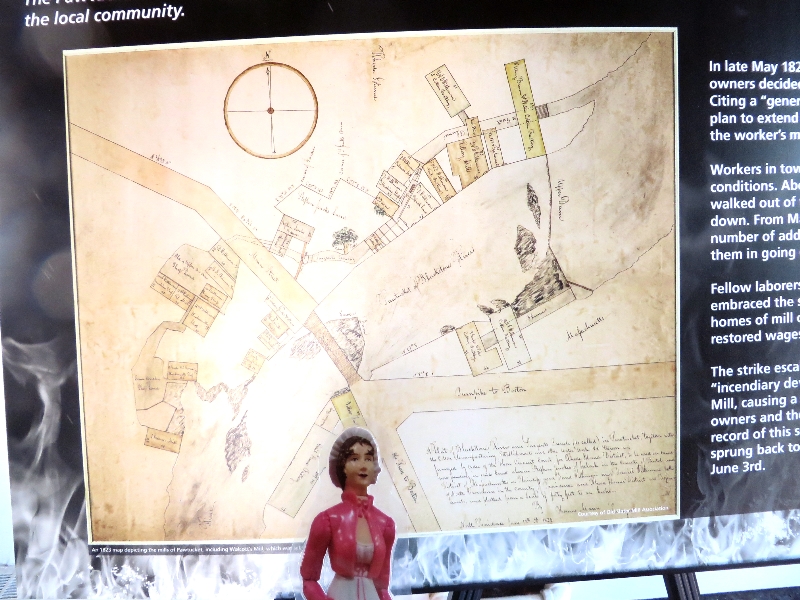
When the mills first opened, the workers came and went as they pleased as they were used to working with the sun and the rhythm of the seasons. This angered the mill owners who insisted on their mill hands being inside at 6 in the morning until 6 at night with only a half hour break for lunch and bathroom. For all this, the girls earned 35 cents a week and the boys 50 cents. By the year [18]10, Mr. Slater could no longer hire solely children, the machines were too powerful. He now hires young women between the ages of 15-30.

Power loom weaving was added to the Wilkinson's mill after Mr. David Wilkinson invented a powerful loom. Pawtucket has grown from a small village to a larger manufacturing town. By the 1820s, the city will have eight textile mills, six machinery manufacturers, eighty-three houses, twelve stores, two churches, a bank, two schools, the population will number 3,000 souls. 
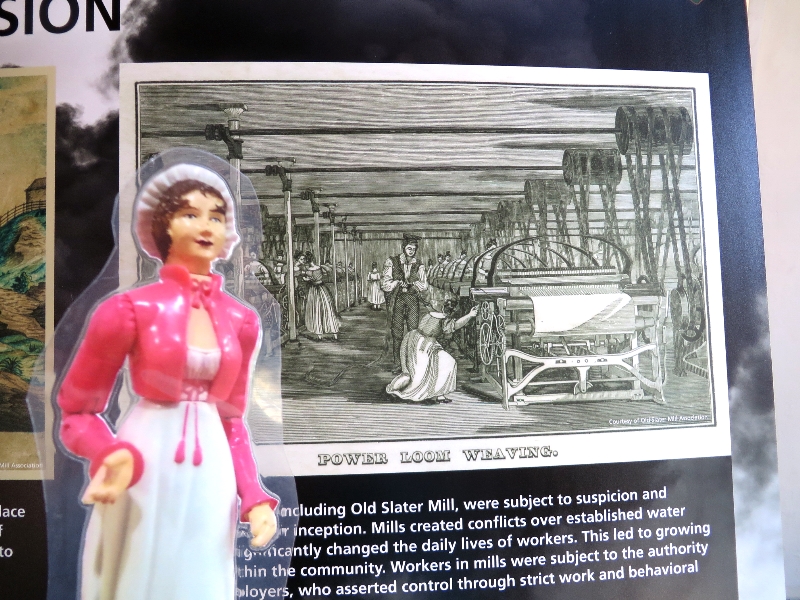
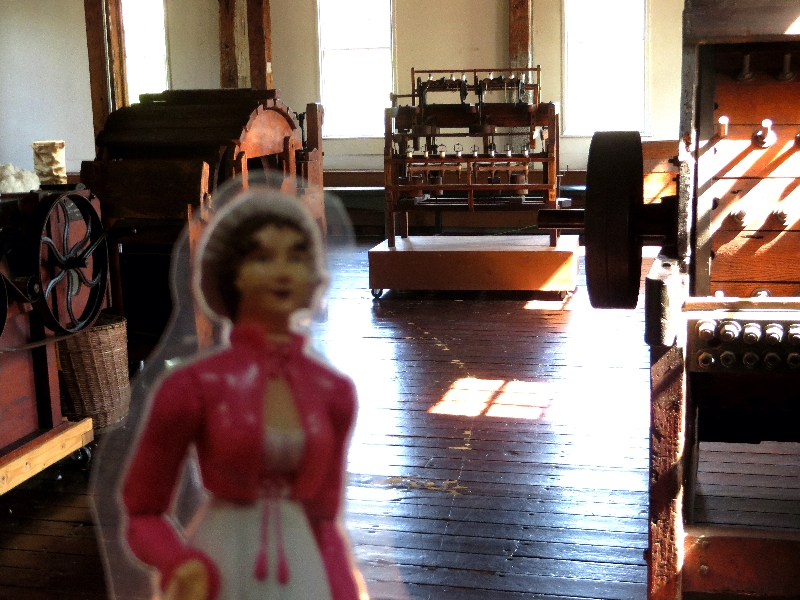
a peek into Slater's Mill in the 1820s


With more powerful machinery, the mill owners could work the hands harder. They began ringing the bells a wee bit earlier in the morning and a bit later in the evening. The workers, lacking clocks, really had no idea how long they worked but they understood the machines were faster and they were working harder for the same pay. Their lives are strictly controlled and their time is no longer their own.

I am told that the American economy is experiencing fluxuations. There will be a Panic (recession) in '19 and '24, those annoying Americans finally established their OWN taxes (Tariff of 1824) designed to protect American manufacturing. As a result of the high tariff, American manufacturers seek to keep costs low and production and profits high.


This causes great tension between the workers and the owners. Local artisans and farmers were angry over the wealthy mill owners taking all the water for their mills. Tensions boiled over in '24 when the weavers' wages were cut by 25 percent and the workday increased by one hour. The women refused to accept lower wages for more work and vowed to walk out until conditions were restored.

On May 26, 1824, 102 young women and other sympathetic community members, blocked the entrance to the hated mill. [Editor: We do not know which one.] The strike then spread to other mills. 


As more people became involved, the strike turned into a riot, an unruly mob making "an excessive noise". The mob grew to 500 people. They then visited successively the houses of the manufacturers, "shouting, exclaiming and using every imaginable term of abuse and insult," according to the newspaper. Windows were broken in the mills and the owners' home and next day the manufacturers shut their gates and the mills did not run. 

A compromise has been reached and as of 3 June, the workers are back at work with the same conditions as before. A clock will soon be installed in a nearby church tower.

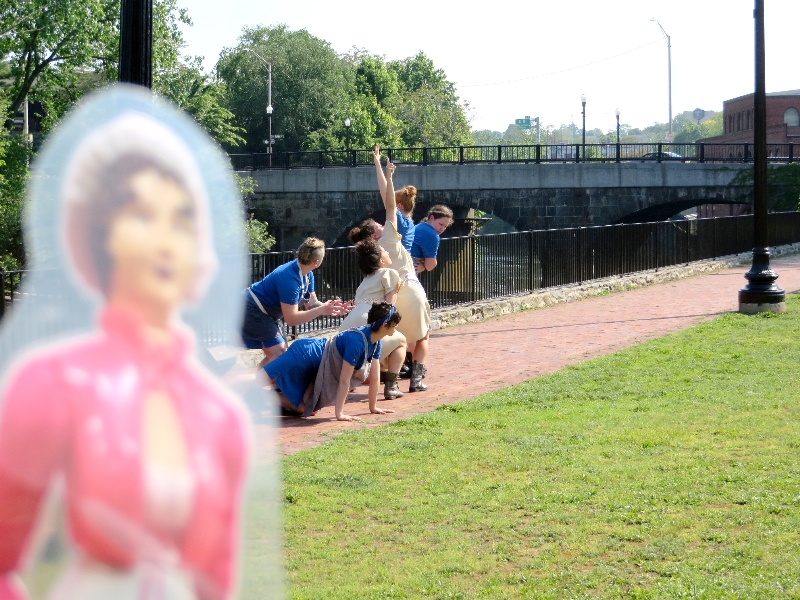
The women express their anger in a dance

Ah, an English country dance

I know not what manner of dance this may be.

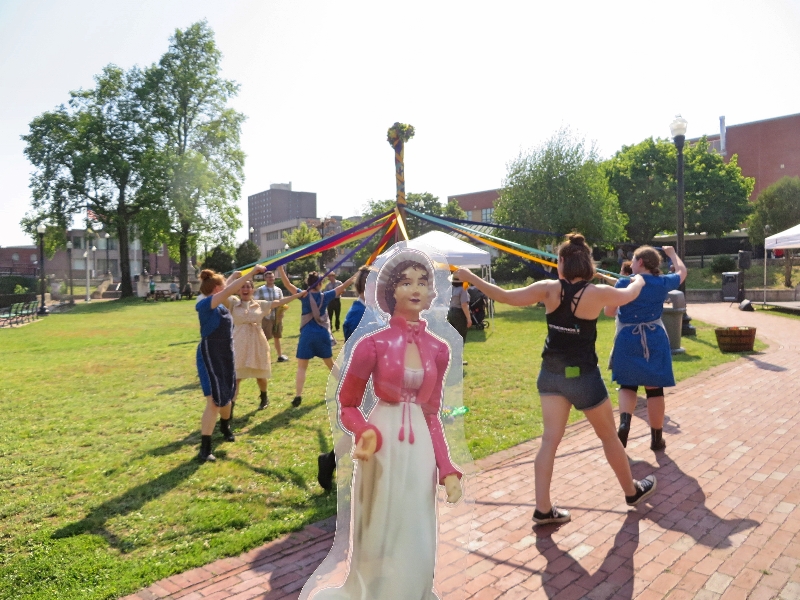
Oh, a maypole dance

A maypole dance


Editor's Note: Slater Mill is part of the Blackstone River Valley National Historic Park. The day we went the museum was commemorating the first strike by women in the U.S. in 1824. Young women portraying mill girls performed an interpretive dance. 


In commemoration of the 150th anniversary of the First Successful Cotton Mill in America this tablet was presented to the Old Slater Mill Association, present owners of this historic building in honor of the textile pioneer whose name they perpetuate. Samuel Slater, father of the American factory system. From this little mill started by Slater in 1790, grew America’s great cotton manufacturing industry whose products are known around the world.


Please turn the page! I have yet to finish writing this letter!

Flat Jane Austen in Pawtucket, Rhode Island (page 3)

Flat Jane Austen in Rhode Island:

In which she learns of a Traitor 

and the Industrial Revolution


Mr. Slater first began to work for Mr. Moses Brown at Ezekiel Carpenter's fulling mill, near Mr. Sylvanus Brown's cottage. Mr. Moses Brown wished for Mr. Slater to correctly put together the pieces of old machinery he had acquired from other manufactories. Mr. Slater realized he needed to start fresh. He struggled a bit but with the help of Mr. S. Brown and Mr. David Wilkinson, he built a spinning machine, a carding machine and added a bale breaker. 

The experiment was so successful, Mr. M. Brown, his son-in-law William Almy, his son Obidiah Brown, and his cousin, Mr. Smith Brown built Mr. Slater a mill and made him a partner. Mr. Slater hired 9 children from nearby farms and his young brother-in-law, Smith Wilkinson, to operate the machines. Here in Britain we use children from the workhouse. Those children used water-powered machines to make white cotton (thread) on demand. Mr. Slater was accustomed to making yarn for stockings. This mill is the first successful, modern, water-powered cotton mill in America.

Editor's note: The following history is going to be difficult. Please read at your own risk. Jane's intention is to show you the process of making thread in the early 1800s.

The process begins with cotton. Cotton comes from a plant which grows in warm climates. 
Cotton plant behind Jane with wool next to her in the basket


Mr. Slater intended to use cotton from the Dutch colony of Surinam in the West Indies to make cloth, however, his late wife, at the time 18 years of age, spun the cotton on a hand spinning wheel resulting in cotton thread stronger than linen. It is said she was the first woman in America to have a patent.  

Mr. Slater, however, first turned his attention to cotton twist threads used for the warp (vertical) threads on a hand loom. After success with local weavers producing cloth, Mr. Slater began producing cotton thread earlier this century.

In '93, the same year Almy, Brown and Slater opened for business, an American Yankee, Eli Whitney, invented a machine to separate the seeds from the cotton. The cotton gin makes it much easier to get American grown cotton from the South. All the work of growing the cotton and separating the seeds is done by slaves [enslaved people]. First they use to cotton gin (engine) to remove the seeds, then they beat the cotton over an open work table (willow) to remove any excess dirt. 

Jane with the cotton plant, a bale, roving and leather belt (that turns the machinery)

Finally, the cotton is made into bales. Bales weighing 500 pounds each, are put on a cart piled with many others, shipped to a seaport city, placed on a boat and shipped to Providence. From Providence it arrives up the Seekonk River by boat and unloaded by the mill. 

Jane in Slater Mill with a cotton bale behind her.
The cotton gin is in the center and carding machine to the right.

Mr. Moses Brown was pleased to have a project solely made in America.

When the cotton arrives in the mill, the hands grab the cotton and place it on the bale breaker which fluffs the cotton back up into workable fiber.

Jane poses in front of the bale breaker.

Next, the hands took the fluffed cotton to the carding machine to be made into slivers, long flat sheets of smooth cotton. Samuel Slater made particular improvements to this machine.

After carding, the cotton sliver is taken to another machine for a twist. This is called roving. Roving is not yet strong enough to weave into cloth. 'Tis still too loose and breaks easily. 

The roving is then taken to a spinning machine such as this Arkwright Water Frame. THIS is the invention Mr. Slater stole and brought to America. He built an American version of a British machine.

Arkwright Waterframe in the background center.

The water power turns the spools with the roving, twists the roving again and wraps it around the finished thread bobbins. 

Mr. Slater had great success with this machine but it soon became outdated. As Mr. Slater is a traitor to his country, he is not allowed to return and observe new machinery at work. He sent word to his younger brother John to 'prentice to one of the mills and learn this machine. Mr. Samuel Slater begged of young John to come to America with his knowledge. Mr. John Slater, also a traitor, brought knowledge of the Crompton Spinning Mule, the machine which makes thread for muslin! 'Tis not as fine as India mull but is much cheaper.

The Crompton Spinning Mule, a hybrid of two earlier machines.
The first to do spinning and winding on one machine.

Another of Mr. Slater's machines. 

The machine Mr. Slater currently uses in his mill is a Throstle, named after the throstle or thrush bird. The early version twisted threads. This machine features a heart-shaped cog at the bottom, an invention of Mr. Slater's. The cog lifts the bobbins up so that the thread may wind more evenly around the bobbins. 

Jane and the 1835 steam powered Throstle. The machine required
two young girls to work. A 6 year old girl would stick her hands in
the machine to collect the bobbins when they were full while an
older girl threaded the roving through the machine.


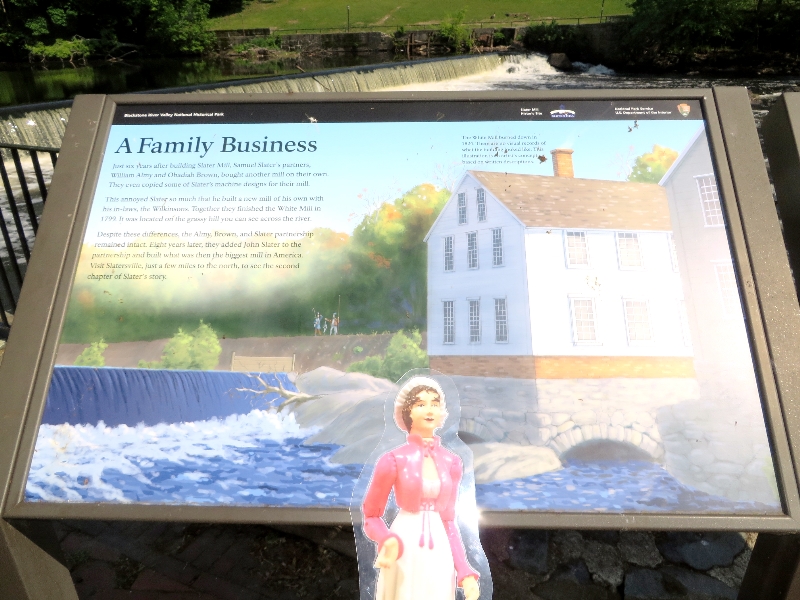
Mr. Slater revolutionized the textile industry. He soon opened a new mill across the river with Mr. John Slater. This one runs continuously so that the mill has a ready supply of thread available for the merchants. The thread can be easily shipped out via the river.

Imagine the White Mill before it burned down


He owns many mills in Rhode Island, Massachusetts, Connecticut and New Hampshire. Recently, following the death of wife Hannah, Mr. Slater removed to  farther up the Blackstone Valley to Massachusetts. He still retains shares in this mill and many others. His business prospered during the late hostilities between Britain and America when British goods were not allowed to be imported but now, with the war over, European goods are much more in demand. Mr. Slater's business is not as robust as it once was but he is not yet ruined. Mr. Slater's success is greatly lauded here in America.

historic mill beams c. 1820s

Mr. John Slater started a new mill and a new system of manufacturing wherein he hired families. There, the families live in the village near the mill, all work in the mills and on Sundays they attend church and Sunday school where the minister preaches the evils of drink. No saloons or other immoral practices are allowed. (Mr. and Mrs. John Slater are Congregationalists).

Where once field and forest stood and farmers eked out a living are now numerous manufacturing villages. Life is no longer governed by the sun but by the bell.  As of today, 1816,
there are 140 cotton manufacturers within 30 miles of Providence, employing 26,000 hands and operating 130,000 spindles.

1820s bell tower

There is now talk of building a canal along the Blackstone River to make transport of goods easier.

Editor's note: While the cotton gin was originally designed to make life easier and reduce the dependency on enslaved labor, in actuality, it had the opposite effect on the American economy. It made cotton cheaper and easier to obtain for our northern mills and perpetuated slavery until the end of the Civil War. Many Rhode Island mills were dependent on southern cotton and made cheap cotton cloth for clothing for enslaved people. To learn more, visit the website for the Blackstone Valley National Historic Park.

The Blackstone Canal was built in 1828 and opened to much fanfare, however, it was soon superseded by the railroad as early as 1847.

Please turn the page

Flat Jane Austen in Pawtucket Rhode Island (Page 1)

Flat Jane in Rhode Island:
In which she learns of a Traitor and the Industrial Revolution

June 12, 18--

My dearest friends,

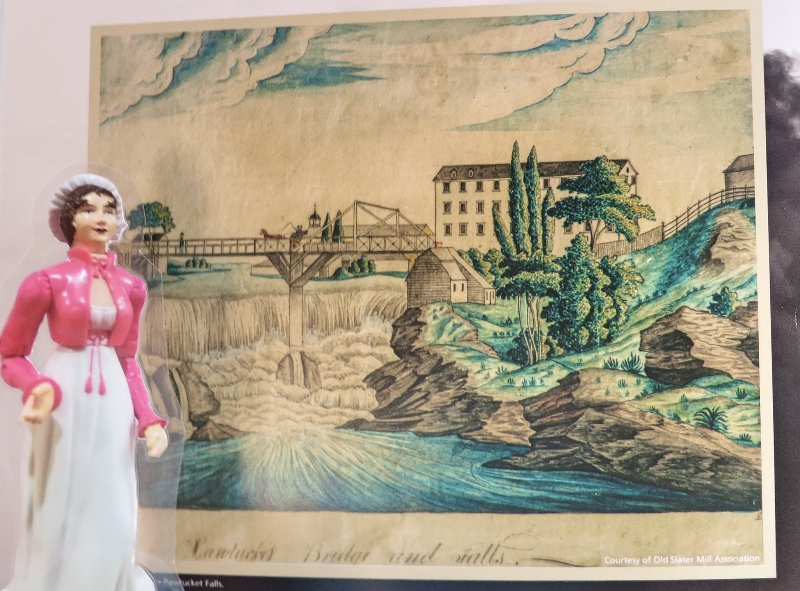
Today we travelled north of Providence to Pawtucket, a village in North Providence on the west side of the Seekonk River, just north of where Susanna's family lives, situated along the Blackstone and Seekonk rivers. 

Jane in the village of Pawtucket

The purpose of our journey was to learn more about the manufactories of this place and how Rhode Island became the birthplace of the Industrial Revolution in America.


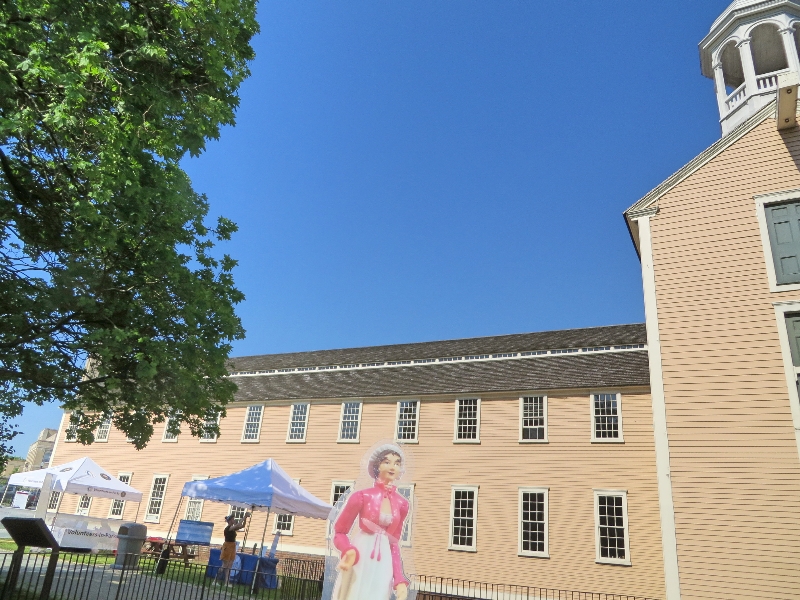
Slater Mill, the birthplace of the Industrial Revolution in America!
Jane at can only see the middle part of the building, the first 6 windows
from the right date from 1793. The rest was added on slightly later than
Jane's short lifespan. The current footprint of the mill dates to 1835!
Yes really! With 1920s renovations and later repairs


In 1790, an Englishman named Samuel Slater chose to betray his country and come to America to start the Industrial Revolution. He had been an apprentice at the Strutt Mills in Derbyshire (not near Pemberley, the Strutts operate in Belper, situated in the Derwent Valley) learning the machinery and management from his master, Jedidiah Strutt. Mr. Strutt's sons wished to stay in business with their father and Mr. Slater knew there would never be an opportunity for him to become master of his own mill based on the terms of his apprenticeship agreement. Then what did he do but get on a ship bound for America with knowledge of the textile machinery in his head. 

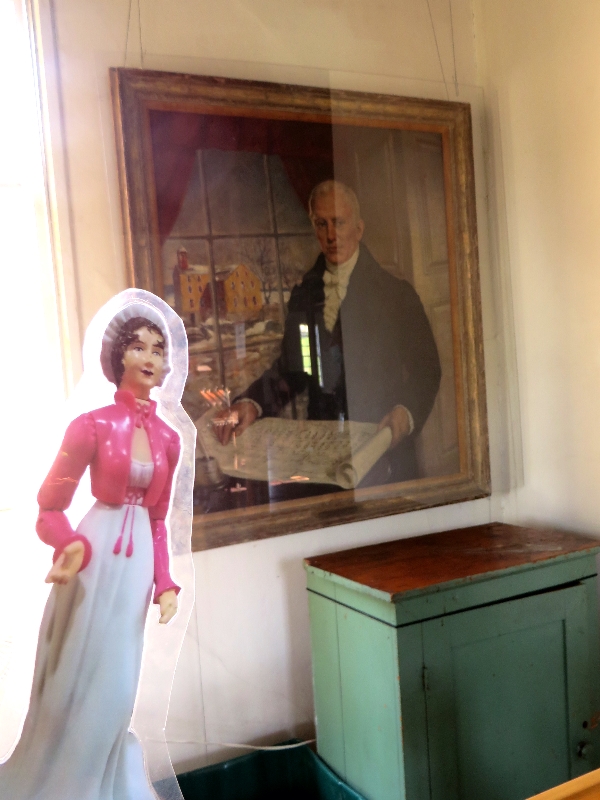
Jane, meet Samuel Slater, a portrait painted nearly 
100 years after his death showing his importance to the 
industry and his past as an apprentice
gift of his great-grandson Horatio Nelson Slater 


The American government, encouraged by the then Secretary of the Treasury, Mr. Alexander Hamilton, was offering rewards for technological innovations to help America become financially independent! How shocking! Mr. Slater had promised faithfully, in his apprenticeship, not to reveal the secrets of his master to any other master or sovereignty! I suppose, perhaps, technically America is no longer a sovereignty under the King but it is a sovereign nation. Mr. Slater chose to break the terms of his apprenticeship and the law! OUR law prevents anyone from carrying out industrial knowledge. 

Just how did Mr. Samuel Slater get away with such lawlessness? Susanna thinks he dressed as a farmer and Susanna’s friend, another Susanna, thinks Mr. Slater memorized the plans. Whatever he did was treason. He should have been punished.

Instead, Mr. Slater settled in New York but could not harness enough water power or find the newest machinery to run a mill. When he heard Mr. Moses Brown was interested in paying someone to build English textile machinery, Mr. Slater offered his assistance. He came to Rhode Island and was hired by Mr. Moses Brown to build an Arkwright Water Frame, a cotton spinning machine that is so outdated we no longer use it in our mills but ‘twas what Slater had learned and what he knew. I shall endeavor to explain the machinery later. I will need help from Mr. Slater to explain it. He is currently busy dealing with some business elsewhere but had time to sit and explain things to Susanna's father. 

First, we must begin at the beginning.

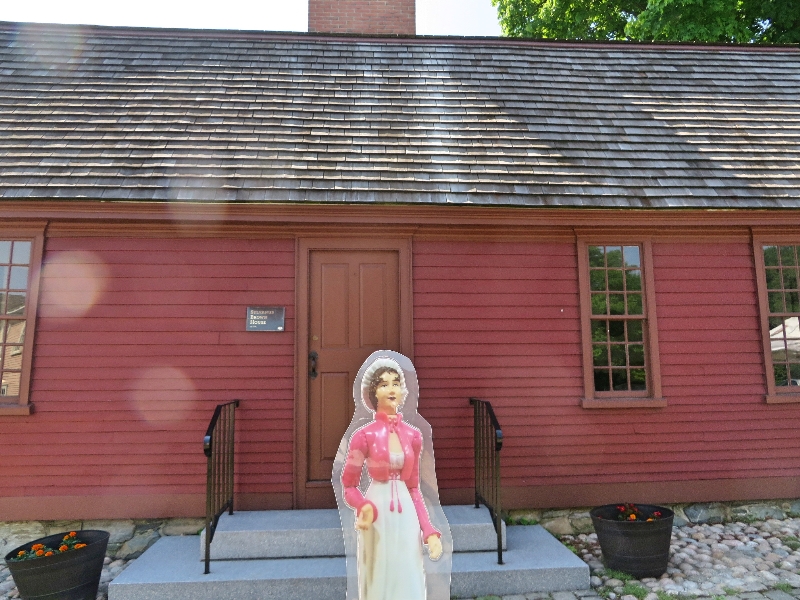
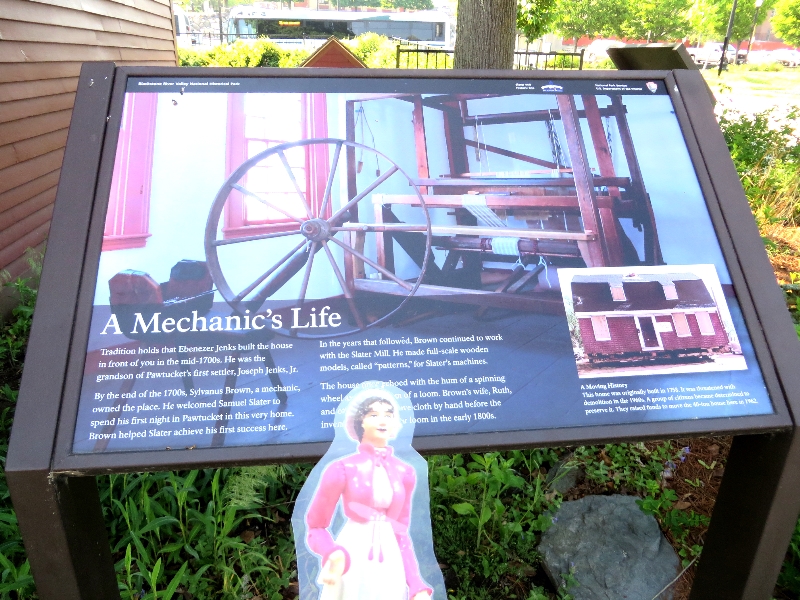
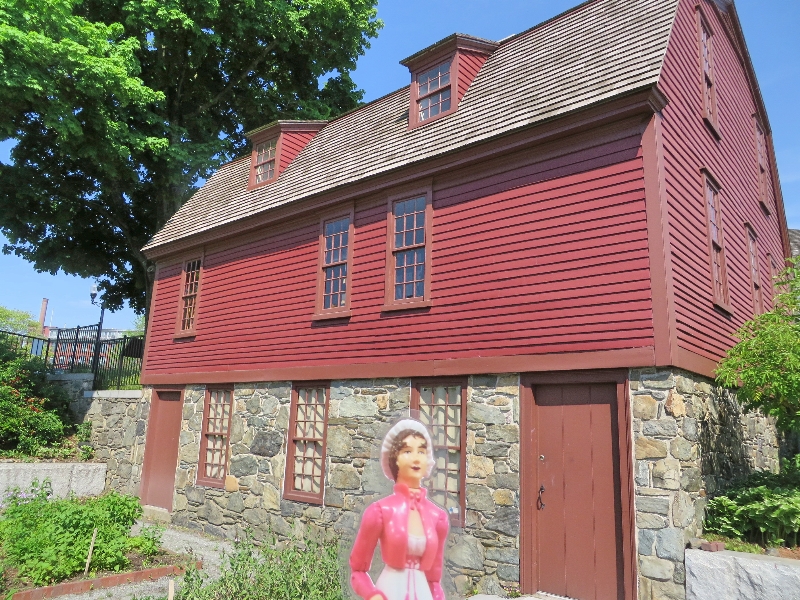
Mr. Moses Brown, a thrifty Quaker, refused to pay Mr. Slater until Mr. Slater could prove himself. He sent Mr. Slater to an associate, Mr. Sylvanus Brown, to test Mr. Slater on his knowledge. Mr. Slater spent his first night in Pawtucket with Sylvanus Brown, a skilled wood and iron worker (he had built ships for the war for independence), and his family. Mr. S. Brown and his family lived in this simple cottage with his family. His carpenter's shop was next door and he helped Mr. Slater build wooden parts for textile machinery. 

Built 1758 for Jencks family. Typical New England artisans cottage

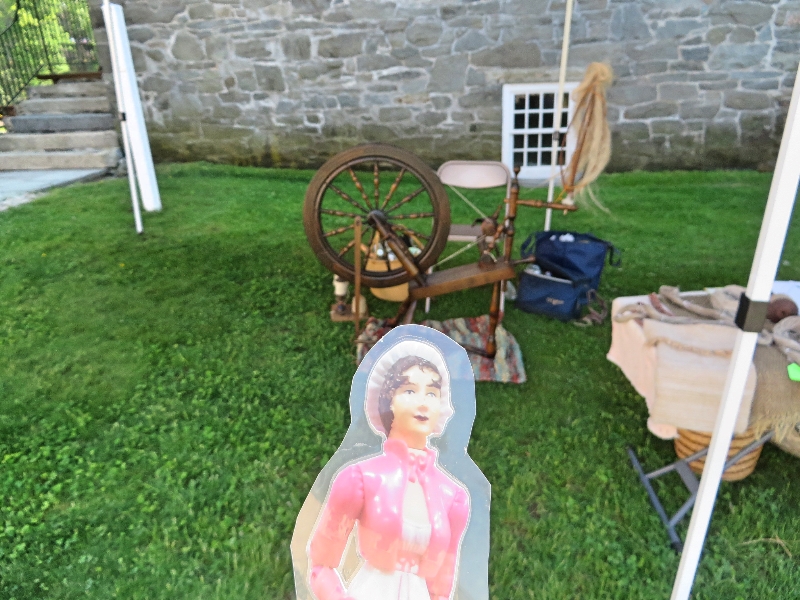
Inside, in the great room, the women carded and spun wool and flax into yarn.
A traveling weaver came to weave the cloth for the family. This was the primitive way New Englanders lived until 1793! I am all astonishment! 

Inside the museum is furnished from Sylvanus Brown's 1825 probate 
and set up to demonstrate pre-Industrial textile production. 


The R.I. Spinners Guild demonstrates flax spinning. Flax grows everywhere
except Antarctica and the desert. Farmers would grow acres of flax, let it dry, cut it, wet it
dry it, break it, beat it, hackle it to remove the shell. Inside is a soft fiber that looks like
a little girl's blond ponytail. Leftovers, spun into coarse sacking, were called tow, 
and looks like a little boy's messy hair. Watch a demonstration.


The kitchen is in the basement to prevent heat, fire and smells from going into the house. 

The house is built into a hill, making it two-and-a-half stories.
The kitchen is here below.

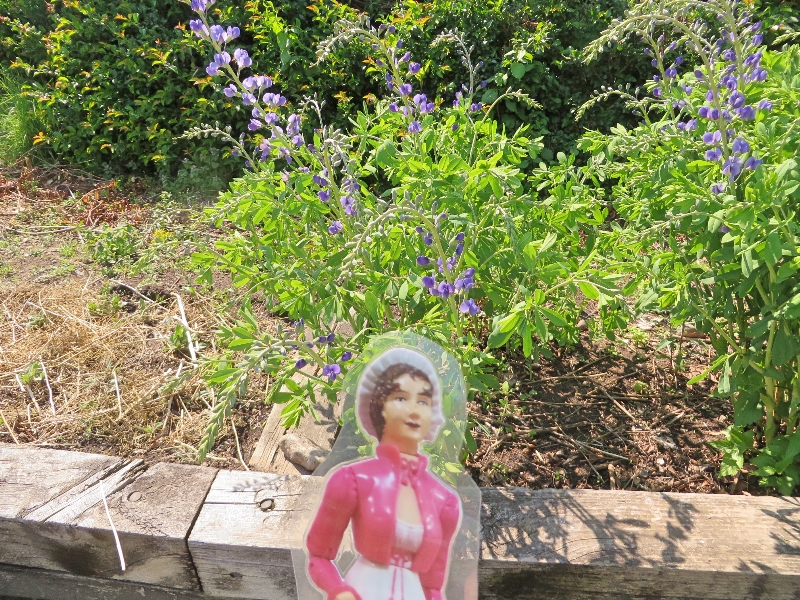
They have a kitchen garden to grow vegetables and herbs; a medicine garden and a dye garden. This plant is known as "false indigo" and makes a beautiful deep blue color. 
False Indigo plant 

Jane visits Pawtucket, Rhode Island. A view of the Pawtucket Falls and yellow 
mill from the opposite side of the river. The Brown cottage is in the foreground.

Editor's note: The cottage was built for the Jencks family. Flat Jane saw their Providence home. Joseph Jencks, Jr., an iron worker, left his father's business in Saugus, Massachusetts to start his own. He established an iron forge and saw mill in Pawtucket in 1671. Joseph's son, Joseph, became the first governor not from Providence or Newport. Sons Nathaniel and Ebenezer lived here with their families, a total of 26 people. The house continued to be a private residence until the 1960s when the neighborhood on the other side of the Blackstone river. The neighborhood was destroyed to build the highway. The house was preserved and moved to the site and restored in the 1970s.

To orient you better, Jane turns the map in the correct direction.


Please turn the page