Showing posts with label 18th century. Show all posts

Monday, May 6, 2024

A Visit With the Durfees of Fall River in the Eighteenth Century

 A Visit With the Durfees of Fall River 

in the Eighteenth Century

Good day my friends!

It has been a long time since I have had anything of note to write to you about. My guardian got a JOB and doesn't have as much time for me anymore. Boo!

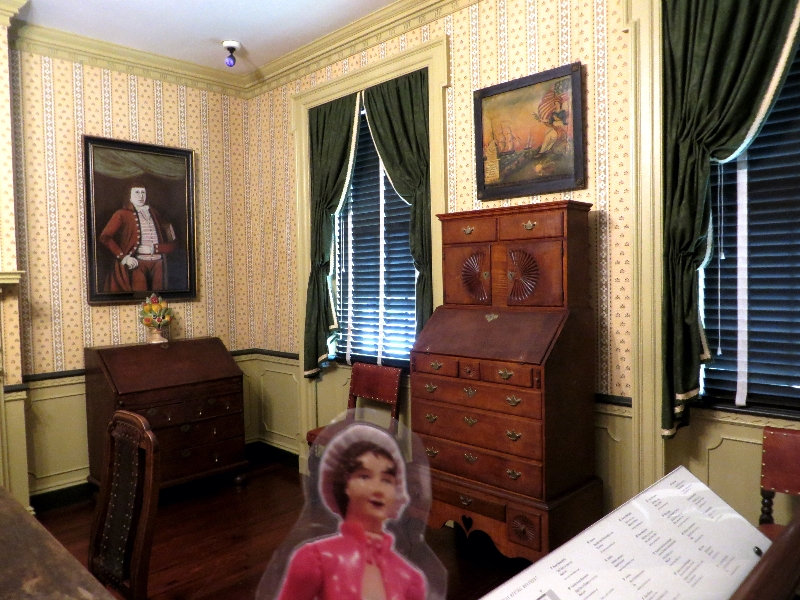
The weekend before last, we traveled to Fall River, Massachusetts to visit the Durfees. This home, in the 18th century, is one of 18 homes near the Taunton River. Judge Thomas Durfee built his house high on the top of a hill, around the year 1750. Judge Durfee was a strong patriot during the war and mortgaged his fine home to pay for the war.


Col. Joseph Durfee led the militia of Fall Rover during the Revolutionary War, served under The Marquis de Lafeyette, fighting in battles in New York, Fall River and Rhode Island. The Marquis was a frequent visitor to Col. Durfee's home.


In the house, we met Col. Durfee and a few merchants selling their wares. We purchased a chocolate block sweetened with sugar for hot chocolate and coffee beans. Both came from the West Indies! 

Downstairs there were samples of beautiful gowns and merchants selling buttons and wool, men's vests and caps. 
Milliners and Mantua Makers


One lady recognized me! She thought I was Felicity. I get that a lot. Felicity or Samantha! [Ed. note: She was sad not to see girls in Boston clutching red bags full of beautiful clothing and accessories We are too! The lady was surprised and sad to hear Felicity's lovely things are not available.]


Upstairs Mr. Durfee gave us a tour. His friend showed us the rope bed and chamber pot, easy chair, foot stove and other things in the room. 

These footwarmers look very familiar

Travel trunk (valise)

Travel Trunk (valise) or tricorn hat

Does the bedwarmer under the bed looks familiar?
How about the bed?


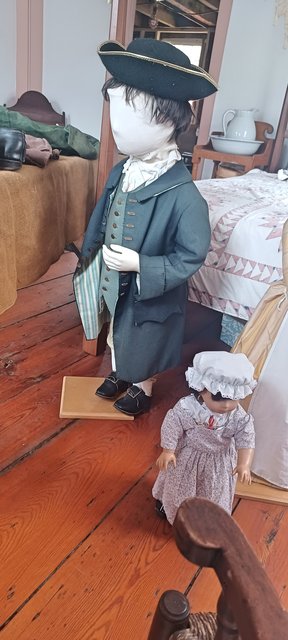
I made friends with this young lady and gentlemen and studied lessons on the hornbook with them.

The young lady is wearing a frock which ties in the back, like mine. 
This is what girls our age wear in the 18th c.
 
His suit and tricorn hat look like Felicity's riding habit

Reading the Lord's Prayer on the hornbook

This must be Grandmother's or Mother's gown. 

Not real sure about the buttons but those cuffs are not original to the gown

Mother's stays and Father's wig


That is all I have to share with you for now but I shall return soon for another adventure!

Sincerely yours,
Susanna


Sunday, July 17, 2022

Flat Jane Austen in Providence, Rhode Island


Flat Jane Austen in Providence, Rhode Island:
In which Jane pays calls on the elite


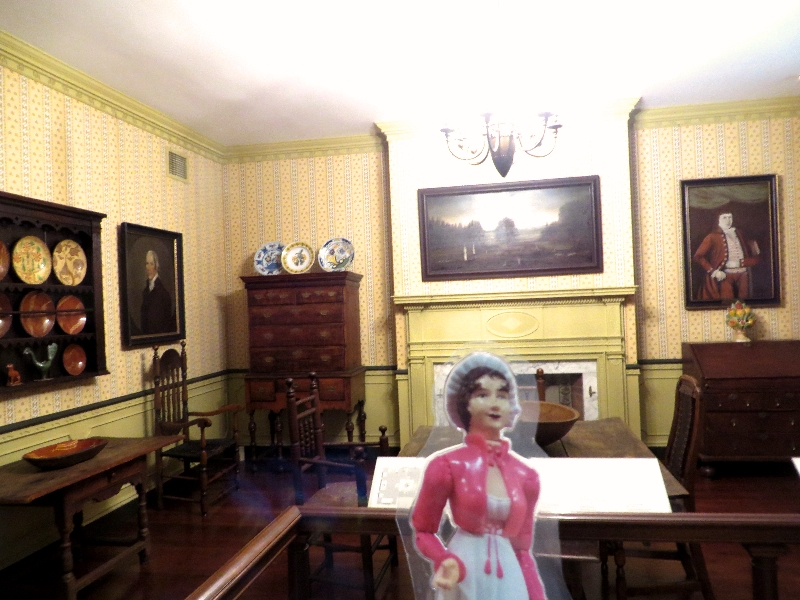
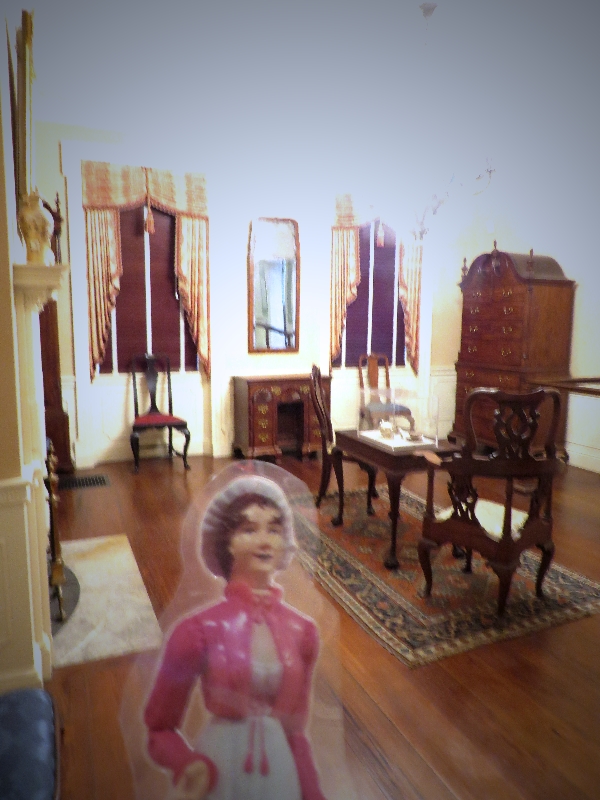
Editor's Note: All photos taken inside the Rhode Island School of Design Museum's Pendelton House. Not all these objects belonged to one family or were displayed at the same time. The furniture in this room is in the neoclassical style built between 1785-1845. All pieces are by Rhode Island cabinetmakers.


My dearest friends,
Are you still reading? 

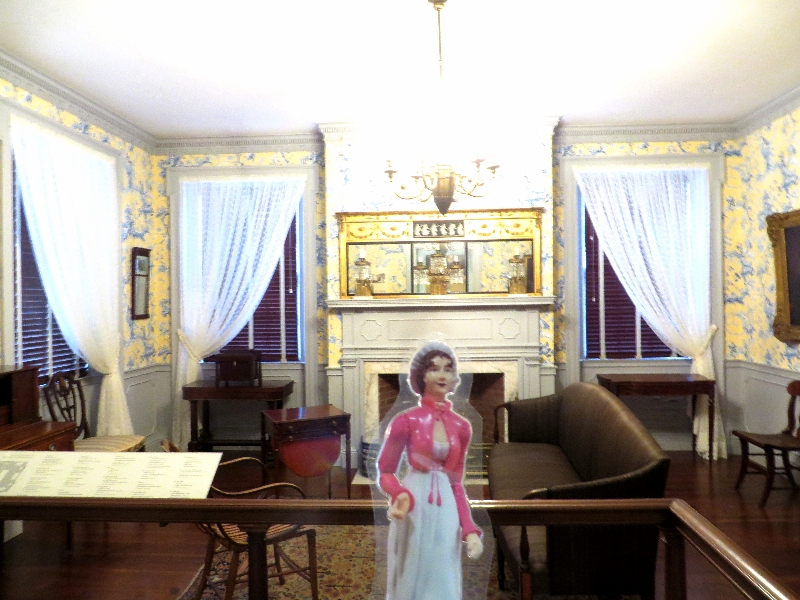
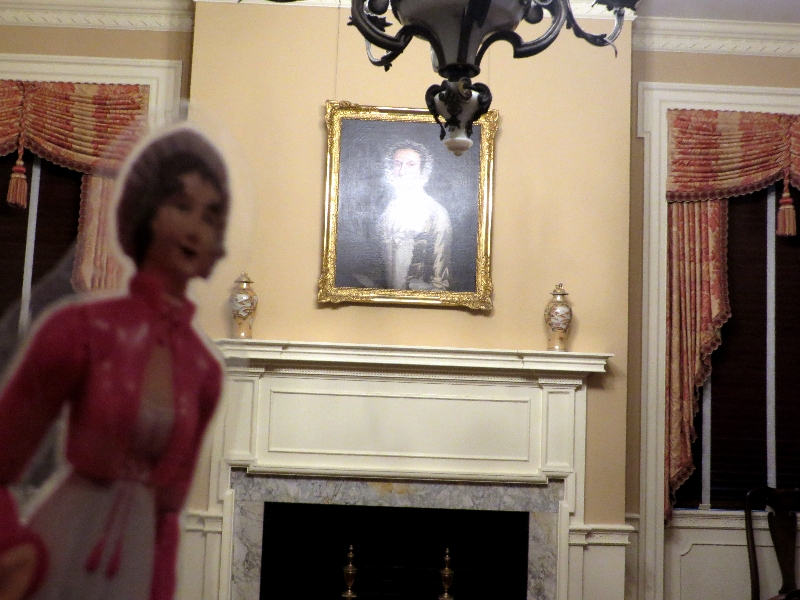
Neoclassical 18th/early 19th-century room


This is the home of Rev. Stephen Gano. He is quite elderly and their home is furnished in the Neoclassical style of the last century. Dr. Gano is a medical man, a Baptist minister and a freemason. Rumor has it his wife left him believing that as a Freemason, whatever that may be, he was a worshipper of the devil! 

His first wife left her mark on the home. Mrs. Allin, the girls and I sit in the ladies' sitting room and work. Behind me you see the sewing table. We do some tambour work while the men discuss theology in Dr. Gano's study. Back in '98 this type of work was new and fashionable, causing a young lady to declare it was "the handsomest thing of the kind" she "ever saw." The table was made by Simeon Hazard of Newport.

The armchair, made in the year '08 in Boston, features a new type of technology. The maker, Samuel Gregg of Boston, calls it "elastic". The chair features a bentwood seat and arms. 'Tis quite comfortable. 


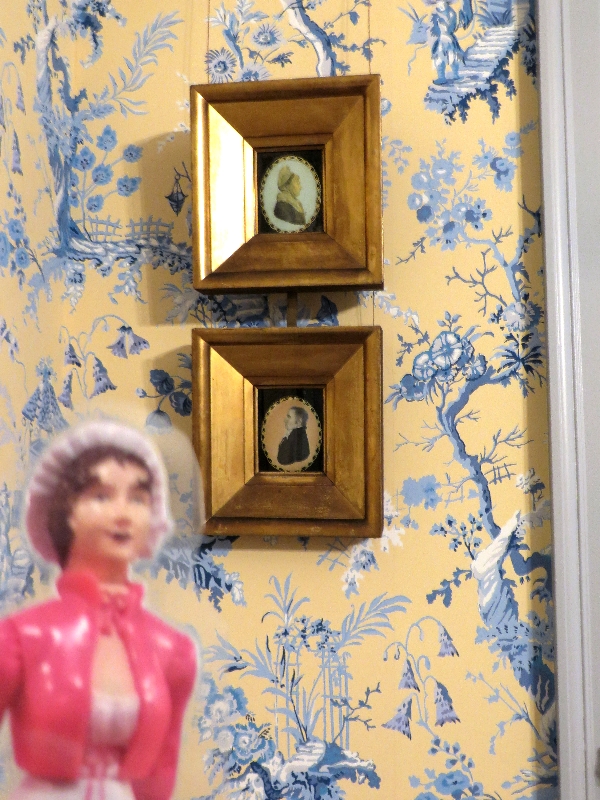
Rev. Stephen and Mary Brown Gano c. 1820; oil and pencil mounted on panel

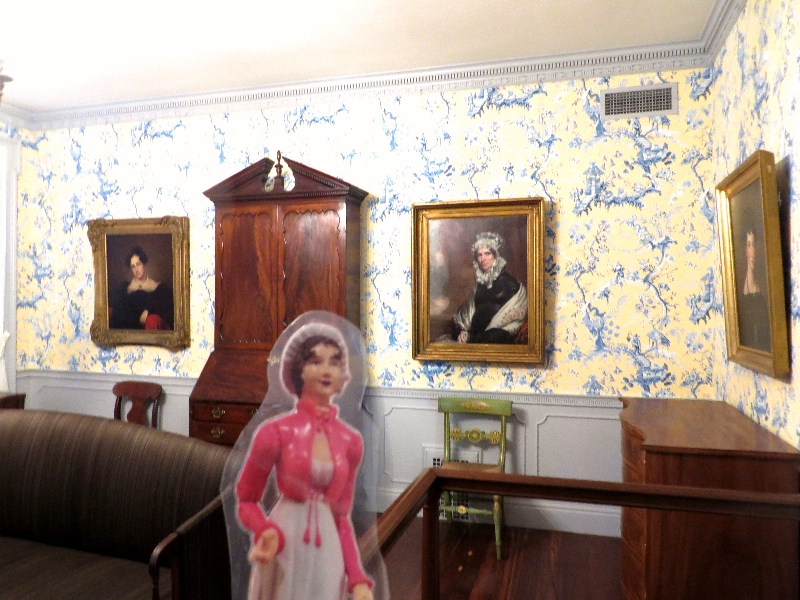
Dr. Gano's desk-and-bookcase was made here in town (Providence) in 1785 by John Carlile, Jr. Dr. Gano purchased this new from the cabinetmaker, one of his first pieces. Providence has overtaken Newport as leader of manufacturing and trade.

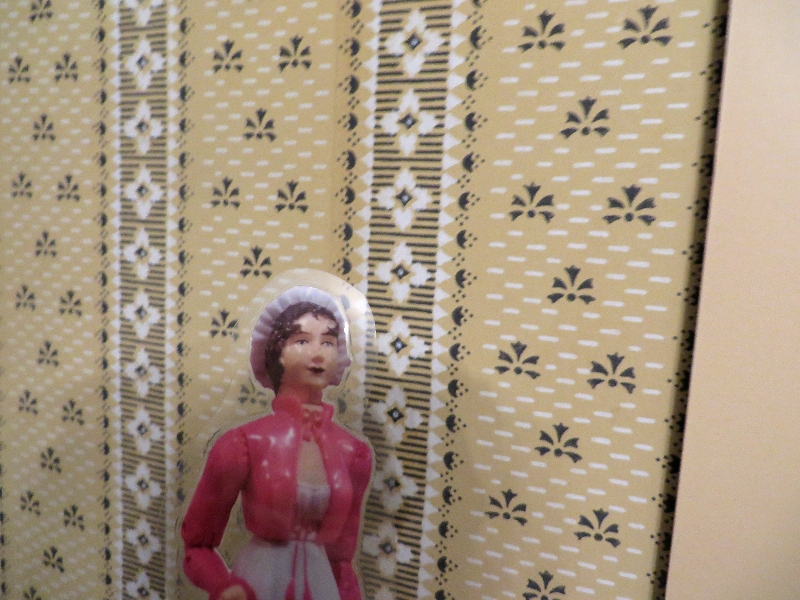
The wallpaper is a French pattern in Chinese taste. Quite surprising for a clergyman. 

Other rooms in the house are not so elegant. Dr. Gano's first wife, Mary, was the daughter of Joseph Brown. She brought with her many family pieces, antiques from the colonial period of the 17th-century.

chest with drawer 1710-1740; ceramics from Pennsylvania and New England made from lead-glazed earthenware ca. 1800-1840 

Editor's note: The 17th-century objects were collected in the early 20th-century during a period of renewed interest in New England history and craftsmanship. The objects also reflect an increasing awareness of folk cultures and objects made by European craftsmen in America. Some collectors collected uniquely American art, folk art, made by people without formal training. 

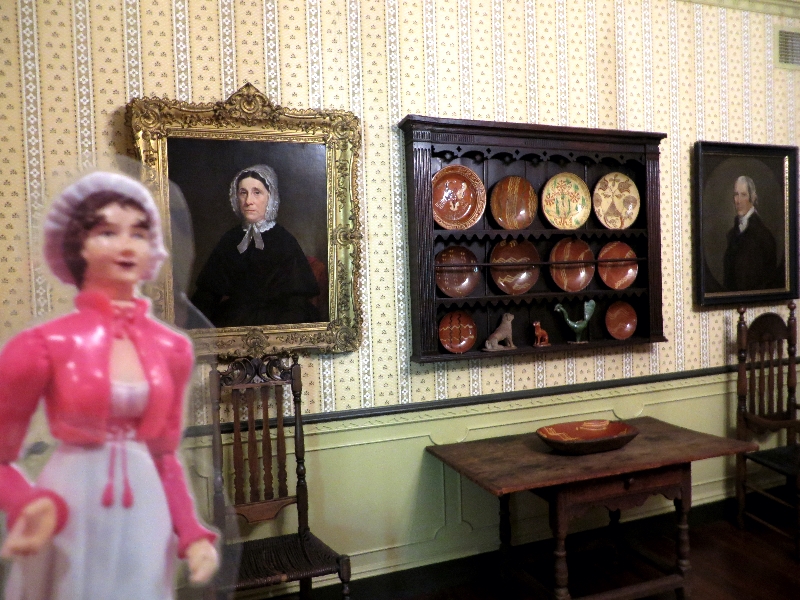
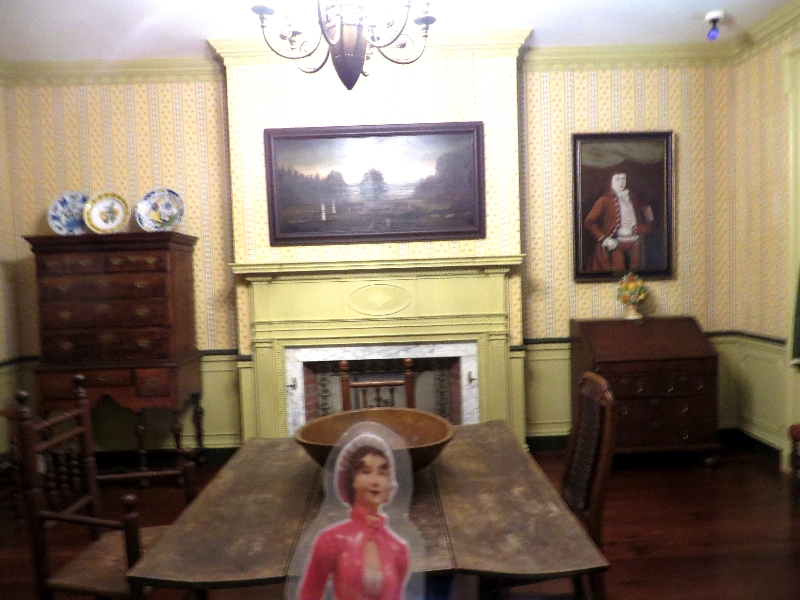
My nieces would say this dining room is positively Gothic! The wallpaper is from the last century at least, while many of the objects are much older.

William Jennys, Portrait of Mrs. Israel Ashley ca. 1800; armchair 1730-1800; 18th-19th c. American ceramics; Portrait of Israel Ashley ca. 1800


18th century reproduction New England wallpaper

The kitchen is such I have never encountered before now.

Rufus Hathaway, portrait of Seth Winsor ca. 1798; drop leaf table 1700-1735; bowl 19th c.; 
Great (Arm) chair ca. 1660-1720


Dr. Gano's study features the same wallpaper and period furnishings.
painted chalkware ornament of fruit and flowers 19th c.; desk ca. 1740; sidechair 1660-1700;
desk on stand ca. 1900

These colonial upstarts are quite proud and firmly believe they beat us in the late wars. They proudly show off their patriotism in their homes.

Emblem of the United States of America ca. 1800

Thus concludes my visits with the neighbors. I have a few other places of note to show you soon. 

Yours,
Jane

Flat Jane in Providence, Rhode Island


Flat Jane Austen in Providence, Rhode Island:
In which Jane pays calls on the elite


Editor's Note: All photos taken inside the Rhode Island School of Design Museum's Pendelton House. Not all these objects belonged to one family or were displayed at the same time. The objects in this room reflect the wealth of Rhode Islanders engaged in the China trade (between 1787-1840s). Funds from imported teas and silks helped build and furnish the elaborate homes in the neighborhood. 

"Here is the home of Mr. Sullivan Dorr and family- more China Trade wealth and another recent addition to the neighborhood. 


Built in '09, this is the most elaborate home in the neighborhood, boasting three stories, a service ell set back from the façade, and connected servants’ quarters and barn. The architect, Mr. John Holden Greene, built the home on the hill, turned the house to the side and developed terraces up the hill. It features Gothick trim on the front porch and just below the roofline. 

Mrs. Lydia Dorr was at home today so we stopped in to pay calls. Mrs. Dorr is a delightful lady. We spent considerable time viewing her China wares and passing a comfortable coze in her sitting room. 

The wallpaper is fashionable but French. 

French wallpaper ca. 1795


American furniture. Tall clock, 1816, William Stanton, Providence, 1816


Mrs. Door is delightful. An intelligent and charming woman of early middle years (34 in 1816). Her husband spent many years in China.


Lydia Door by Edward Green Malbone, unfinished, 1803
Federal mantlepiece, 1804, from the home of John H. Mason, Westminster St., Providence
removed in 1906

Lydia, as she has given me leave to call her, has had a remarkable and difficult life. She and her sister Candace were left to raise their little brothers after the deaths of their parents. She married in '04 and now there is also a hopeful Dorr family. The eldest, Thomas Wilson (currently a schoolboy of 11) is a bit rebellious. There are five younger children. Gossip has it that Mr. Sullivan Dorr is not good to his wife. 

I was tired from all this toing and froing and paying calls. Mrs. Allen was so kind as to allow me to rest.

Edward Carrington's bed with bed hangings and window curtains modeled after the interior photos of Edward Carrington's home. The bed was likely made in Boston in 1810 and is unusual for its ivory hardware.


Upon arising I admire my reflection in the glass and fix my cap.

Dressing bureau, Providence, featuring ivory; Dressing glass ca. 1800, Providence


Mr. Sullivan Dorr was engaged in the fur trade business early in life. At the age of 20 he went to Canton China to work for his brothers. He was one of the first Americans to live there for an extended time. He stayed there until 1803 when he returned and settled in Providence. Currently he is engaged in mercantile pursuits.

We drink tea from a Cantonese tea pot.

Settee, Chinese for export, early 19th c,. Asian hardwood and cane; porcelain tea and coffee service ca. 1790-1800

Please turn the page

Flat Jane Austen in Providence, Rhode Island

Flat Jane Austen Visits Providence, Rhode Island:
In which She Pays Calls on the Elite


Editor's Note: All photos taken inside the Rhode Island School of Design Museum's Pendelton House. Not all these objects belonged to one family or were displayed at the same time. 

"On the way home the following day, we stop to call on another farm family in Providence. We call on Mrs. Prudence Dexter, a widow [ed: actually died July 1815, age 55 years], with five daughters and three sons. Her late husband, Mr. Jeremiah Dexter, was a farmer and "natural bone setter." The property originally belonged to Mr. Dexter's ancestor, Mr. Gregory Dexter, a printer and friend of Mr. Roger Williams.

This property is famous because the French army, led by General Comte de Rochambeau, camped here in 1782 during the War for American Independence on their return from Virginia. They stayed eight weeks while awaiting transportation back to France.

A monument marking the spot where the French encampment once stood

This bed looks quite comfortable. It fits me as Mr. Dexter was over six feet in height. The bed hangings are simple, yet elegant. Miss Anna Dexter, six-and-twenty years of age, made them just last year. 


The fabric used for the room curtains is an adaptation of Indian palampore of the last century.

The tall chest of drawers has been handed down in the family since the house was built in 1754. I suspect they store extra linens inside.


The upholstered easy chair is a popular bedroom item. Used for entertaining guests, the wings of the chair retain the warmth of the fire and cradle the head of the sitter. Such chairs are costly, so the Americans say.


The Dexters also own shield back chairs with carved arms and swags in the Neoclassical style. 'Tis amazing how farmers can be so fashionable. This design is especially popular here in Providence and the chairs are made by cabinetmaker John Carlisle, Jr.

John Brewster, American, 1766-1854, Portrait of a Young Girl, 
c. 1801-1821, collections of the Rhode Island School of Design Museum

This portrait must be the youngest daughter of the family, Miss Freelove Dexter.

Much of the furniture is American, however the creamware obelisks (ca. 1790) and brass andirons (ca. 1760-80) are English and the pole screen is Irish. The mahogany Pembroke table is another example of Newport-made furniture.

We do not tarry long here and move on to call on one of the most grand families in the city.

Please turn the page

Flat Jane Austen in Providence, Rhode Island


Flat Jane Austen Visits Providence, Rhode Island:
In which she pays calls on the elite


Editor's Note: All photos taken inside the Rhode Island School of Design Museum's Pendelton House.

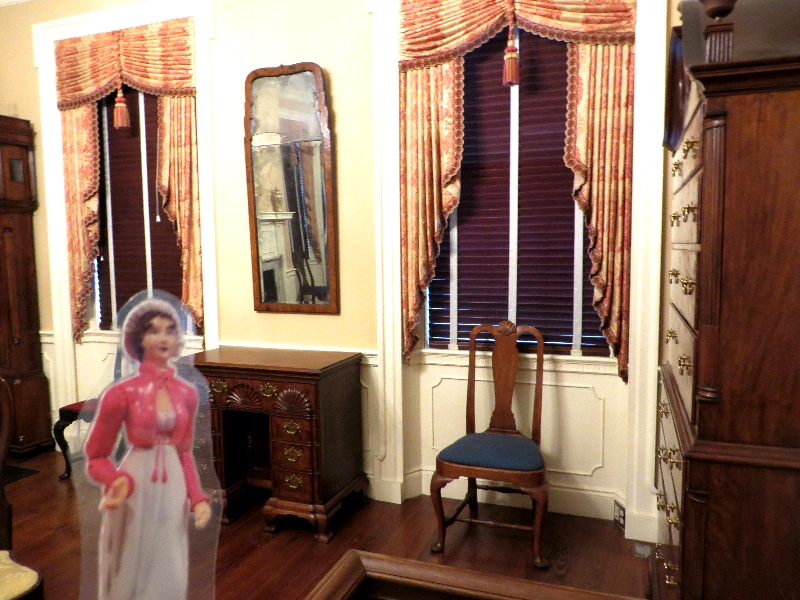
Not all these objects belonged to one family or were displayed at the same time. This room is set up to showcase furniture made in Newport by the Townsend and Goddard workshops. Several generations of craftsmen, related by marriage, created a distinctive furniture design with carved shells on projecting and receding panels. The mahogany desk and bookcase is one of 9 known to exist. Each one is unique, coming from a different cabinet making shop.


"This is the home of the Potter family. We had to travel a great distance to the southern part of the state to a town called South Kingston in the country. The Potters are what I know as gentry or large land owners in spite of the family fortune coming from trade. They are quite influential in their town, being involved in business, politics, and the criminal justice system. Mr. Elisha Reynolds Potter, the patriarch, was a blacksmith and farmer turned lawyer and statesman. He has served in the Rhode Island House of Representatives for several terms now (1796-1797, 1809-1815). Mrs. Potter is his second wife. She has small children including six year old Elisha, Jr. and one two-year-old Thomas Mawney. There is also a new baby, I believe it is another boy. 

American made furniture of the 18th-century


The large chest on chest is attributed to Mr. John Townsend. This was one of the most costly pieces of furniture in the previous century.

The desk-and-bookcase was acquired recently, in 1813 and constructed by Mr. John Goddard in 1761. 

The roundabout chair was designed for gentlemen to turn from side to side without moving the chair.


Here is a small desk in the form of a dressing table.


The side chairs were made in Newport as well (or perhaps Boston). The carved shell design is especially popular here in New England. 

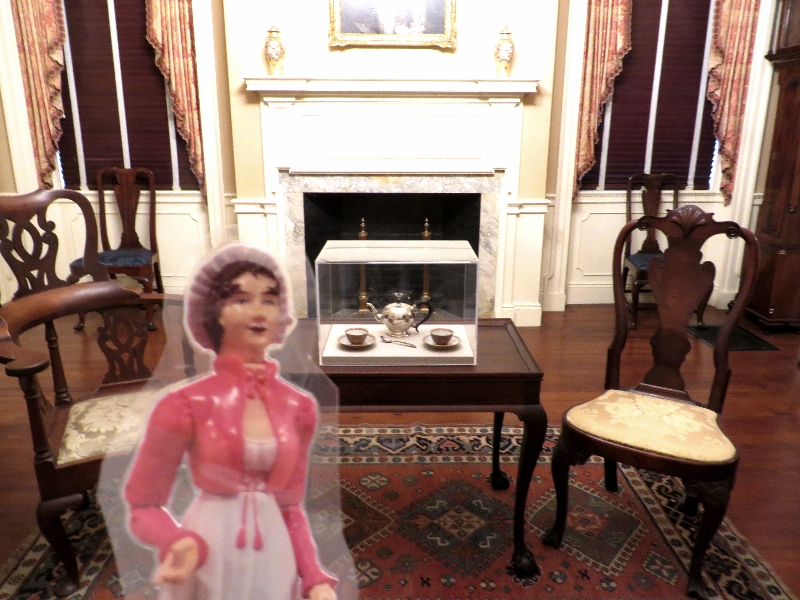
silver and wood teapot,  American, ca. 1735


The curtains are at least English printed and quite new! (1815-1820).

The Americans lack portrait galleries in their homes and are proud to display family portraits and other portraits around the house. Here is an ancestress of the last century.


John Wollaston, American, Mrs. Ebenezer Pemberton, ca. 1750


Please turn the page

Flat Jane Austen in Providence, Rhode Island

 Flat Jane Austen in Providence, Rhode Island: 
In which Jane pays calls on the elite

Editor's note: Apologies for any offensive images and scenes from 18th and 19th-centry life. I am attempting to try to accurately depict what Jane Austen might have seen if she had been a famous author travelling in America. All items on display at the Rhode Island School of Design Museum Charles Pendelton House. 

I have been given leave to sketch some American homes for you. American homes are much more primitive than our noblemen's' seats or gentry class country homes yet larger than our London townhouses. The main difference as far as I can tell is Americans enjoy conspicuous displays of wealth. 

They place their prized objects on display and proudly share what price they may have paid for it, as if bargain hunting were a competitive sport. They lack the inherited possessions and land of our gentry. 

Perhaps one day they will pass their teapots and such on to their children. Will the popular designs of today one day be out of fashion and the tea sets and things thrown away? Or will they one day end up in a museum?

Inside, the Allins, the Doors, the Browns and others display their China prominently. There is porcelain from Germany and China, earthenware and transferware from England and Mexico; Chinese export coffee sets, chocolate sets. 

These Americans seem to collect multiple tea sets. I am uncertain whether all of these serve a function or are purely decorative. Imagine having THAT great wealth to only display a tea service? That is America for you. They seem to do everything in spades here. 
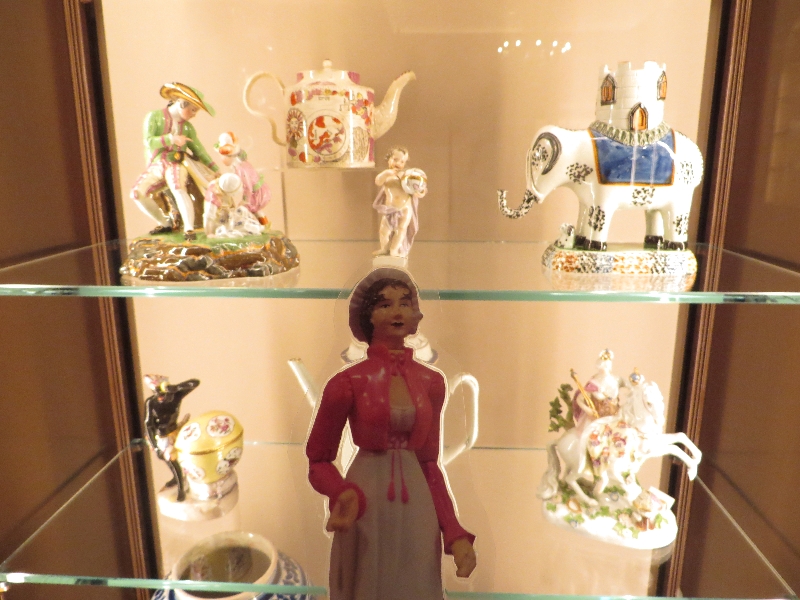
Johann Peter Melchior, modeler Map Seller and Two Children, ca. 1775; Creamware Teapot, 1770-1782  Earthenware with transfer print and glaze; Figure of man holding a globe; Pratt Ware Money Box in the collections of the Rhode Island School of Design Museum


What charming figurines from Germany, a lovely creamware teapot from England and a good old English Prattware money box. The teapot has quite a unique design. It depicts the goddess Juno on the reverse. 
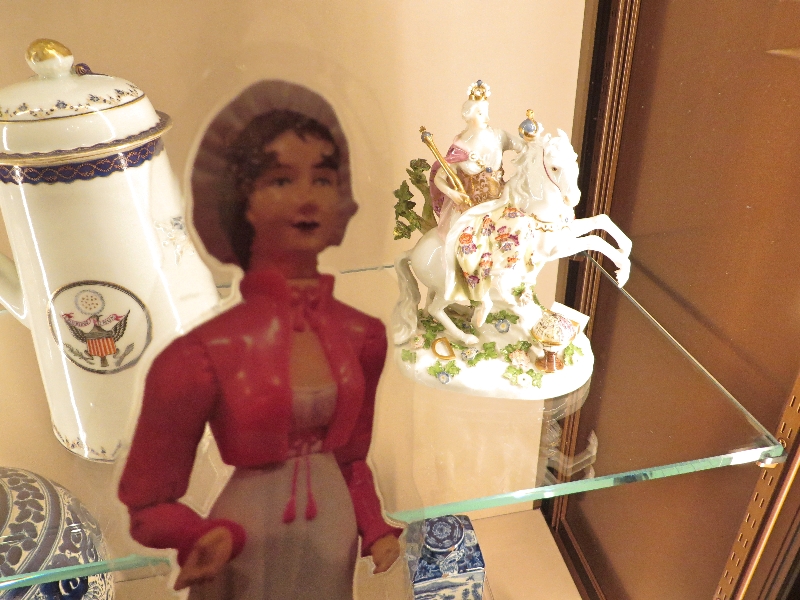
Coffee pot, Chinese 1800; Europa on a Horse, 1745-1747, 


The coffee pot is very American yet made in China in the year 1800! I hear the Chinese are making objects for export now.

This German figurine of a lady on a horse depicts the story of Europa, consort of Zeus.
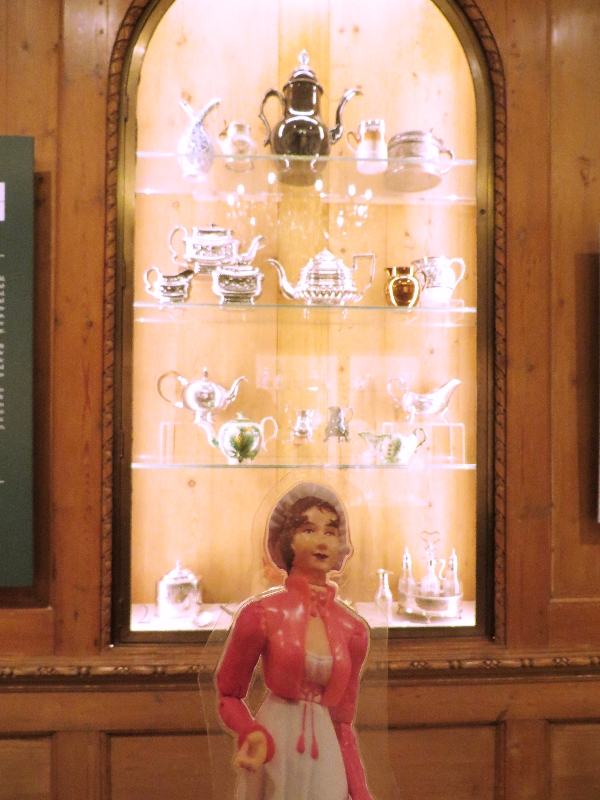
from the collections of the Rhode Island School of Design Museum


Many many teapots of all shapes, sizes and designs! The silver object on the top shelf above is a Dutch double necked vessel from the 1600s. Next to it is a stoneware and gilded silver mug from 1520-1550! For some reason, the family still displays an English coffeepot of earthenware made in the 1760s. This family also displays an English mug (1708) and German tankard (1650-1700) on the top shelf. The rest of the objects in the middle are good English pieces from different tea sets made in the middle of the last century. Finally, the bottom shelf showcases 18th-century English, Dutch and German silverware.

Now we get to the fine Chinese export porcelain. 

Batavia ware vase and bowl with cover c. 1740, Chinese;
pot, silver and ivory, Indian, 1800s; Batavia ware teacup and saucer, ca. 1720 and Batavia ware bowl
ca. 1740; Chinese for export in the collections of the Rhode Island School of Design Museum

Porcelain coffee set from Meissen Porcelain Manufactory
 ca. 1760, Collections of the Rhode Island School of Design
Museum 36.611


This bird design is quite nice. Susanna rather likes the little robins. 

I saw such an unusual teapot shaped in the form of a pineapple. Though it is English, I do not recall ever seeing such a thing.

Teapot in the shape of a pineapple, 1750-1770; This teapot's form underscores England's interest in and commercial connections to Eastern cultures. The pineapple was a costly import to Europe, and in social settings signified gracious hospitality and worldly knowledge.
To the right, a figurine by J
ohann Joachim Kändler, modeler
The Cherry Pickers, 1753 - 1765

An unusual and eclectic display of objects, both European and American.
Josiah Wedgewood & Sons, pudding or jelly mold, early 1800s, earthenware with glaze,

object number 22.217;  creamware custard cup with cover ca. 1780, earthenware with glaze, object number 24.512; Johann Wilhelm Lanz, German, Man Breaking Eggs, ca. 1757-1759, object number 55.181.1; Meissen, Adam Friedrich von Löwenfinck, 1714 - 1754, German, designer, Ice Cream Pail, 1727-1736, object 2020.09

In the middle we have marine ivory pie crimpers or jagging wheels. These objects reflect New England's maritime culture. Next to that is displayed a rather terrifying ice cream pail and a sweet little custard cup.

cup with cover Chinese for export ca. 1800 2014.4; Jasperware custard cup with cover, ca. 1800, 2002.59.9


I find implements for serving a fine dinner proudly on display. 

Is that a GOOSE tureen? I see they also have a more traditional Wedgewood tureen.

Chinese export Goose Tureen and Cover, ca. 1760-1780, object number 2017.74.30ab; Josiah Wedgewood & Sons tureen with cover and stand, 1805-1815 (center object), object number 40.187; 

In this case, the Americans display implements for preparing and drinking beverages of alcohol. Rum made in Rhode Island is a major export, traded for African slaves who are sent to the West Indies to harvest the sugar cane to make molasses.

Flagon with arms of Rhode Island, Chinese for export, ca. 1800, object number 2016.
102.20.1; Flint glass bottle , late 1700s, early 1800s, American, object number 25.070.14; Tumbler with carrying case and stamp, English, ca. 1800-1810, lead glass, rattan case and ivory, object number 1993.038


These tea seats are quite unusual.

Tortoiseshell ware teapot, and cream pitcher, English, ca. 1750-1765, object 04.337 
and 04.202; Teapot, Chinese intended for the Thai market, 1800s, object number 2004.12.15; Samovar, Persian, brass and wood, 1800s, object 67.397ac; South American drinking straw with filter (bombilla) 1800s, objects 40.017.326, 1989.045.12.502, 1989 045.12.30; mate cup with bombilla, 1800s, South American, silver, object 13.1504; far left on second shelf is Mochaware teapot, English, late 1700s/early 1800s, object 29.187; next shelf: [1800s and 1600s Japanese tea paraphernalia and water jar. Jane wouldn't know about Japan.]; Fourth shelf: Tortoiseshell ware teapot, and saucer, English, ca. 1750-1765, object 64.227; Agate ware teapot, English,  ca. 1745; Meissen teapot, German,1735-1737, object 17.090.02


Is that... a teapot? In the shape of a squirrel?! Squirrels represent industriousness and hard work. Mr. John Brown was quite fond of them and even had wallpaper made up depicting squirrels. 

Please turn the page