Showing posts with label Blackstone River Valley National Historic Park. Show all posts

Friday, June 17, 2022

Flat Jane in Pawtucket, Rhode Island (Page 4)


Flat Jane Austen in Rhode Island:

In which she learns of the Industrial Revolution and gets a peek into the future

When the mills first opened, the workers came and went as they pleased as they were used to working with the sun and the rhythm of the seasons. This angered the mill owners who insisted on their mill hands being inside at 6 in the morning until 6 at night with only a half hour break for lunch and bathroom. For all this, the girls earned 35 cents a week and the boys 50 cents. By the year [18]10, Mr. Slater could no longer hire solely children, the machines were too powerful. He now hires young women between the ages of 15-30.

Power loom weaving was added to the Wilkinson's mill after Mr. David Wilkinson invented a powerful loom. Pawtucket has grown from a small village to a larger manufacturing town. By the 1820s, the city will have eight textile mills, six machinery manufacturers, eighty-three houses, twelve stores, two churches, a bank, two schools, the population will number 3,000 souls. 
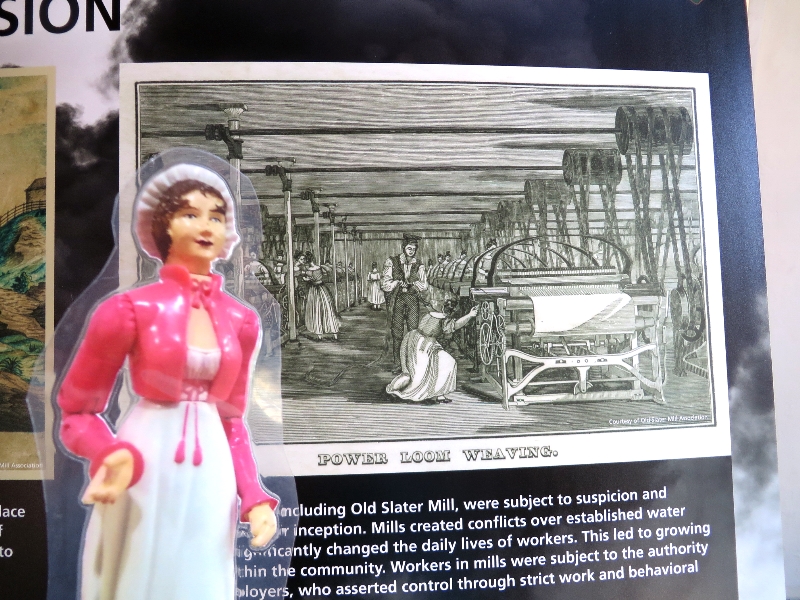
a peek into Slater's Mill in the 1820s


With more powerful machinery, the mill owners could work the hands harder. They began ringing the bells a wee bit earlier in the morning and a bit later in the evening. The workers, lacking clocks, really had no idea how long they worked but they understood the machines were faster and they were working harder for the same pay. Their lives are strictly controlled and their time is no longer their own.

I am told that the American economy is experiencing fluxuations. There will be a Panic (recession) in '19 and '24, those annoying Americans finally established their OWN taxes (Tariff of 1824) designed to protect American manufacturing. As a result of the high tariff, American manufacturers seek to keep costs low and production and profits high.


This causes great tension between the workers and the owners. Local artisans and farmers were angry over the wealthy mill owners taking all the water for their mills. Tensions boiled over in '24 when the weavers' wages were cut by 25 percent and the workday increased by one hour. The women refused to accept lower wages for more work and vowed to walk out until conditions were restored.

On May 26, 1824, 102 young women and other sympathetic community members, blocked the entrance to the hated mill. [Editor: We do not know which one.] The strike then spread to other mills. 


As more people became involved, the strike turned into a riot, an unruly mob making "an excessive noise". The mob grew to 500 people. They then visited successively the houses of the manufacturers, "shouting, exclaiming and using every imaginable term of abuse and insult," according to the newspaper. Windows were broken in the mills and the owners' home and next day the manufacturers shut their gates and the mills did not run. 

A compromise has been reached and as of 3 June, the workers are back at work with the same conditions as before. A clock will soon be installed in a nearby church tower.

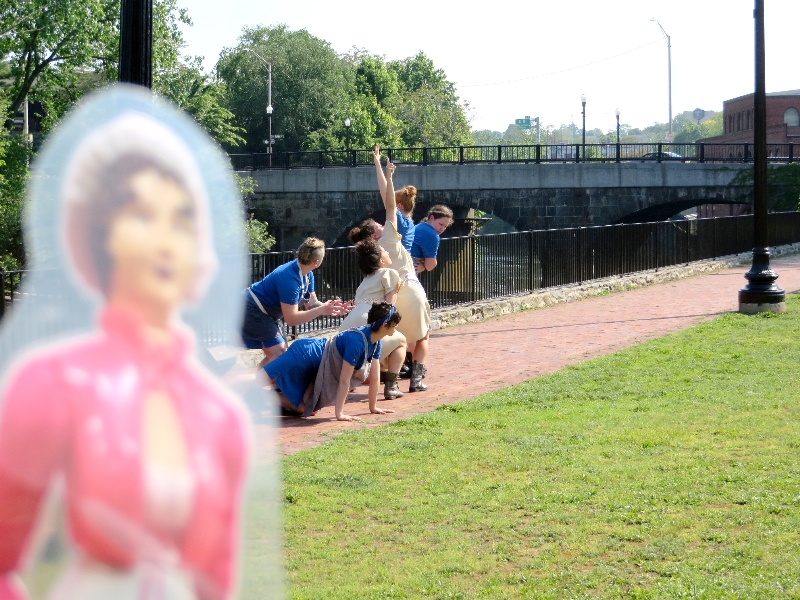
The women express their anger in a dance

Ah, an English country dance

I know not what manner of dance this may be.

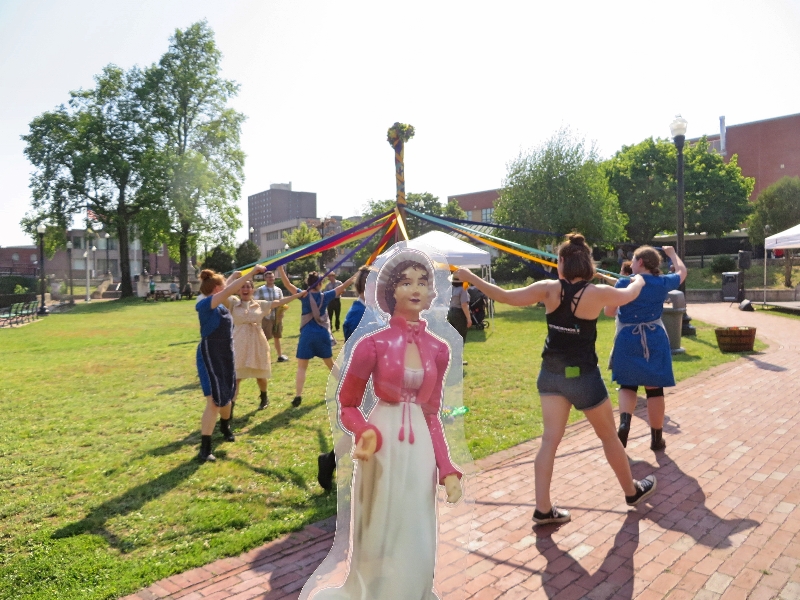
Oh, a maypole dance

A maypole dance


Editor's Note: Slater Mill is part of the Blackstone River Valley National Historic Park. The day we went the museum was commemorating the first strike by women in the U.S. in 1824. Young women portraying mill girls performed an interpretive dance. 


In commemoration of the 150th anniversary of the First Successful Cotton Mill in America this tablet was presented to the Old Slater Mill Association, present owners of this historic building in honor of the textile pioneer whose name they perpetuate. Samuel Slater, father of the American factory system. From this little mill started by Slater in 1790, grew America’s great cotton manufacturing industry whose products are known around the world.


Please turn the page! I have yet to finish writing this letter!

Flat Jane Austen in Pawtucket, Rhode Island (Page 2)

 Flat Jane Austen in Rhode Island:

In which she learns of a Traitor 

and the Industrial Revolution


Mr. S. Brown referred Mr. Slater to the Wilkinson family. There Mr. Slater was introduced to David Wilkinson, a young machinist and inventor who helped build Mr. Slater a carding machine to straighten the cotton. Mr. Slater had difficulty reproducing what he knew as the bog iron from the American rivers shrunk more than English iron.

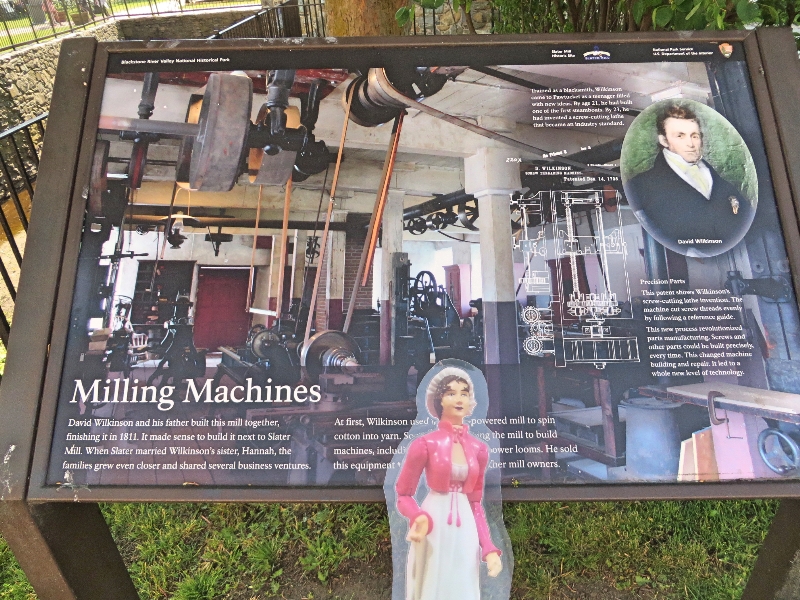
Jane learns about machinist and inventor David Wilkinson

Mr. Oziel Wilkinson and his sons opened a machine shop recently in the year 10. It features a small water wheel with a backup steam engine in the basement. Inside they make machines and machine parts for Almy, Brown and Slater (named for Mr. Moses Brown, his son-in-law William Almy and Mr. Slater) and other mills springing up in this direction. Upstairs the women weave on power looms. Americans seem to have more success and interest in steam power than we do.

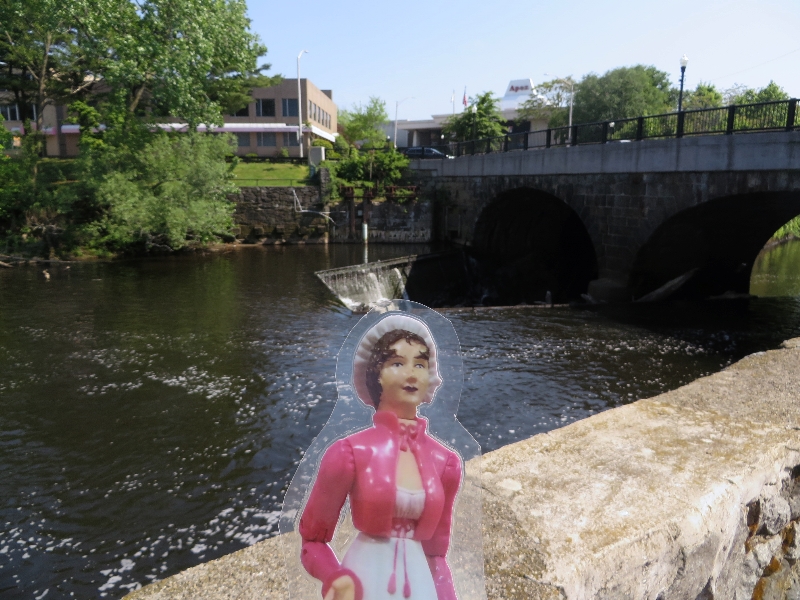
The Blackstone River is the key to the success of the mills. The river begins in northwest Massachusetts, in a place called Worcester, just like our Worcester . This American Worcester is situated 479 feet above sea level! The water flows from the mountains down to Pawtucket, a distance of 46 miles. The Pawtucket Falls is at the end of the river 440 feet below where the river started. This word, Pawtucket, is an Indian word which means "place where water falls." The heavy drop makes for a faster water flow.

View a virtual tour of the Pawtucket Falls with a National Park Service ranger.

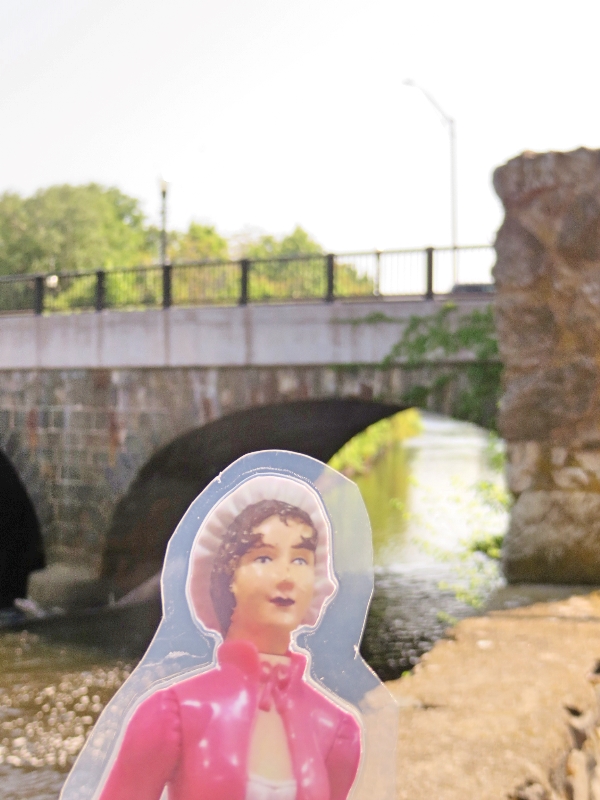
The Pawtucket Falls flows under the Main Street
Bridge  (built after Jane's time in 1858). She sees
a wooden bridge across the river.


The Pawtucket Falls marks the end of the freshwater
Blackstone River. The water here is brackish as the Blackstone
meet the saltwater Seekonk River. Jane has shown you the other
end of the Seekonk where it flows into Narragansett Bay!

The water flows to the mills from the dam built on the Blackstone River by Mr. Slater. It blocks the water from flowing forth too freely, infuriating the local farmers who destroyed the first dam. On top of the dam is the mill pond from which the mills draw their water. 

Slater Dam is in the background


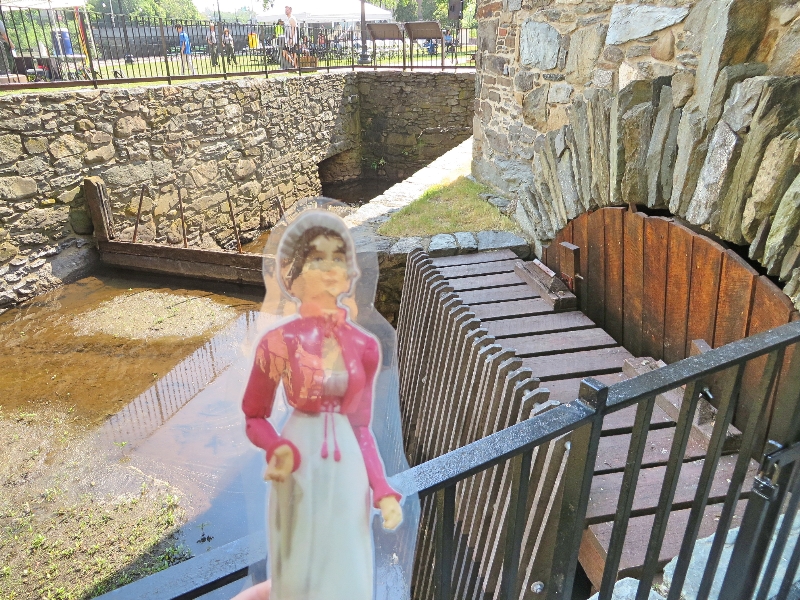
The water from the mill pond flows into the head gate here. The head gate can be manually raised and lowered to control the flow of the water. From the head gate, it flows to the head race it flows into the Great Flume (raceway) which flows under both Almy, Brown and Slater's (yellow) mill and Wilkinson's mill. 

Flat Jane at the head race of Slater Mill

The Great Flume runs through both mills.

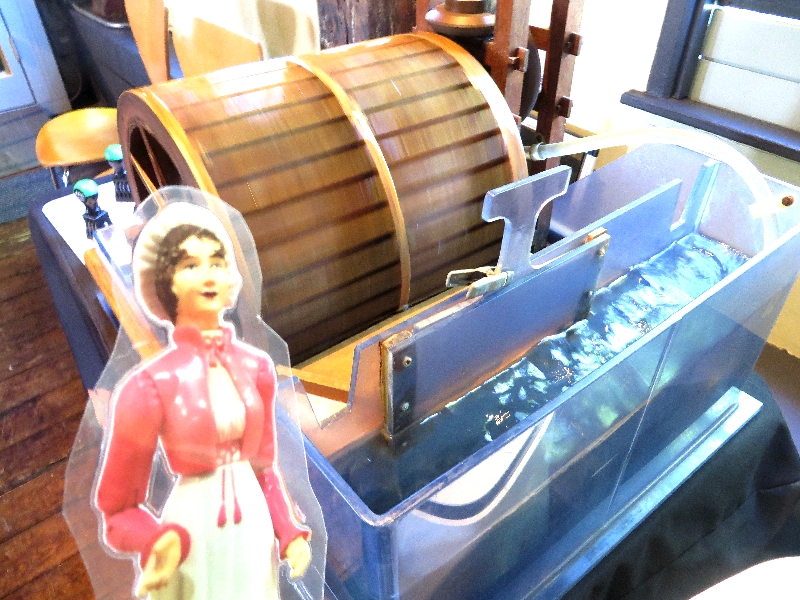
Wilkinson Mill Raceway. The gate is closed and no water
is flowing into the Great Flume today. The (20+ year old reproduction) wheel
has been broken for a couple years now but you can find it going on YouTube

At the end of the Great Flume is the water wheel pit. 

Giant metal pins are used to open and close the gate to allow water
to flow through and turn the wheel.

Jane learns about water power


The water flows under the wheel filling a few buckets at a time. 
Water from the mill pond flows into the raceway. 
The gate is raised to allow the water to flow.
Today the gate is partially raised to allow a moderate flow.


The weight of the water pushes the wheel backwards. 
The water comes back out the tail race and flows back
into the river. 


The wheel turns the drive shaft (axis pole), which turns the two sets of gears at the top. 

Little pinion gears turn the large bevel gears which
turn the DRIVE SHAFT! 

The drive shaft continues up through the ceiling to the mill floors all the way up. Attached is another horizontal pole, the line shaft, and attached to that is a series of metal gears and leather belts which turn the machinery.

The Wilkinson Mill has separate levers to turn individual machines on or off. They have wood working machines and metal working machines. Mr. David Wilkinson is said to have invented something called a screw lathe. He enjoyed inventing and using steam power. 

Editor's note: The Editor's former colleague, Mr. Carl L. Johnson, demonstrates the wheel and machinery


Take a virtual tour of the Wilkinson Mill with the National Park Service. 


Editor's Note: Flat Jane would like to acknowledge the Indians on whose land the Blackstone Valley National Historic Park sits on. The Nipmuk, Narragansett and Wampanoag have made their home here for thousand of years.  

Please turn the page