Flat Jane in Rhode Island:In which she learns of a Traitor and the Industrial Revolution
June 12, 18--
My dearest friends,
Today we travelled north of Providence to Pawtucket, a village in North Providence on the west side of the Seekonk River, just north of where Susanna's family lives, situated along the Blackstone and Seekonk rivers.
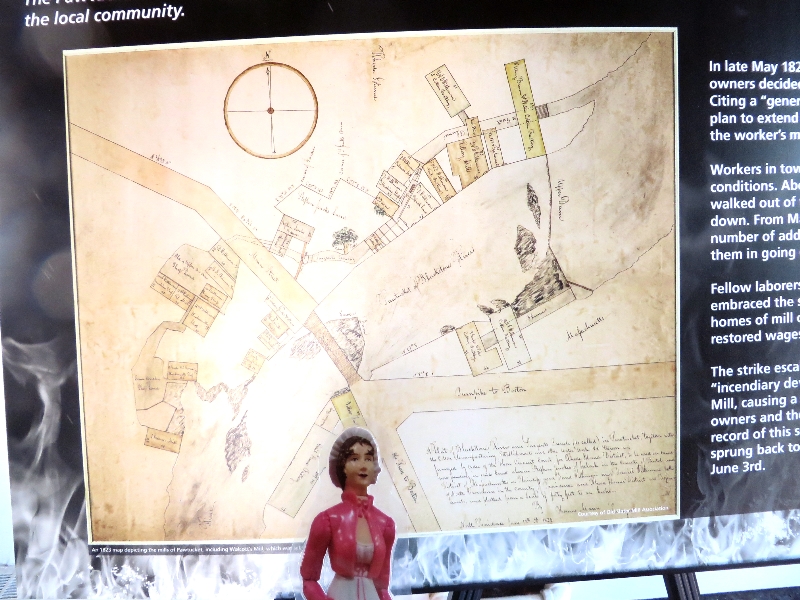 |
| Jane in the village of Pawtucket |
The purpose of our journey was to learn more about the manufactories of this place and how Rhode Island became the birthplace of the Industrial Revolution in America.
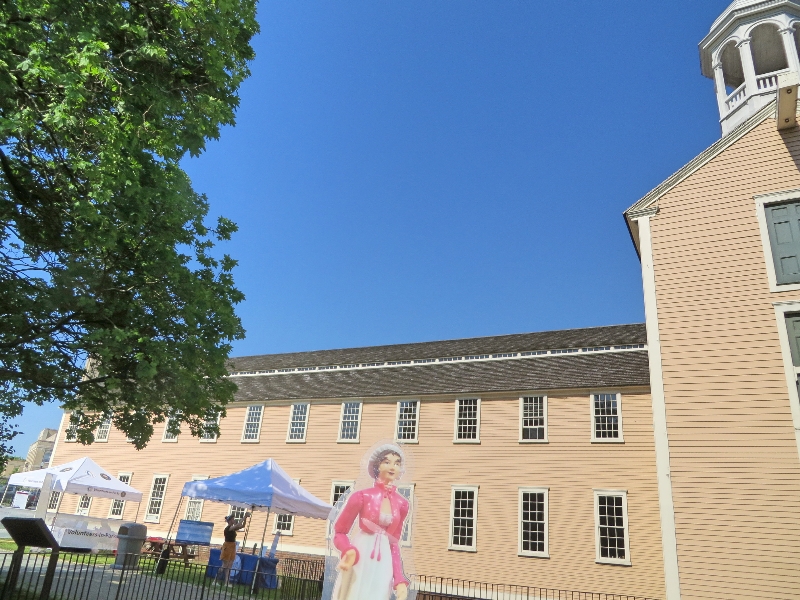 |
| Slater Mill, the birthplace of the Industrial Revolution in America! Jane at can only see the middle part of the building, the first 6 windows from the right date from 1793. The rest was added on slightly later than Jane's short lifespan. The current footprint of the mill dates to 1835! Yes really! With 1920s renovations and later repairs. |
In 1790, an Englishman named Samuel Slater chose to betray his country and come to America to start the Industrial Revolution. He had been an apprentice at the Strutt Mills in Derbyshire (not near Pemberley, the Strutts operate in Belper, situated in the Derwent Valley) learning the machinery and management from his master, Jedidiah Strutt. Mr. Strutt's sons wished to stay in business with their father and Mr. Slater knew there would never be an opportunity for him to become master of his own mill based on the terms of his apprenticeship agreement. Then what did he do but get on a ship bound for America with knowledge of the textile machinery in his head.
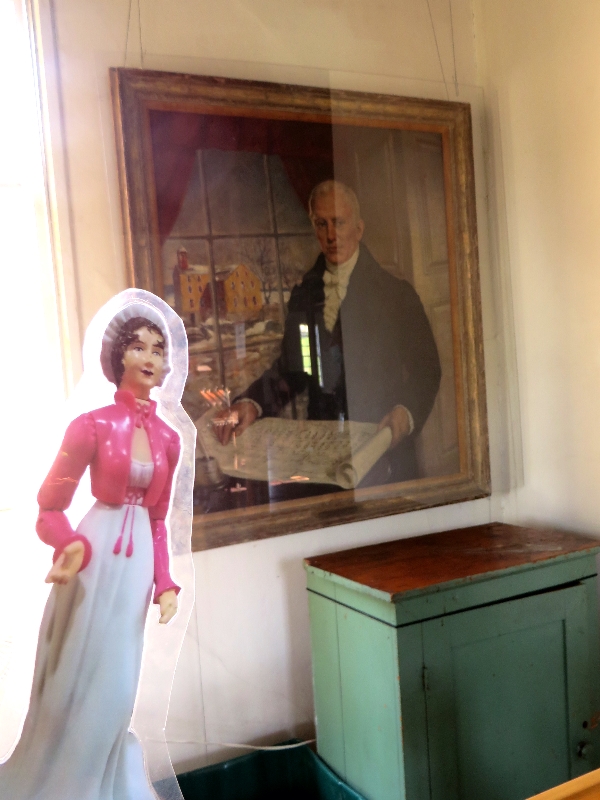 |
| Jane, meet Samuel Slater, a portrait painted nearly 100 years after his death showing his importance to the industry and his past as an apprentice gift of his great-grandson Horatio Nelson Slater |
The American government, encouraged by the then Secretary of the Treasury, Mr. Alexander Hamilton, was offering rewards for technological innovations to help America become financially independent! How shocking! Mr. Slater had promised faithfully, in his apprenticeship, not to reveal the secrets of his master to any other master or sovereignty! I suppose, perhaps, technically America is no longer a sovereignty under the King but it is a sovereign nation. Mr. Slater chose to break the terms of his apprenticeship and the law! OUR law prevents anyone from carrying out industrial knowledge.
Just how did Mr. Samuel Slater get away with such lawlessness? Susanna thinks he dressed as a farmer and Susanna’s friend, another Susanna, thinks Mr. Slater memorized the plans. Whatever he did was treason. He should have been punished.
Instead, Mr. Slater settled in New York but could not harness enough water power or find the newest machinery to run a mill. When he heard Mr. Moses Brown was interested in paying someone to build English textile machinery, Mr. Slater offered his assistance. He came to Rhode Island and was hired by Mr. Moses Brown to build an Arkwright Water Frame, a cotton spinning machine that is so outdated we no longer
use it in our mills but ‘twas what Slater had learned and what he knew. I shall endeavor to explain the machinery later. I will need help from Mr. Slater to explain it. He is currently busy dealing with some business elsewhere but had time to sit and explain things to Susanna's father.
First, we must begin at the beginning.
Mr. Moses Brown, a thrifty Quaker, refused to pay Mr. Slater until Mr. Slater could prove himself. He sent Mr. Slater to an associate, Mr. Sylvanus Brown, to test Mr. Slater on his knowledge. Mr. Slater spent his first night in Pawtucket with Sylvanus Brown, a skilled wood and iron worker (he had built ships for the war for independence), and his family. Mr. S. Brown and his family lived in this simple cottage with his family. His carpenter's shop was next door and he helped Mr. Slater build wooden parts for textile machinery.
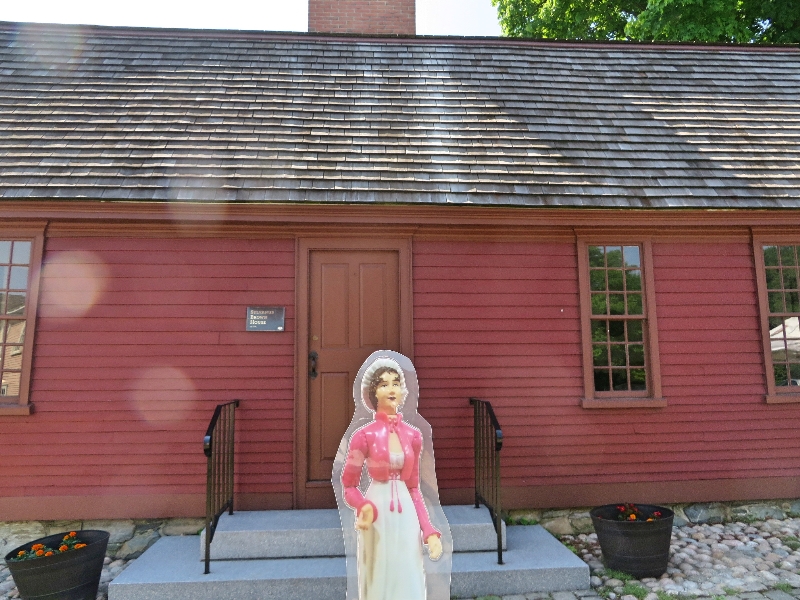 |
| Built 1758 for Jencks family. Typical New England artisans cottage |
A traveling weaver came to weave the cloth for the family. This was the primitive way New Englanders lived until 1793! I am all astonishment!
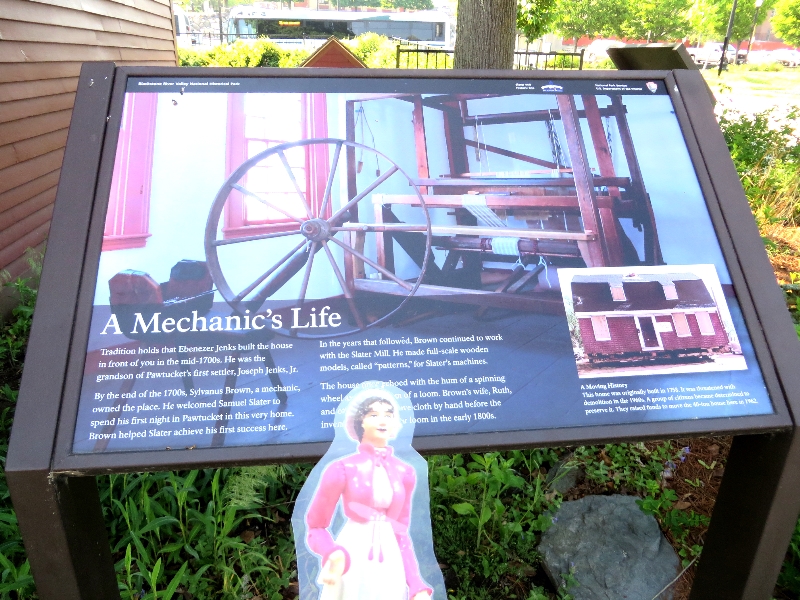 |
| Inside the museum is furnished from Sylvanus Brown's 1825 probate and set up to demonstrate pre-Industrial textile production. |
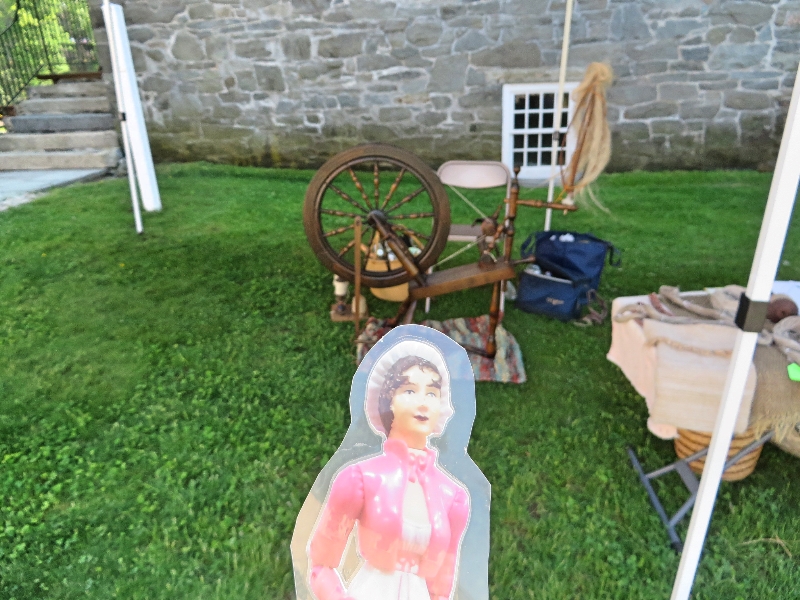 |
| The R.I. Spinners Guild demonstrates flax spinning. Flax grows everywhere except Antarctica and the desert. Farmers would grow acres of flax, let it dry, cut it, wet it dry it, break it, beat it, hackle it to remove the shell. Inside is a soft fiber that looks like a little girl's blond ponytail. Leftovers, spun into coarse sacking, were called tow, and looks like a little boy's messy hair. Watch a demonstration. |
The kitchen is in the basement to prevent heat, fire and smells from going into the house.
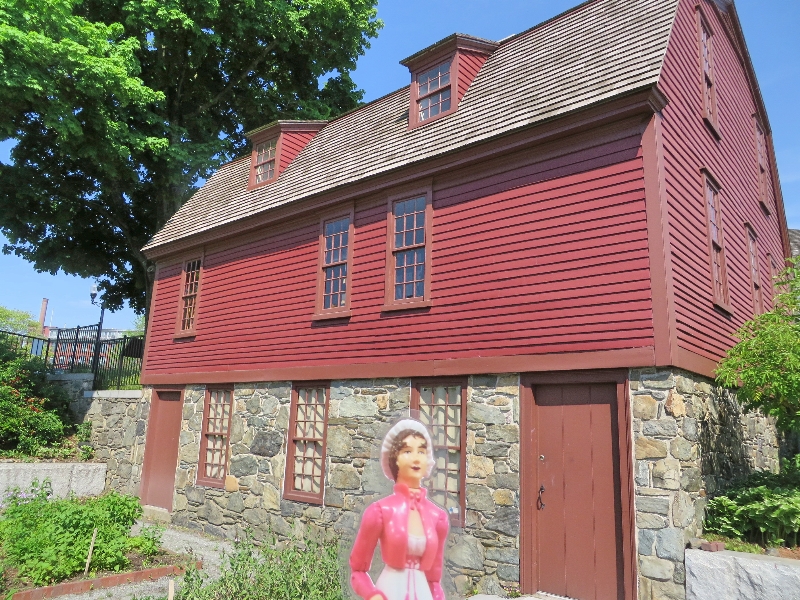 |
| The house is built into a hill, making it two-and-a-half stories. The kitchen is here below. |
They have a kitchen garden to grow vegetables and herbs; a medicine garden and a dye garden. This plant is known as "false indigo" and makes a beautiful deep blue color.
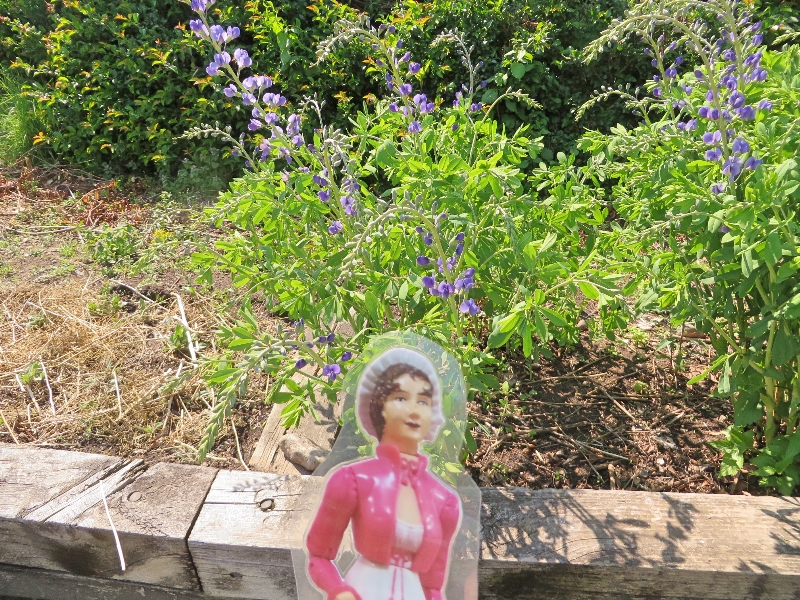 |
| False Indigo plant |
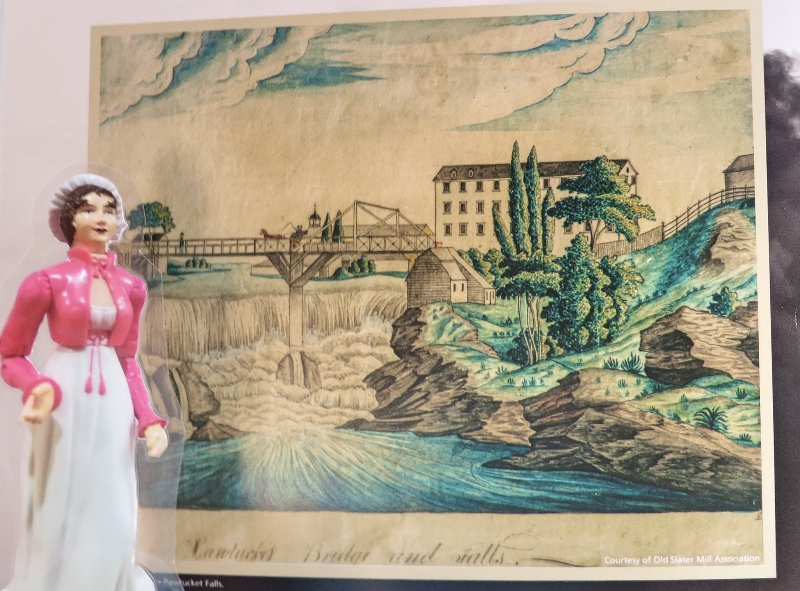 |
| Jane visits Pawtucket, Rhode Island. A view of the Pawtucket Falls and yellow mill from the opposite side of the river. The Brown cottage is in the foreground. |
To orient you better, Jane turns the map in the correct direction.

Please turn the page


