Showing posts with label women's history. Show all posts

Friday, June 17, 2022

Flat Jane in Pawtucket, Rhode Island (Page 4)


Flat Jane Austen in Rhode Island:

In which she learns of the Industrial Revolution and gets a peek into the future

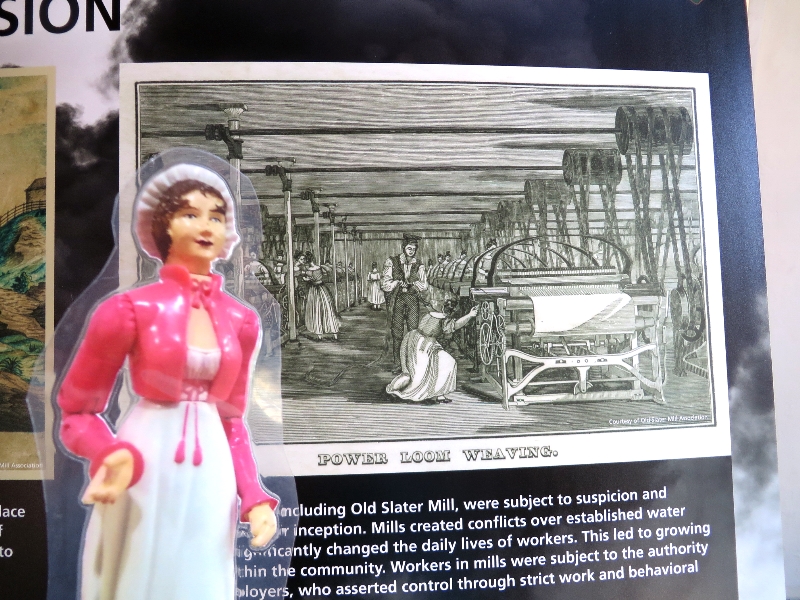
When the mills first opened, the workers came and went as they pleased as they were used to working with the sun and the rhythm of the seasons. This angered the mill owners who insisted on their mill hands being inside at 6 in the morning until 6 at night with only a half hour break for lunch and bathroom. For all this, the girls earned 35 cents a week and the boys 50 cents. By the year [18]10, Mr. Slater could no longer hire solely children, the machines were too powerful. He now hires young women between the ages of 15-30.

Power loom weaving was added to the Wilkinson's mill after Mr. David Wilkinson invented a powerful loom. Pawtucket has grown from a small village to a larger manufacturing town. By the 1820s, the city will have eight textile mills, six machinery manufacturers, eighty-three houses, twelve stores, two churches, a bank, two schools, the population will number 3,000 souls. 

a peek into Slater's Mill in the 1820s


With more powerful machinery, the mill owners could work the hands harder. They began ringing the bells a wee bit earlier in the morning and a bit later in the evening. The workers, lacking clocks, really had no idea how long they worked but they understood the machines were faster and they were working harder for the same pay. Their lives are strictly controlled and their time is no longer their own.

I am told that the American economy is experiencing fluxuations. There will be a Panic (recession) in '19 and '24, those annoying Americans finally established their OWN taxes (Tariff of 1824) designed to protect American manufacturing. As a result of the high tariff, American manufacturers seek to keep costs low and production and profits high.


This causes great tension between the workers and the owners. Local artisans and farmers were angry over the wealthy mill owners taking all the water for their mills. Tensions boiled over in '24 when the weavers' wages were cut by 25 percent and the workday increased by one hour. The women refused to accept lower wages for more work and vowed to walk out until conditions were restored.

On May 26, 1824, 102 young women and other sympathetic community members, blocked the entrance to the hated mill. [Editor: We do not know which one.] The strike then spread to other mills. 


As more people became involved, the strike turned into a riot, an unruly mob making "an excessive noise". The mob grew to 500 people. They then visited successively the houses of the manufacturers, "shouting, exclaiming and using every imaginable term of abuse and insult," according to the newspaper. Windows were broken in the mills and the owners' home and next day the manufacturers shut their gates and the mills did not run. 

A compromise has been reached and as of 3 June, the workers are back at work with the same conditions as before. A clock will soon be installed in a nearby church tower.

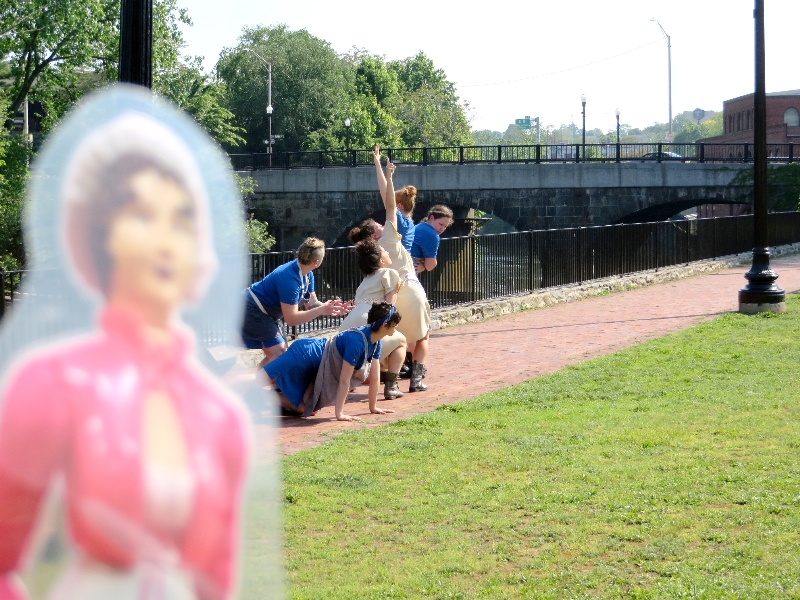
The women express their anger in a dance

Ah, an English country dance

I know not what manner of dance this may be.

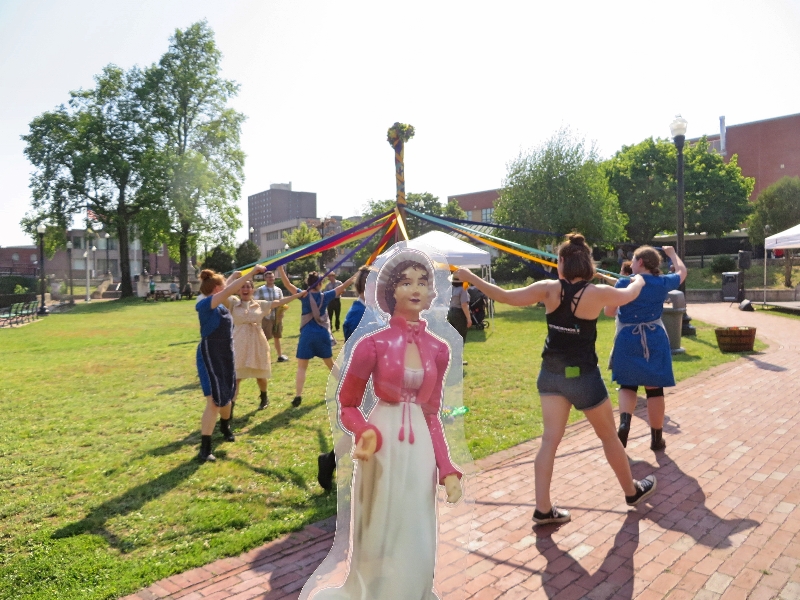
Oh, a maypole dance

A maypole dance


Editor's Note: Slater Mill is part of the Blackstone River Valley National Historic Park. The day we went the museum was commemorating the first strike by women in the U.S. in 1824. Young women portraying mill girls performed an interpretive dance. 


In commemoration of the 150th anniversary of the First Successful Cotton Mill in America this tablet was presented to the Old Slater Mill Association, present owners of this historic building in honor of the textile pioneer whose name they perpetuate. Samuel Slater, father of the American factory system. From this little mill started by Slater in 1790, grew America’s great cotton manufacturing industry whose products are known around the world.


Please turn the page! I have yet to finish writing this letter!

Wednesday, March 9, 2022

Women's History Month Part 1

 Nellie Bly

Muckraking stunt journalist, World Traveler

Good afternoon to everyone, once again Samantha has a school report to share with her class and everyone else who will listen. Let's see what she has to say this year.

This year I am reporting on another one of my journalist heroes, Nellie Bly! You may have heard of her, she was the first person to go around the world in less than 80 days, inspired by the Jules Verne novel Around the World in 80 Days. I am going to share a bit more about her with you.

Samantha in Nellie Bly's blue dress and lace color
Nellie Bly


Nellie Bly was born Elizabeth Jane Cochran on May 8, 1864 in the village of Cochran's Mills, Pennsylvania. Why, yes, it was named after her family. Her father was a local politician, judge, made money from selling land and also owned a general store and ran a grist mill for grinding grain. The western Pennsylvania village of Pitt's Mills was renamed in his honor. When Elizabeth was born, she was the youngest of 16 children! 12 of her older siblings were half siblings and already grown when she was born. Her nickname was "Pink" or Pinkey because Elizabeth loved and often wore that color. 

Girl doll in pink Victorian dress standing in front of a sepia toned photo of a wood frame house
Pink Cochran 


You can see I am wearing my pinkest dress today in her honor. (No, I don't own any other pink dresses, why do you ask? It is not a popular color for children). 

Here is the house where Nellie Bly was born, on Crooked Creek. It still stands today in 1906 but it may not exist if you try to find it in the future. 

Then when Pink was 5, she moved with her parents and three older brothers to a much nicer, custom built house in the town of Apollo. They brought their cow, two dogs and a horse when they moved because there was a large yard for the animals. 

Girl doll in pink Victorian dress stands with plush cow, two beanie dogs and sepia photograph of a large Victorianhouse
Pink Cochran and animal companions

(No silly girls, this isn't a REAL cow. A cow wouldn't fit in the classroom. Please hold your questions until the end, thank you.)

Pink's father became ill and died whenwas only 6 years old without leaving a will. The court decided all surviving children, including Pink and her baby brother, were to get an even share, once their house was sold, with the money held for the little ones until they grew up. Mrs. Cochran's income was only $16 a month. Did you know many families like my friend Nellie's live on much less? Can you imagine any of your mothers making do with only $16 a month for herself and 5 small children? What would she do?

Well, Pink's mother did what anyone else back in our grandmothers' day would do- she married someone else. By 1870, Pink had a new stepfather, one she did not like because he was angry a lot and drank too much alcohol. He threatened and hit Pink's mother so she decided to divorce him. 

At 15, Pink was determined to go to work and help her family. She did not want to have to depend on any man to support her the way her mother did. So then Pink went to college to learn to be a teacher., studying reading, writing, arithmatic and grammar. She changed her name back to her birth name and added an e to the end of her surname, becoming Elizabeth J. Cochrane. Sadly she ran out of money before she finished college. She tried to sue the bank holding her father's money but the law suit went on too long and cost too much.

girl doll in pink Victorian dress carrying leather bookstrap and school books stands in front of a blackboard classroom scene
Elizabeth J. Cochrane at school


Her life changed forever in January 1885 when Elizabeth read a series of newspaper columns in the Pittsburgh Dispatch titled "What Girls Are Good For." The writer said girls were only good for keeping house and having babies!


Newspaper ad Pittsburgh Dispatch
Google Doodle newspaper image showing two Victorian men
Google Doodle Nellie Bly

Elizabeth saw red! She wrote a letter to the editor explaining how this is very untrue and how that idea hurt her family. Even though she wrote under the name "Lonely Orphan Girl," and not her real name, the male editor of the paper was impressed enough by Elizabeth's writing to track her down and offer her a job writing about the women's sphere. She urged people to think about what life was like for girls without money, talent or beauty. If they had the same jobs as men their "lives would be brighter, their health better, their pocketbooks fuller." She also wrote about (Samantha lowers her voice to a whisper), divorce! That article was published under her new nickname "Nelly Bly," after an old popular song.

Girl doll in pink Victorian dress holding notebook and pencil
Nellie Bly, journalist at last


Nellie Bly also wrote about the conditions of women working in factories. You all heard my speech about thread factories. Nellie Bly said it all first, before we were born! Unfortunately, poor Nellie was then forced to write about boring stuff like gardening, fashion and society. She didn't like that and left the paper to be a freelance writer.

In early 1886 Nellie and her mother travelled to Mexico. They stayed in Mexico City and took train trips out to the country where Nellie showed off her independent spirit. She also wrote about the bad government which got her into trouble for defying censorship laws. Nellie and her mother had to return home. While in Mexico, Nellie posed for a photo in a fancy dress. 
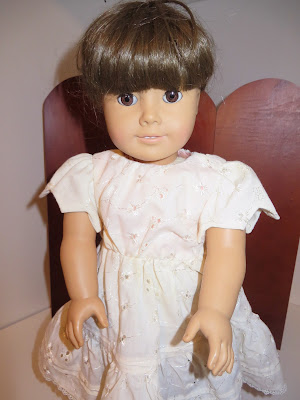

A girl doll in fancy eyelet off white Victorian dress
Nellie Bly in Mexico

Woman in a light lacy Victorian dress in front of a Mexican blanket
The real Nellie Bly in Mexico


Back home in the United States, Nellie was able to freely criticize the Mexican government in her articles. She later compiled them into a book

Nellie rejoined the Pittsburgh Dispatch when she ran out of stories about Mexico. She was given more women's topics: arts and theater. 

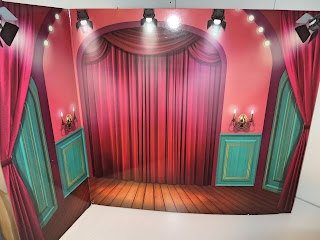
cardboard folding illustrated theater curtain scene


Nellie Bly still thought that was too boring for her so she packed her bags and headed east to New York City! 

Here in New York Nellie Bly couldn't get a job right away! It took awhile and more boring articles on fashion. The male editors were very rude to Nellie. Women were ONLY fit to write about all that silly society stuff and not real news. Nellie published a series of interviews she had with the male editors and her reputation grew. FINALLY, the editor of the New York World liked Nellie's story ideas and hired her. 
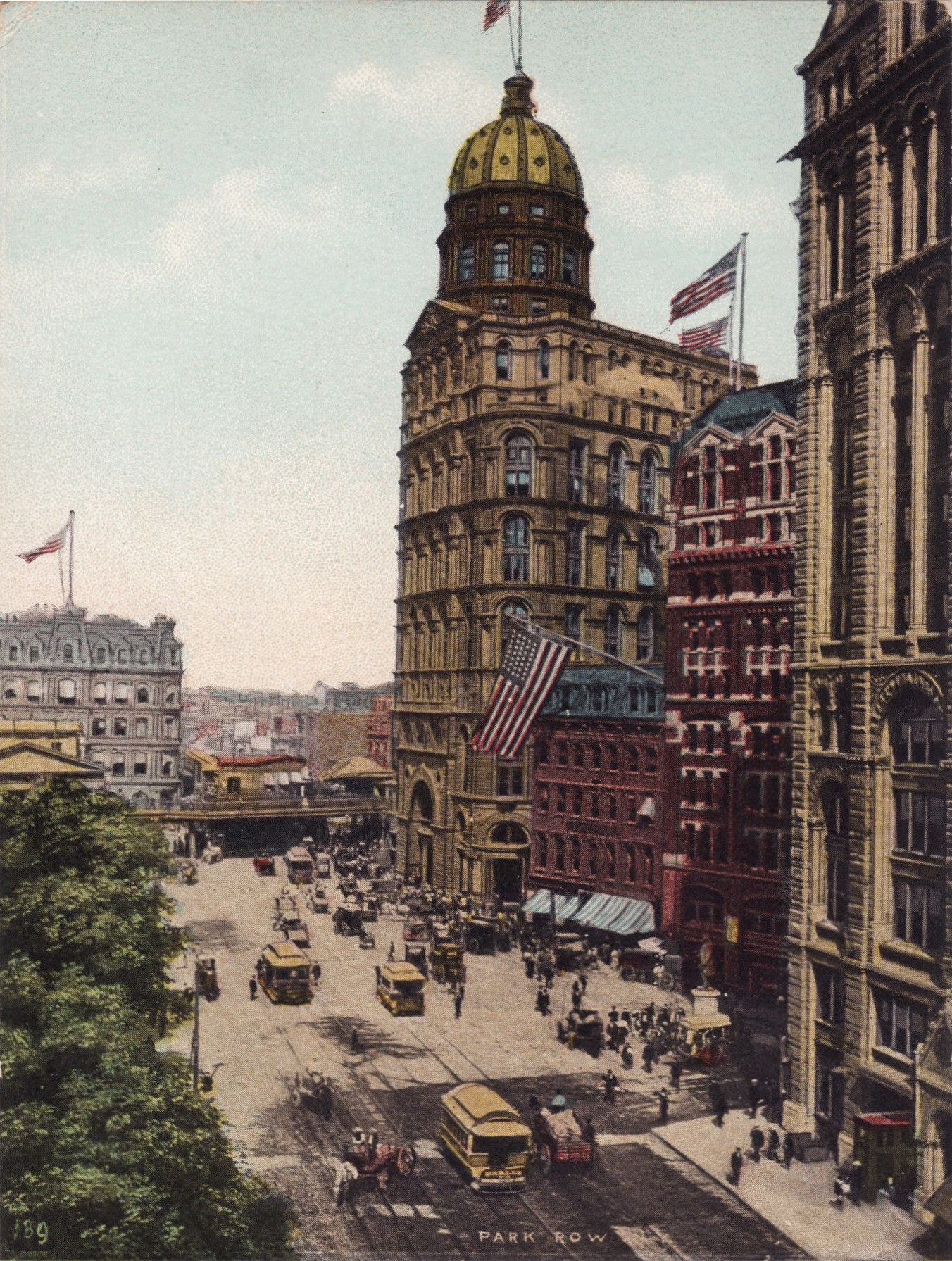
New York World Building early 1900s
New York World Building c. 1900s


Her editor asked Nellie to investigate the conditions of the Women's Lunatic Asylum on Blackwell's Island- from the inside! Nellie rented a room in a women's shelter for a night and pretended to act mad. She acted mad as she was examined by a police officer, a judge and a doctor who sent her to Blackwell's Island. During the next 10 days Nellie got a first hand look at the terrible conditions at the Asylum. The women were not treated well at all. Many became poor and weakened by illness or couldn't convince the doctor they were sane because they did not speak English. 
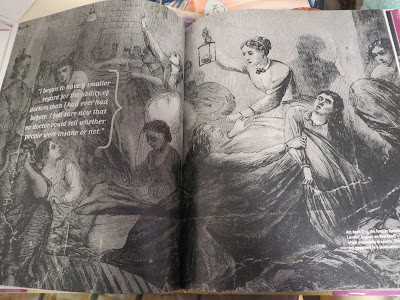
black and white illustration of women in a 19th-century mental institution
Illustration of women in the mental hospital 


Nellie vowed to help her "suffering sisters" once she got out. Her editor sent a lawyer to convince the doctors she was sane and should be let out. She then wrote a two part story on her experiences [editor's note: please be advised that this story appeared in 1887 and contains images and language that may be offensive to modern viewers]. It made front page news in October '87! Other newspapers picked up the stories and Nellie's work helped make conditions better for women in asylums!

Antique newspaper image https://wp.wwu.edu/dreamteam2018/2018/07/31/nellie-bly-reports-from-inside-the-asylum/


Throughout '88 Nellie wrote other "stunt journalism" stories exposing all kinds of bad things happening in New York. At last she had a steady job and loyal readers but her best was yet to come! 

sepia toned image of Nellie Bly board game and quote about the New York World sending Nellie to discover the truth

I need a drin of lemonade. I shall be right back with the rest of the story!
... Intermission... 


Monday, August 31, 2020

Celebrating the 19th Amendment: After the March

 Celebrating the 19th Amendment: 

After the March

By 1917, Alice Paul and Lucy Burns had organized a new, more militant suffrage organization: The National Women's Party. In January 1917, the NWP set up a silent picket outside the White House gates. Suffragists were frustrated by the lack of results after years of meetings. They decided to use the White House building as a stage to influence the man inside. The "Silent Sentinels" wanted to make it impossible for the President to enter or leave the White House without encountering a sentinel bearing some device pleading the suffrage cause."

Two American Girl dolls dressed in purple dresses wearing purple, white and gold votes for women sashes and carrying purple and gold political protest signs in front of a fence

"To ask for freedom for women is not a crime. Suffrage prisoners should not be treated as criminals." Arrested over and over, Alice Paul, Lucy Burns and others went on hunger strike and were force fed  by tubes shoved down their throats.

American Girl doll in plum colored tweed jacket and skirt, straw hat, holding a yellow and purple sign asking for freedom for female prisoners

Kaiser Wilson: Have you forgotten your sympathy for the poor Germans because they were not self-governed? 20,000,000 American women are not self-governed." The banners compared the president to the German emperor. The suffragists wanted to point out the hypocrisy on the part of President Wilson to support the cause of freedom in WWI but not support the freedom of women at home. Shortly after this photo is taken, on August 13, 1917, a crowd begins to taunt and intimidate the suffragists. Some people are pelting the women with eggs and tomatoes! They tear the banners from women's hands and rip them up. The women make more, only to have those taken as well. Nevertheless, they persisted

American Girl doll in short sleeved lavender floral print dress wearing a purple, white and gold votes for women sash holding a sign comparing President Wilson with the German Kaiser

August 26, 2020: Women's Equality Day. "We did it! hooray!" Susanna celebrates the 100th anniversary of the 19th-amendment. 

While Susanna is happy, she's heard there's still work to do. "Addy told me many women like her can't vote. Anita can't vote either because she's an immigrant and poor! My guardian tells me all women didn't get the right to vote until Melody's time. I don't know this girl Melody. I guess I have to go there next and find out what happened!" 

Alice Paul paused to drink a glass of grape juice, sew the final stars on her suffrage flag and then got to work on an equal rights amendment. It still has not been passed as a Constitutional amendment. There is still work to do and Susanna is proud to grow up in a time when people are (still) fighting for their rights. She knows the future will be different, if only she can get there.

 Yoohoo Luciana! We need your spaceship!

American Girl doll in lavender American Girl t-shirt, lavender pants holding a yellow and purple votes for women 100 years pennant


Celebrating the 19th Amendment: Time Travel to the Women's Suffrage Parade in 1913


Celebrating the 19th Amendment: 

Time Travel to the Women's Suffrage Parade in 1913


American Girl doll in white nightgown wrapped in red, wired ribbon holding a dance pose with arms out


Liberty makes her "lyrical" entrance to the "Triumphal March" of Verdi's Aida. Liberty, clad in crimson silk, moves across the stage "a flying figure, unfettered and free."

American Girl doll in white nightgown wrapped in red wired ribbon holding a dance pose with arms out; American Girl doll in white nightgown with blue ribbons around her waist and head dances behind the first


Liberty dancing with twisting and turning movements interprets the music concerning a female slave and her struggle for liberty. Liberty dances "triumphant and free."

gray and silver scarf with paper dove silhouettes lying on top


Peace, in a gown of silver and white, releases a dove from the top of the steps. (the tune is the overture from Wagner's Lohengrin). She descends with her attendants who hold olive branches and cornucopias

American Girl doll in white nightgown with green velveteen dress draped across one shoulder in imitation of ancient Roman robes

The final allegorical figure is Hope. Like a "bright spirit" she dances between the Treasury's columns to "Elsa's Dream" from Lohengrin. This music portrays a woman's sentiment of hope amid life and death circumstances. 

When she finishes, Hope will be joined by rainbow-hued attendants to the tune of Dvorak's "Humoreske." Then a troop of 50 children will come out holding balloons. Together they will all dance "merrily" to Mendelssohn's "Spring Song" and greet Columbia at center stage.

All five dolls in their costumes standing and sitting

The rainbow symbolizes a better tomorrow for women. "After a storm comes sunshine and the indication of a beautiful day." Hearing the approach of the Procession, summons to her side, Justice, Charity, Liberty, Peace and Hope, to review with her this "new crusade" of women. The cast assembles, the band plays "America" to form the final tableau.

Time will tell if we are successful at getting the vote. Thank you to the professional actresses and dancers who participated in the tableau. We'll see you at the next march!

(See more in the original archival photos)
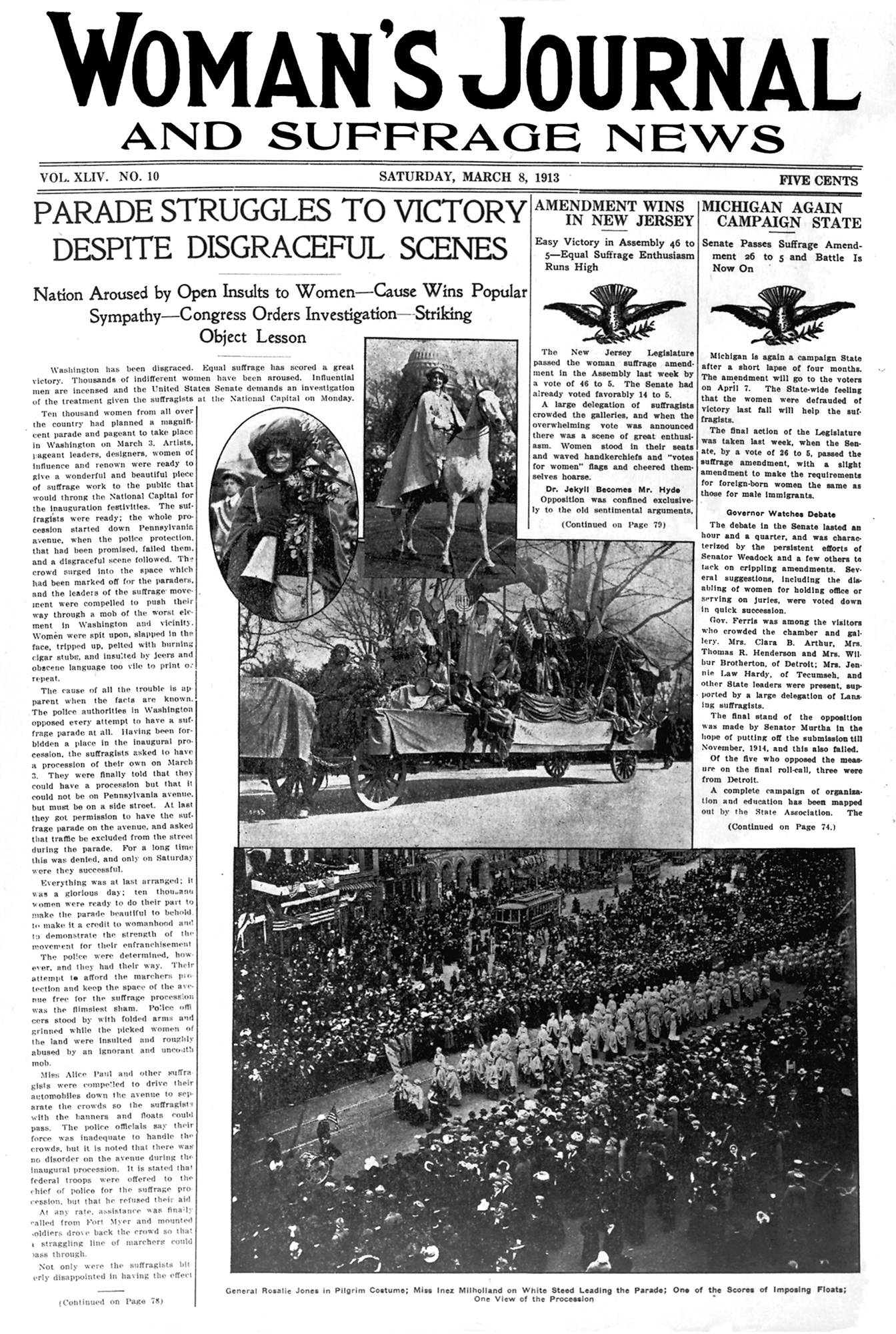
Woman Suffrage Postcard 1913 Smithsonian Institution

and original newspapers

Read the specific details that inspired this tableau and the previous sections
Annelise K. Madsen, Columbia and Her Foot Soldiers: Civic Art and the Demand for Change at the 1913 Suffrage Pageant-Procession, Winterthur Portfolio, Vol. 48, No. 4 (Winter 2014), pp. 283-310 (scholarly article)

Original source photographs:
Suffragette Parade Pennsylvania Avenue Stereoscope card at the Library of Congress
Head of Suffrage Parade in Washington, DC March 3, 1913 at the Library of Congress

Read more:
Women's Suffrage 100 Massachusetts film Looking Back, Marching Forward
Crusade for the Vote National Women's History Museum
Parading for Progress National Women's History Museum
Harriet Stanton Blatch New York State Museum
Creating Icons: How We Remember the Woman Suffrage  Smithsonian National Museum of American History
Votes for Women: A Visual History Brandywine River Museum of Art

Original newspaper article on the parade from the San Francisco Chronicle

Celebrating the 19th Amendment: Time Travel to the Women's Suffrage Parade in 1913


Celebrating the 19th Amendment: 

Time Travel to the Women's Suffrage Parade in 1913

American Girl doll depicting the goddess Columbia in white nightgown, gray scarf breastplate, red, white and blue bathrobe cap, gold paper helmet, wooden winged creature on a stick

On the steps of the Treasury allegorical tableau is taking place. The procession is intended to show "what woman is striving to achieve, as well as what she has so far attained." The allegory portrays "those ideals toward which both men and women have been struggling through the ages and toward which, in co-operation and equality, they will continue to strive." The band plays "The Star Spangled Banner"

American Girl doll depicting the goddess Columbia in white nightgown, gray scarf breastplate, red, white and blue bathrobe cap, gold paper helmet, wooden winged creature on a stick

Columbia, robed in a blue velvet mantle lined with the stars and stripes, wearing a white silk dress, breast plate and helmet and carrying an eagle-topped scepter in her right hand, emerges from behind the Treasury columns and descends the Treasury steps to the edge of the plaza. She will meet the personified nation and her ideals.

American Girl doll in white nightgown with light purple cloth robe over one shoulder, purple ribbon headband, silver paper sword in hands, American Girl doll representing Columbia (same as above)

After saluting the audience, Columbia then summons Justice who enters to the melodies of Wagner's "Pilgrim's Chorus." Dressed in robes of purple, sword in hand, Justice moves across the stage with her 12 attendants. 

American Girl doll in white nightgown with purple cloth robe over one shoulder, purple ribbon headband, silver sword in hand

Justice's attendants manipulate large parchment-like scrolls as they move towards Columbia.

American Girl doll in white nightgown with purple cloth robe over one shoulder, purple ribbon headband, closed parchment scroll in hand

American Girl doll in white nightgown with purple cloth robe over one shoulder, purple ribbon headband, open parchment scroll in hand


Next comes Charity in robes of blue led by a girl and boy, followed by older girls. They arrive to the tune of Handel's "Largo." After greeting Columbia, Charity takes her place at the front of the plaza at stage left, with Justice and her crew assembled at stage right.

Three American Girl dolls: one in white nightgown with pale blue ribbon sash and headband, one in light blue evening gown with pale blue chiffon scarf over her head, doll representing Columbia from above photos


Celebrating the 19th Amendment: Time Travel to the Women's Suffrage Parade in 1913


Celebrating the 19th Amendment: 

Time Travel to the Women's Suffrage Parade in 1913


Harriot Stanton Blatch, daughter of Elizabeth Cady Stanton, organizes working women in the Women's Political Union. New Jersey WPU women march wearing green, white and violet. 

American Girl doll in plum and purple wool sweater and skirt wearing a green, white and violet sash and ribbon carrying a sign representing the Women's Political Union of New Jersey


American Girl doll in white gown wearing a tri-star silver crown, carrying a red and blue shield with the word Illinois. Black doll in purple coat, white sash and paper hat featuring purple stars


Women of color are allowed to participate but asked to march in the back of the parade as so not to alienate the southern delegations. Prominent civil rights activist and suffragist, Ida B. Wells-Barnett doesn't agree with the decision. "I shall not march at all unless it is under the Illinois banner…Either I go with you or not at all. I am taking not this stand because I personally wish for recognition, I am doing it for the future benefit of my whole race.” 

Black doll in purple velvet coat with white trim wearing a paper hat and sash with purple stars, carrying a yellow flag with purple stars


She is an anti-lynching activist and founder of the National Association of Colored Women’s Club to address issues dealing with civil rights and women’s suffrage. Earlier this year, in January, she also co-founded the Alpha Suffrage Club, which was the first suffrage organization for Black women in Illinois. Her flag and sash represent the nine states that have granted women's suffrage. 

At 2 p.m. the Illinois delegation assembled on New Jersey Avenue and Wells was nowhere to be found. The other two ladies who agreed to march with Ida in the separate section, Geraldine Brooks and Belle Squire (co-founders of the Alpha Suffrage Club) went to look for her, but returned to the march without Ida. Ida jumps in and marches with the Illinois delegation mid-way through. You may see more "colored" women in various delegations such as professional groups, women's clubs, sororities and women's clubs. You may also see some on the floats, in the marching bands and other places. [Editor's note: I ran out of energy to change Addy multiple times in one day but look for a women's history month project highlighting specific women in the future.]

Uh-oh, the crowd is getting rowdy. Men surge into the street making it almost impossible for the marchers to pass. Occasionally only a single file can move forward. Women are jeered, tripped, grabbed, shoved, and many hear “indecent epithets” and “barnyard conversation.”  The police do nothing to protect us and even join in the heckling.

[Non-costumed women march here.] 

American Girl doll in purple velveteen coat and hat with gold and purple Votes for Women flag


Mrs. Champ Clark, (Genevieve Davis Bennett Clark)  D.C. resident and an active figure in the suffrage movement. Her husband, Champ Clark, is a Democrat and the Speaker of the House  representing Missouri. 

American Girl doll in faded pink gingham dress and red and white checked sunbonnet

Farm women are represented too in their faded gingham gowns and sunbonnets. 

Celebrating the 19th Amendment: Time Travel to the Women's Suffrage Parade in 1913


Celebrating the 19th Amendment: 

Time Travel to the Women's Suffrage Parade in 1913 

American Girl doll in red riding hood cape carrying a satchel and a sign that says ye votes for women pilgrimage from New York to Washington, DC 1913


"General" Rosalie Jones led a group of 225 marchers from New York to Washington, DC. This morning, a cavalry brigade of women met General Jones and escorted the group into DC. 

The sections of the parade represent the progress of women's rights. The fourth section represents "The Appeal of Business and the Professions," It includes business women and teachers, women in government service, social workers, librarians, writers, artists, actresses and musicians. 

Two American Girl dolls in red coats holding musical instruments, left doll holding brass triangle and right doll holding tamborine


Musicians march in red. 

The sun is shining brightly and it is just cold enough to make walking enjoyable. The procession advances up Pennsylvania Avenue with groups of marchers cascading into formation from side streets. 

Homemakers march in white.  White dresses symbolize the femininity and purity of the suffrage cause.

American Girl doll in long white nightgown with white paper nurse's cap


The steady stream of people walk and ride horseback to the U.S. Treasury Building at 1500 Pennsylvania Avenue, NW.

Two American Girl dolls in white dresses with gold, white and purple ribbon sashes holding gold, white and purple flags and banners from the National American Woman Suffrage Association founded 1869


The future leaders of the movement are Lucy Burns and Alice Paul, currently members of the National Woman Suffrage Association, founded in 1869 by Susan B. Anthony. We march because "this is the most conspicuous and important demonstration that has ever been attempted by suffragists in this country."

Alice Paul has introduced the new color scheme of gold, purple and white. "Purple is the color of loyalty, constancy to purpose, unswerving steadfastness to a cause. White, the emblem of purity, symbolizes the quality of our purpose; and gold, the color of light and life, is as the torch that guides our purpose, pure and unswerving.”

Because this parade will be taken to indicate the importance of the suffrage movement by the press of the country and the thousands of spectators from all over the United States gathered in Washington for the Inauguration.

Celebrating the 19th Amendment: Time Travel to the Women's Suffrage Parade in 1913

 Celebrating the 19th Amendment: 

Time Travel to the Women's Suffrage Parade in 1913 


The section section chronicles "The Seventy-Five Years' Struggle for Freedom or Justice Conquering Prejudice" by highlighting different points in the suffrage movement. This float represents "As It Was in 1840"—The first leader of the Movement for the Emancipation of Woman is standing alone, scorned by her own sex  (3 figures in black representing obstruction to our progress).

Two American Girl dolls dressed in purple, one shrouded in black to represent obstruction to the pursuit of women's suffrage

As it is today:  4 women in darker purple representing how the suffrage movement has grown over time from the 1840s to the 1860s to today (19teens).

Four American Girl dolls in dark purple dresses representing the progress of women's suffrage

We honor the pioneers of women's suffrage, Elizabeth Cady Stanton and Lucretia Mott. They organized the first women's rights convention in Seneca Falls, New York in 1848. Elizabeth Cady Stanton (left) drafted the Declaration of Sentiments. (The woman chosen to represent her is holding a copy).


Two American Girl dolls in pioneer dresses and bonnets, one holding a booklet report of the Woman's Rights Convention in Seneca Falls, New York in 1848

Our next pioneer needs no introduction. Sojourner Truth was a formerly enslaved woman who took her freedom and advocated for abolition and women's rights.


Black doll in pioneer dress of green and purple plaid wearing a shawl, white cap and glasses

The next generation of women's rights leaders also included Lucy Stone, abolitionist and suffragist. She was the first Massachusetts woman to earn a college degree and wrote marriage vows to reflect her egalitarian beliefs. When Lucy Stone married Henry Blackwell, she refused to take her husband’s last name.  In 1850 Lucy Stone organized the first national Women’s Rights Convention in Worcester, Massachusetts. 

In 1858 she reminded Americans of the “no taxation without representation” principle refusing to pay property taxes. She was punished by the impoundment and sale of the the family's household goods. 

American Girl doll in Union blue Civil War suit (Zouave jacket, skirt, white Garabaldi blouse) and anti-slavery medallion


Lucy Stone went to Kansas to work on the referendum for suffrage there following the Civil War. She also served as president of the New Jersey Women Suffrage Association and helped organize the New England association.

American Girl doll in dress of light purple and white stripes and puffed sleeves holding a yellow and black flower, carrying a sign stating failure is impossible


The second wave of suffragists also included Susan B. Anthony, who needs no introduction. She died only 7 years ago. She carries a Kansas sunflower, a symbol of the women's suffrage movement. In 1867, Kansas suffragists adopted the sunflower, the state flower, as a symbol of their campaign. From then on, yellow (gold) became associated with the national women’s suffrage movement. "The color of light and life, is as the torch that guides our purpose, pure and unswerving."