Wednesday, June 8, 2022

Flat Jane Austen in Providence


Flat Jane Austen in Providence

May --, 1816 con't

We continue walking along Main Street and up a hill to Benefit Street. This one mile street features the original homes of the merchants and tradesmen of Providence. 

First, we walk along South Main Street to see the former home of 10-time colonial governor and signer of the Declaration of Independence, Stephen Hopkins. It was first built as a small, sort of shack, in 1707. Mr. Hopkins later enlarged the home. It is simple, in keeping with his Quaker faith but well enough for a colonial. 


He was a very important man in the colonies and supported the cause of Independence from the beginning. For some unusual reason, this man who espoused liberty and freedom for all enslaved a number of people in spite of opposition from his fellow Quakers.

 [Editor's note: Read a timeline of his life. Read more about the house. We were unable to go inside.]


Also on South Main Street we see the home of Mr. Joseph Brown, the architect and brother of Mr. John Brown. He designed a number of important buildings in the neighborhood including the Market House, the Baptist Meeting House and College edifice using English design books. This house was begun in 1774. He also taught mathematics at the University. Mr. Brown passed away in '85 and the home passed to his brothers. In 1791 Mr. John and Mr. Moses Brown opened the Providence Bank and used this building as their headquarters.


We pass by a few homes along this street likely belonging to merchants or mariners.


Early Federal style home Planet Street?

The very grand people are beginning to build their homes up the hill now, near to Mr. John Brown's house. I shall write to you about them soon. Now we walk up the hill and in the opposite direction away from Susanna's home.

We walk up Planet Street, so-called for the Transit of Venus that occurred in June 1769. (There is also a Transit Street). Local scientists, including Mr. Joseph Brown,  placed an observation platform and installed equipment installation on the crest of the hill above the Town House, near the college edifice.
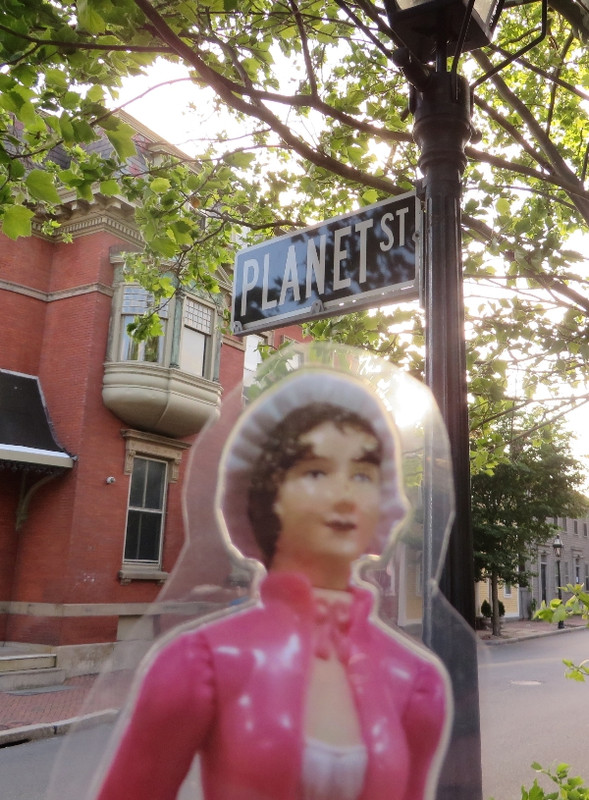
Flat Jane Planet St Providence, RI

They Observed the passage of the planet Venus between the earth and the sun occurring in a pattern of two December observations 8 years apart, followed some years later by two June observations 8 years apart. 243 years pass between one June observation pair and the next, and the same between each December observation pair.

Mr. John Brown's house is just up the hill on Benefit Street. We walk along the street paying calls and nodding to the neighbors.

Here is a map to help guide you.

A map of Benefit Street

At the foot of College Hill and Benefit Streets, at the opposite end from Roger Williams is the Town House, hosting offices of public officials. 

Old Town House c. 1850; built 1795, demolished 1860
The site of the Town House is now part of 
Brown University. All that is left
is this plaque to note what was once there.

                                      
Next door is a charming subscription library. It is not open today so we must return.
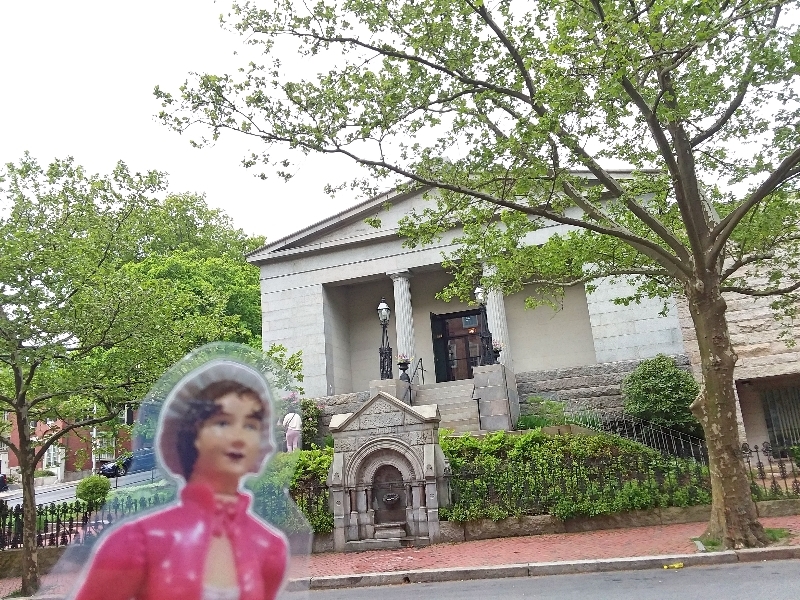
Providence Athenaeum built 1838- more later

There are not many homes completed here at the South end of the street so we head North. Past the street where we saw Stephen Hopkins's home, past the street where we saw the Shakespeare's Head and brick schoolhouse, Old State House, St. John's...
                               
This house is said to be cursed!


Built between 1747-1784 by John Mawney, a physician, this was one of the first houses built on Benefit Street [now number 135] after that roadway was completed in 1758. Mr. Mawney may have used the basement entrance as his medical office. A store now occupies that space. It is the second owner, Stephen Harris, who is of primary interest to local lore. 

Local legend has it that Stephen Harris had the house built his home over the top of a Huguenot (French Protestant) burying ground. Shortly thereafter, Mr. Harris, a merchant, fell on hard financial times. He lost a number of his trading vessels at sea; several children; his wife went mad and was confined to the upper floor of the dwelling! According to the story, Mrs. Harris could be heard to rant tirades in French, a language she did not know. There is much potential for a Gothic story there.

Jane and the Shunned House


Editor's note:

This house is best known as "The Shunned House" from an H.P. Lovecraft story. His aunt lived next door and shared gossip with him that became the basis for the story about  I know for a fact the family suffered many misfortunes. Grandson-in-law misappropriated their finances; a granddaughter had mental health issues and was institutionalized off and on in Worcester. A granddaughter died in her 20s, a great-grandson almost died when a maid purchased the wrong medication and daughter-in-law Sarah Hawes Harris was forced to sell her family property to the railroad.

Here lives Thomas Holden at 118 Benefit Street, the first of the brick homes built here along Benefit Street, in 1809. The land was part of Major Jabez Gorham's estate, sold to the printers John and Amy Carter, then to the printer John Updike. A mariner, John Miller Noyes, owned the lot and sold it to Josiah Humphrey. Mr. Humphrey left his house and land to his wife. She then sold it to Thomas Holden who made improvements. He has put his home up for sale to pay war taxes. I believe Mr. Holden is a tailor.


Nathaniel Smith House, a small scale merchant lives at 58 [106] Benefit Street. His house is newer, [1795-1798] and is quite comfortable for an American home. It looks much like a cottage to me. The architecture is very different here than in Hampshire and Somerset or even Dorset. The neighbors are middle class families: reformers, politicians and businessmen.

Flat Jane Nathaniel Smith House
                                   

This is the home of the father of the free-school system, John Howland. A direct descendant of a servant upon a ship called The Mayflower, Mr. Howland of Providence is a barber and member of the Providence School Committee. His house was built in 1784 on land purchased from Gersham Jones, a pewterer. 

Flat Jane John Howland House


[The editor is also a descendant of the Mayflower John Howland and his wife, fellow Pilgrim Elizabeth Tilley]

Next door lives Col. James Burr and Mrs. Burr, on the corner of Church St., in the pink house.

Burr House and Snow House


William Snow House. Another typical dwelling of this place. Built in 1784 and restored in 1798. We pay a call on Mrs. Marcy Snow. Her husband served in the navy during the War for Independence.


The Providence Benevolent Congregational Society Parsonage, a ladies benevolent society.


This home, 56 Benefit Street, was built for a very important family of tradesmen. It was built in '93 for Jabez Gorham, now deceased, a cousin of John Howland. His family no longer lives on the property but his son and namesake has been making quite a name for himself here in town as a silversmith.

Jabez Gorham House

Jabez Gorham, silversmith is only 24 years of age and already has formed a partnership in business with four other young men to make jewelry.

Editor's note: in 1831 Jabez Gorham, Jr. formed the Gorham Manufacturing Company, once world famous for their silverware, castings, jewelry, tea sets, statuary, etc.

Samuel Staples built two houses. The small, narrow house squeezed in here was built in 1760 and moved to this spot more recently. 


Samuel Staples, a housewright, built 52 Benefit Street as well. It is a typical late 18th-century clapboard house with gable roof, two stories, five bay façade and pedimented centre entrance. It is built close to the street with an additional lower floor at the rear.

Elisha Angell's house, at 48 Benefit Street, is a newer house, completed in 1810. The Angells are one of the first families in Providence. 


There are many empty lots to be filled. Our carriage awaits us here to return home. 

I am saving the most delightful accounts of my visits with the elite of Providence for when my hosts are not around. I shall share my impressions with you soon. Until then I am 

ever yours,
Jane

Follow Susanna and her freind Felicity from Virginia to see more homes.

Tuesday, June 7, 2022

Flat Jane Austen in Providence

Flat Jane Austen in Providence

May --, 1816
My dear friends,

Today we took the carriage down to Main Street and disembarked to view some of the important buildings in town and pay calls. 

Heading South on Main Street from the Episcopal Church and Roger Williams homestead, we walked down Main Street and up a few small hills. Like Bath, this city boasts many steep hills!

Here is the state house. Did you know Rhode Island has no less than three capital cities? Providence is only one of FIVE: Providence, Newport, Bristol, East Greenwich, and Kingston. What they should want for so many I do not know nor can I contemplate how they are able to do any governing with all that to-ing and fro-ing.  

This building is the Rhode Island State House when the General Assembly session meets in Providence. It also serves as the county courthouse. 

Flat Jane at the Old State House.
However, ignore this scene ... The façade dates
to the 1850s and Jane would be facing the Great
Salt Cove


This building replaces an earlier wooden courthouse built in 1730 on Meeting Street. By 1762 it was largely completed with some details being completed by 1771. It is in the late English Baroque style of the William & Mary and Queen Anne periods. Many architectural details were borrowed from the larger and more ornate Newport Colony House. It sounds as if the colonists who did not wish to obey a king did enjoy copying our English architectural stiles.

In this building the colonists denounced the authority of good King George on 4 May '76, being the first of the colonies to lose their senses. Mr. Moses Brown took his brother John to court here to sue Mr. John to give up some of his slave ships. The General Assembly has met to repeal restrictions on the voting rights of Roman Catholics (1783) and passed the Gradual Emancipation (of slaves) Act in 1784. The late President Washington visited in 1781 and 1790.

Turning slightly to travel up a side street known as Meeting Street, I spy a small brick building that is apparently some sort of school. 

Flat Jane at the Old Brick Schoolhouse


The building served as a free-based grammar school in 1769;  an arsenal during the War for American Independence; was occupied by the college for some years and is now a free public school. There is much discussion among the colored people in town of educating their children. Perhaps in the near future [1828] they will open a separate grammar school in this space for children of color.

Next we stop at 21 Meeting Street, the Shakespeare's Head Building, the former offices of the Providence Gazette. 

The Shakespeare's Head Building 21 Meeting Street

In 1772, printer John Carter built the house and ran a post office, bookstore and printing press from downstairs while his family lived above the shop. The establishment featured a bust of Shakespeare's head as advertisement. In '93 the printing office removed to Market Square and I am pleased to report the heirs do not smell in the least. I daresay Miss Bingley would not agree.

Another trip up the hill to visit the families of Deacon Edward Taylor and more Brown family members.
Flat Jane at the Providence Art Club


Seril Dodge built the grey house between '86 and '89 after arriving in Providence in 1784 after serving a clockmaking apprenticeship in Connecticut. In 1791 the home [one story] was sold to the heirs of Mr. Nicholas Brown, brother of Mr. John Brown.

Jane at the Providence Art Club


Seril Dodge also built the brick house you can see behind me in my sketch. More Brown family members live here, a nephew of Mr. John and Mr. Nicholas, son of Mr. Moses. Obadiah Brown's home was built in 1790 and is believed to be the first brick veneer structure in Providence.

editor's note: These three buildings, plus a later 19th-century structure form the Providence Art Club, founded in 1880 to stimulate the appreciation of art in the community. Providence is now an artsy city with a first class art university and world class art museum. Jane would have a wonderful time Observing the eccentric art students!

Please turn the page to learn more about the oldest homes in this city and the people who inhabit them.


Sunday, June 5, 2022

Flat Jane Austen in Providence : Sunday Worship

 Flat Jane Austen in Providence:
Sunday Worship


Sunday, May, 18--

My dearest friends,

I daresay you will criticize me writing to you on a Sunday but the mail ship leaves tomorrow at first light so I must make haste and dash this note to you while I am able. 

Today, Sunday was a day of worship here in town. My hosts worship at the Baptist Meeting House here in town. 

Jane at the First Baptist Church in America


This is the house that Roger Williams built. Baptists believe only knowing adults should be admitted to worship. They must testify to their conversion experience. How peculiar! The church is based on Scripture.

This building is new, as old as I! Before 1700 the congregants worshipped in each other's homes. The first meeting house was built nearby, a simple 20 X 20 foot structure. Soon after, there were enough people to build a meetinghouse twice that size next door. The Great Awakening saw a large number of converts and 'twas necessary to erect a much larger building down the street. Built between 1774-75 and designed by Joseph Brown, John Brown's brother, the design was borrowed from English churches.
First Baptist Church in America ink-on-paper engraving
by S. Hill (southwest view)


The actual building was done by shipwrights. All members were expected to help in the construction of the church and contributed oak from their farms for the the interior columns.  The ceiling is also made from products native to Providence including sand, Gipson, cow hair, and oyster shells. The church also features Palladian windows. It measures 80 feet X 80 feet plus the 185 foot steeple added shortly after.

 
1822 watercolor painting of First Baptist Meeting House by 
Joseph Partridge (1792-c.1832)

Looking south from North Main Street (Roger Williams) 
can you see the steeple of the Baptist Meeting House?

Roger Williams left this church he founded very early on and was a seeker the rest of his life. 

This is a brand new, 1816,  Congregational Meeting House  [editor's note: now a Unitarian church] for those who stayed true to their Puritan leanings. The previous version having been burned by arson in '14. They say this Congregation is different from the Puritan church and is far more liberal. 

Jane at the First Unitarian Church in Providence
formerly the First Congregational Church


'Twas designed by John Holden Greene, Providence’s foremost architect and a member of the congregation. This building features classical arches and urns combined with soaring pointed Gothic style windows with delicate tracery decoration.


In last year's gale, The Second Baptist Meeting-house succumbed and went to pieces under the combined force of the wind and the waves, whilst the tall spire of the First Baptist Church wavered and bent to the blast, but it fell not. The steeples of the first and second Congregational Churches were partly blown down, and the roofs of the Episcopal and first Congregational Churches were partly carried away.

Finally, I discover the whereabouts of the true and established church, down from where Roger Williams made his home. 

Jane at the Cathedral of St. John

This one is also relatively new, built in 1810 to replace the original 1722 wooden structure. This church was also designed and built by John Holden Greene in the early Gothic Revival style.


[editor's note: Directly across the Roger Williams National Memorial; now a center for exhibition and reconciliation on the trans-Atlantic slave trade]


I must attempt to sketch Church Street where there are some old houses.


There do not seem to be any Papist churches here in Providence. In spite of professed religious tolerance, the Papists are not any more welcome here than they are in England.

I must make haste and post this letter. I will write more soon. 

Yours, as ever,
Jane


editor's note on the Great Gale of 1815: Small State, Big History,
The Great Gale of 1815 Slams into Newport, Providence and Narragansett
By Christian McBurney

Tuesday, May 31, 2022

Flat Jane Austen in Providence: Shopping

Flat Jane Austen in Providence: In Which Jane Goes  Shopping 

(With a very brief peek into the not so far off future)


May 21, 1816

My dearest friends,

We headed out for a day of shopping and a look around the Town. The prices for dry goods are rather dear. I did not purchase anything. 

We travel down, down the hill (by carriage of course) to Broad Street to the Providence Arcade. A devastating fire destroyed 40 shops nearby on South Water Street in '01. The shopping district has been rebuilt in a more elaborate stile since then. This is the only indoor shopping mall in all of America! At this time it is also the first and only major commercial building on the west side of the river. Oh my heavens! This town is much smaller than London and even Bath but larger than the villages of Steventon and Chawton. 


It was built in the Greek Revival style with columns, granite walls and classical facades resembling a Greek temple. 'Twas modeled after the Burlington Arcade in London and arcades in Paris. 


Between two streets, a wide central walkway runs through the center of the building with a great skylight overhead admitting a flood of light over the building’s gracious cast iron balustrades and railings. 


This location is not so ideal. There is much dust, wind and rain, and frequently ladies are obliged to step off the side walks to pass by stones, timers laid there by masons and carpenters. If by chance they meet a hog or a chimney sweeper on the sidewalks, they must give way for them or receive a "dark rub." (Providence Gazette). 

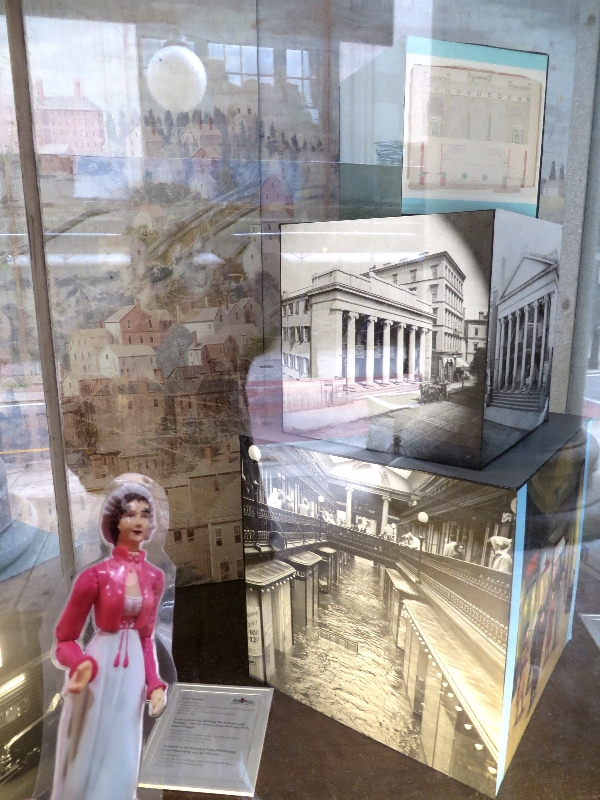
Westminster Street entrance museum windows by RIHS

A copy of the theatre curtain from the first theatre in Providence, nearby on Westminster and Matthewson Streets, built not so long ago in 1795. The curtain was painted by John Worrall in 1809 and is used to entertain audiences between shows.

I shall attempt to copy this pencil, ink and watercolor sketch for the Westminster front of the Arcade drawn by architect Russell Warren. [c. 1828] 

There are two facades. One on Weybosset street designed by Joseph Bucklin and one on the other side [Westminster Street] by Russell Warren. [photo Weybosset façade c. 1865 and Westminster façade c. 1867]

Can you imagine the flooding from the Great Gale last year? [or perhaps in the future in 1954?]

Editor's note: Actually not built until 1828 but close enough! Technically the Burlington Arcade in London was not yet built when Jane Austen died either, but Flat Jane has to bend time a bit. The street was renamed Weybosset Street at some point later in the 19th-century. The 1920s theater we went to is at the other end of the street, for reference. The Arcade has had its ups and downs. In my VERY early childhood, in the early 1980s, it was still used as an indoor shopping mall. It fell into disuse as the suburban shopping centers and later modern malls became more popular. It was renovated recently and how houses a few shops and restaurants and the upper level has micro lofts for students at the Rhode Island School of Design and other young professionals. Windows by Rhode Island Historical Society.

We travel back home by way of Market Square to fetch produce for the household.  
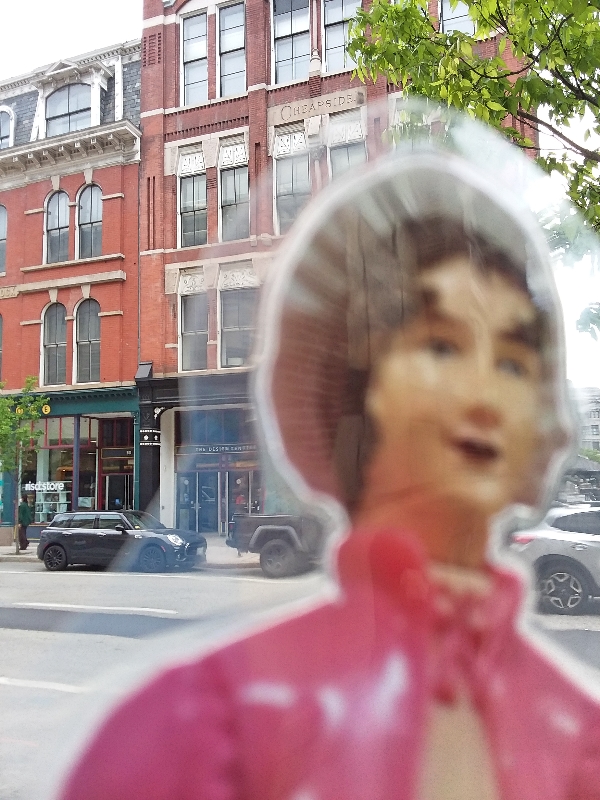
Can you see where I am?
Blow up the photo to see where Jane is!


How about now?!
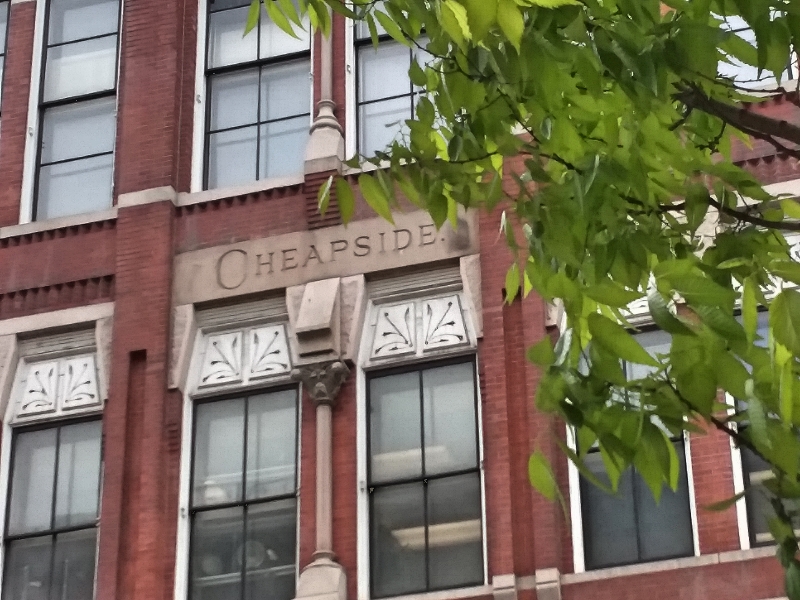
Cheapside! Yes there are warehouses nearby!


Yes, indeed, there is a Cheapside here in Providence. Cheapside is the major commercial center of this town.

Editor's note: While the buildings date to late 19th-century, I couldn't resist taking pictures of Jane in front of the Cheapside sign. Jane is at the Cheapside Block, built in 1873 in the High Victorian Gothic style. (Architecture nerds can click the link to read the Providence Preservation Society's report).

We visited Market House in Market Square, at the east end of Weybosset street, designed by Mr. John Brown's brother, Mr. Joseph Brown and colonial governor Stephen Hopkins. The original structure was only two stories high. Here they sell fish, meat and produce in an open storey on the ground floor. The second floor serves as town hall. In '97 another storey was added to house the first Masonic Lodge in Rhode Island. I know not who these Masons are or what they do, 'tis all a secret. 
Market House 


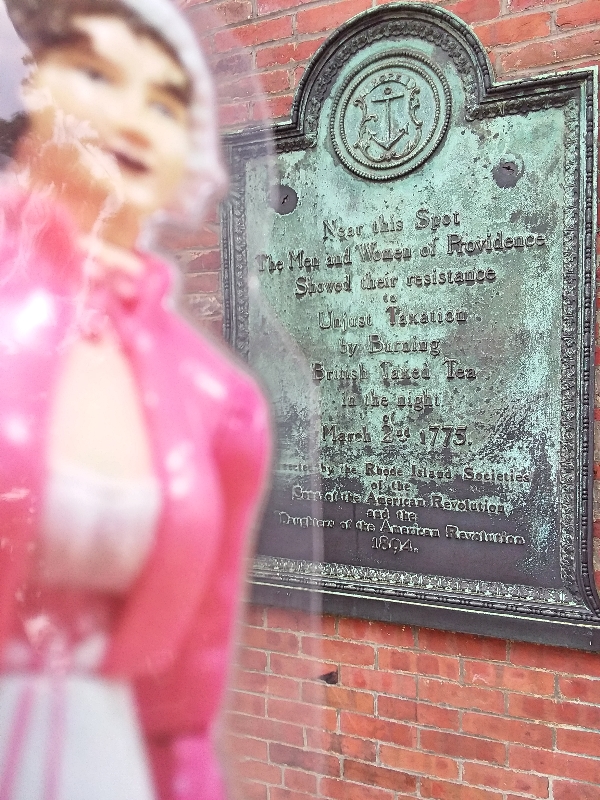
In this building, or near to it, the roguish colonists gathered to protest the King's tax on tea. They outdid those horrid Bostonians and burned the tea on 2 March 1775! The horror! Do they not know tea is expensive even in England? We keep it under lock and key! During the War for American Independence, the building served as barracks for the French Army. Those Frenchies! They sided with the colonial upstarts causing war between our countries, as usual.

Site of the little known PROVIDENCE tea party!
No wonder one can not find a decent cup of tea around here.

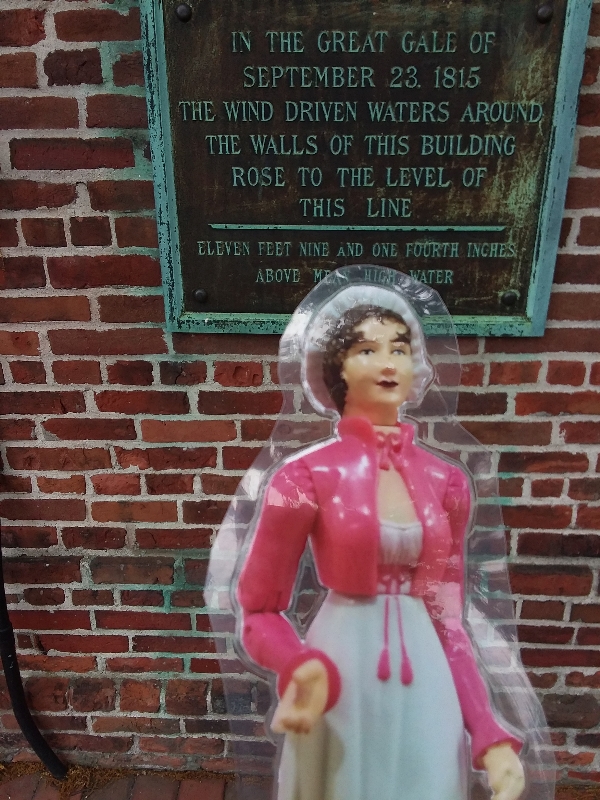
Here you can see the high water mark from a gale that blew through September last. 

High water mark for the Great Gale of 1815

The buildings along the waterfront were flattened, the city destroyed by flood as the water rose to over 11 feet. Astonishing! I have heard of such gales from Francis and Charles who have been on their ships the midst of such storms. I can not imagine the terror. Susanna just remarked, it was windy! On the hill they were safe from the flood. 

I am quite busy paying calls and seeing this town. I shall try to write again soon.
Yours most affectionately,
Jane

Flat Jane Austen in Providence

Flat Jane Austen in Providence
History of the Waterfront

Edior's note: Jane wishes to describe how much Providence has grown over the last nearly 200 years since Roger's day. We walked under the former Great Salt Cove to explore the growth of the town.

May 20,  1816
My dearest friends, 

You must allow me to educate you further on the geography of this town. It is quite unique to anything I have seen before. 

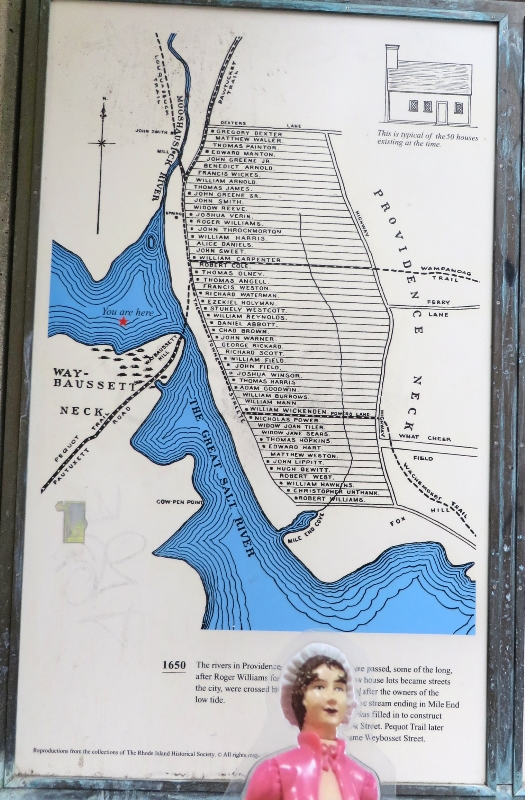
The Moshassuck and Woonasquatucket rivers flowed into the Great Salt River (Providence River) and Providence has grown on top of the three rivers. The Woonasquatucket River flowed slowly through a broad valley of salt marshes.


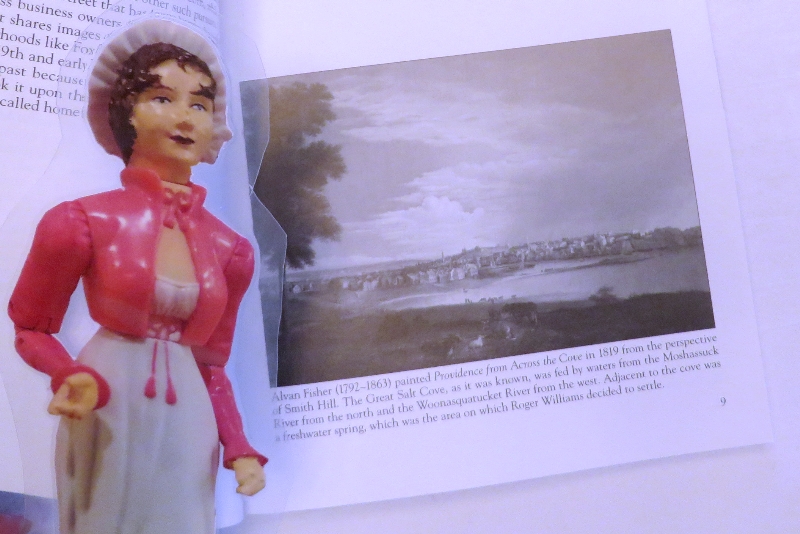
Providence in Roger's day

Three rivers converge at the Great Salt Cove. They could be traversed at low tide. Susanna's mother, grew up on the other side of the Wampanoag Trail in what was known as Seekonk and then Rehoboth (1644) in Plymouth Colony. There is a cove there too, Watchemoket.


Do you spy a familiar name of this map?
That is not Benedict Arnold of the War for American Independence but rather his great-grandfather, a president and governor of the Colony of Rhode Island and Providence Plantations.

A better look at the house lots in Providence. 
Chad Brown was a minister and the great-grandfather of John Brown!


By 1700 the town had grown quite a bit. The cove covered several hundred acres and was deep enough to accommodate sailing ships. A drawbridge connected the East Side to Weybosset Point.


The first bridge across the Providence River was built in 1660. The first wharf behind Towne Street (South Main Street) had been built and the center of town was now called Mohassack Square. Market Square is located at the south edge of the cove and became the center of Providence (see next page). The town's growth was spurred by shipping and seafaring interests, textile manufacturing, bleacheries, printworks, foundries, ironworks, and machine firms. (Many owned by John Brown and his family).


The First Baptist Church in America was built in 1775, long after Roger Williams founded and then left the church. The market building and college edifice were built in 1770. I shall journey forth to see them all later.

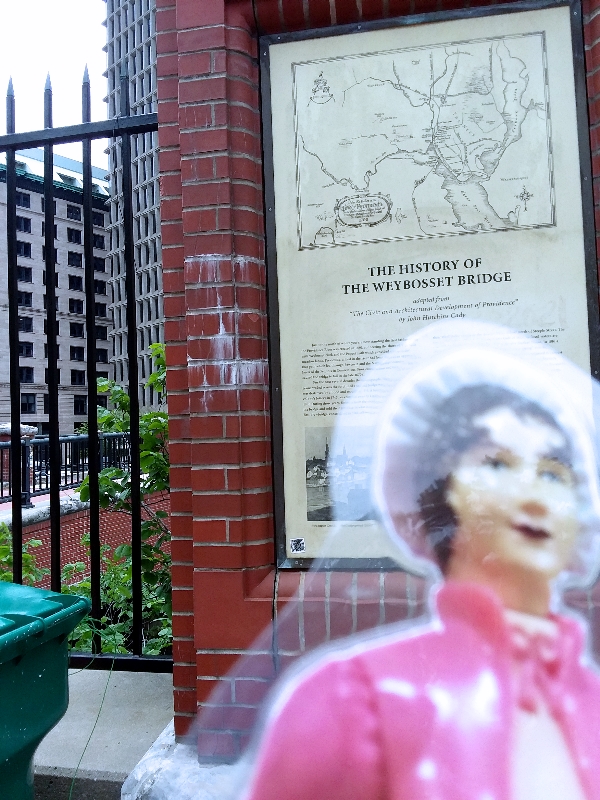
Jane at the Weybosset Bridge 
Read the text of the sign

In colonial times, a bridge was built on the western side of town, called Weybosset. It provided a link between what is now Providence to the path to the Pequot lands in Connecticut. After only about a decade, in the 1670s, the bridge fell into disrepair. People and animals were forced to ford the crossing until 1711 when a new bridge was constructed. That bridge was destroyed by flood a few years later. The fourth was blown away by gale force winds in 1761. 

Jane at the site of the Weybosset Street Bridge
The newest, late 20th century bridge (1994) links the east side with 
downcity. 

In 1764 a drawbridge was built to accommodate the square-rigged ships carrying cargo from the West Indies. Providence was by then a major shipping port and more wharfs had been built behind Towne Street. THAT bridge disappeared in last year's gale (1815) and has been replaced by a fixed bridge, preventing sea-faring vessels from entering the cove.  


Providence 1790 by John Fitch 

The city was blocked by several hills and more land was needed. The Great Salt Cove was filled in beginning as early as 1780 in order for more wharves to be built. By 1792 the east side of the cove was filled in creating a new street called North Water (Canal) street.

Now here is a map from only a decade or so ago in '03. 

Both sides of the river have been developed since 1784 and new wharves built. John Brown built a new harbor on Narragansett Bay to accommodate his ships making the route to Africa for slaves and the West Indies for sugar cane and back home to collect rum for the return voyage. This place is called India Point after the shipping route. The Indians called this part of town Moshassuck. Shipping and commerce forced the center of town to move south and across the river. The merchant fleet consisted of 120 ships.

Looking towards John Brown's house
with his ships docked in harbor behind me

                                         
. 

A great gale blew through Providence September last and destroyed much of the city, including the drawbridge and sent ships flying into the structures along the waterfront. A new, fixed bridge, was built at Market Square. The cove has become a tidal lake.

Here is a view of what Providence looks like now. 


To the east of the Great Salt Cove where the city edges into the bay is Tockwotton (Foxes) Hill. When Mr. Williams first came it was wooded with many foxes running around. The Narraganset called the place Tockwotton, a word which hear means either "that which is frozen" or "steep ascent to be climbed." 


Behind Jane is Tockwotton Hill 
now known as Fox Point


In July of last year (1815), the town's harbor lines were extended to the lower harbor. The head of navigation became Weybosset, south of the cove. Providence is growing rapidly and there is much talk about a steamboat ferry between Providence and Newport (1817). They say steam engines are the way of the future and are more in use here than they are back home as yet.


I have much to do tonight but will write again tomorrow.

Most sincerely yours,
Jane

Editor's note: 
Take a closer look at the maps and bridges . Jane would like to thank the Rhode Island Historical Society for their signs;  41° North February 6, 2018/Winter 2018 issue for filling in more details; The College Hill Independent Dec. 5, 2014 issue for the history of Tockwotton. Read more about Fox Point before moving on.

Jane owes a debt of gratitude towards the editor's mother for the pictures of India Point and Tockwotton Hill (Fox Point). She's standing in East Providence looking west across the Seekonk river to Providence in the other direction from the period painting.


Monday, May 30, 2022

Flat Jane Austen in Providence Part III

 Flat Jane in Providence:
In which Jane continues to learn about the early history of Rhode Island

editor's note: A visit to the Rhode Island Charter Museum in the State House
May, 18--
Dearest friends,
I continue my exploration of the early history of this "lively experiment".

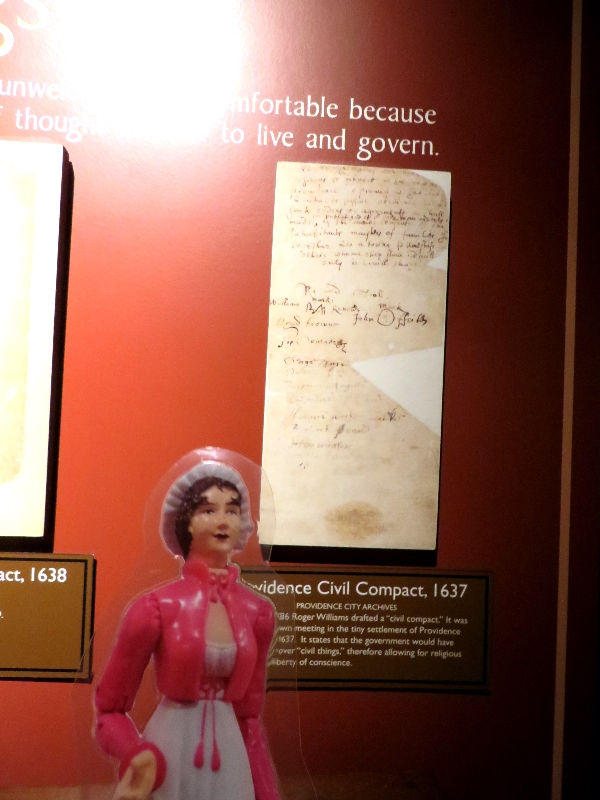
In fall 1636 Roger Williams drew up what he referred to as "a civil compact." It was adopted at a town meeting on 20 August 1637. The document states the government shall have authority over civil things, allowing for liberty of conscience and religious tolerance. This is the first time in America church was separated from state. 'Tis quite different from England where our king is head of the church.


Providence Civil Compact 1637


A fragment of the original deed of Providence

'Tis a scrap of paper, really, but quite important to the history of this town- the original land deed of 1638 signed by Roger Williams, Canonicus and Miantonomo. The sachems drew their "signatures" with in the symbols of a bow and an arrow. This document confirms earlier verbal and written agreements between the parties.


The new colony attracted people of diverse opinions and lifestyles! Truly I have never seen so many dissenting churches in one place. Later I shall attempt to sketch some for you. The colony was also home to Jews, Mohammedans (Muslims), Native religions and even NO religion at all! 


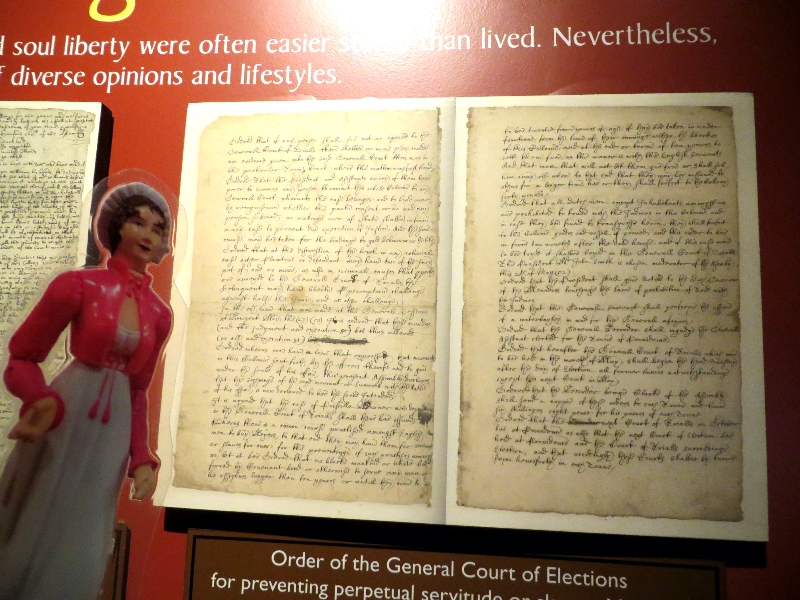
Order of the General Court of Elections for preventing
perpetual servitude or slavery, May 1652

In 1652 Rhode Island passed the first law prohibiting indentured servitude after 10 years limit and slavery. The law also said children indentured prior to the age of 14 should be freed at the age of 24. was, alas, not enforced due to Rhode Island being coastal. Rhode Island became the centre of the Triangular Trade, shipping rum to Africa in exchange for slaves and slaves to the West Indies to harvest sugarcane used in making rum here in Rhode Island. Mr. John Brown, his brothers and others like them participated in this insidious trade. (Yes I am aware of where we obtain the sugar for our tea. )


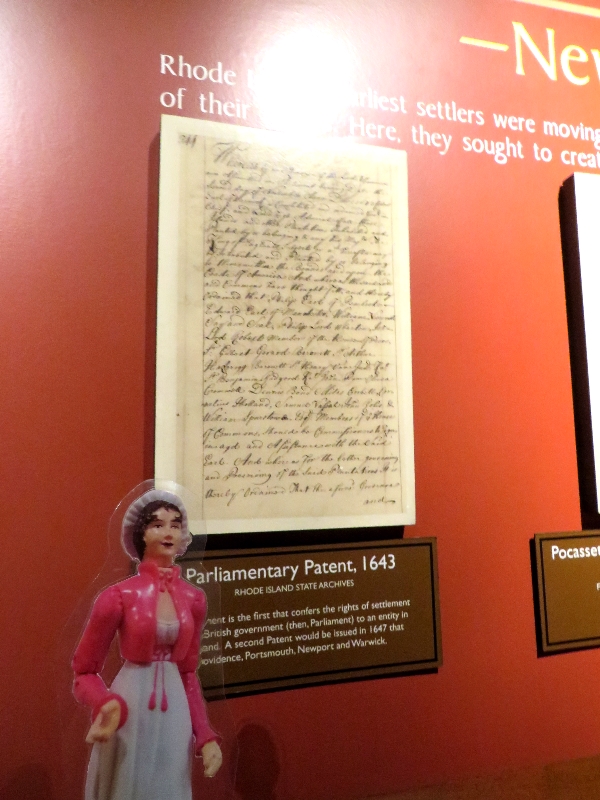
Jane and the Parliamentary Patent of 1643


While that dreadful Cromwell and the Puritans were in charge during the Civil War, Rhode Island was governed by a patent from Parliament granted in 1643. Roger Williams risked his life to travel back to England to obtain this document. Under this patent, the new settlements of  Providence, Portsmouth and Newport were united and named “the incorporation of Providence Plantations in Narragansett Bay in New England.” The patent prevented encroachment from neighboring colonies  (tho'  I am told Massachusetts and Connecticut both tried to incorporate parts of land claimed by Rhode Island). The patent also provided for self-government, and focused on civil laws. 'Twas the first document that conferred the right to settle here from Parliament. Parliament granted another patent in 1647 incorporating the new town of Warwick. At least the Cromwellians managed to do something good, at least for this colony at any rate.

Editor's Note: Read a transcription or view the original document

In 1653, dissenters in Newport were discontent. Newport, on the island that gives the state its' name, along with the town of Portsmouth and smaller neighboring island of Conanicut (Jamestown) were then under a separate government with a separate governor. Governor Coddington had obtained a commission in 1649 naming him governor and without a provision for elections, Mr. Coddington was governor for life. He lied to Parliament to obtain this commission. Coddington's commission annulled Roger Williams's 1644 charter.


The dissenters in Newport and Warwick felt a keen lack of support from their governor and encouraged Dr. John Clarke of Newport; Roger Williams of Providence; and William Dyer, of Portsmouth, to sail to England to get Parliament to revoke Coddington’s commission and affirm the 1644 charter. The dissenters wanted to protect their way of life as growing threats to their religious freedom from Massachusetts and Connecticut colonies.


John Clarke, a Baptist minister from Newport and Roger Williams traveled to London in 1652 to secure a new charter. Roger Williams returned two years later but John Clarke stayed behind for 12 years, pressuring Parliament and then King Charles II for a charter. In 1663 good King Charles agreed to grant the charter.  On July 6, 1663 King Charles II added his royal seal of approval.

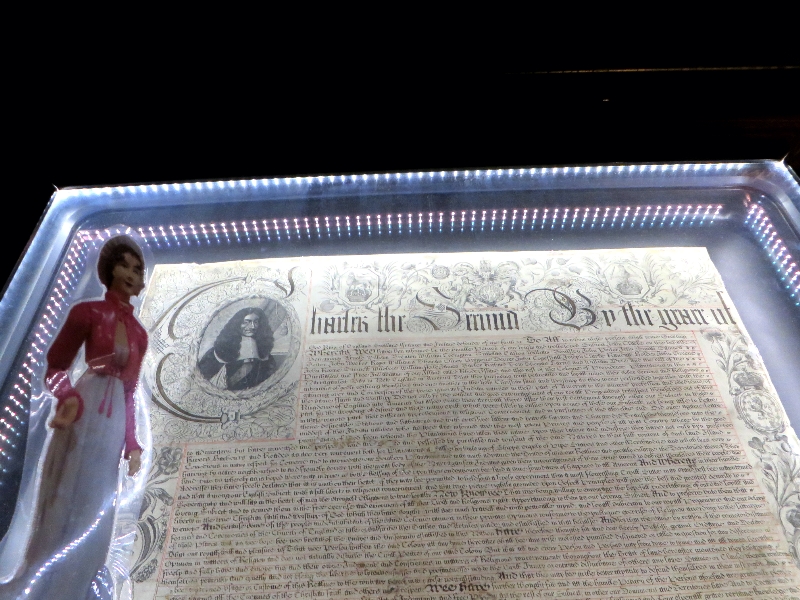
Jane learns about the Royal Charter of 1663

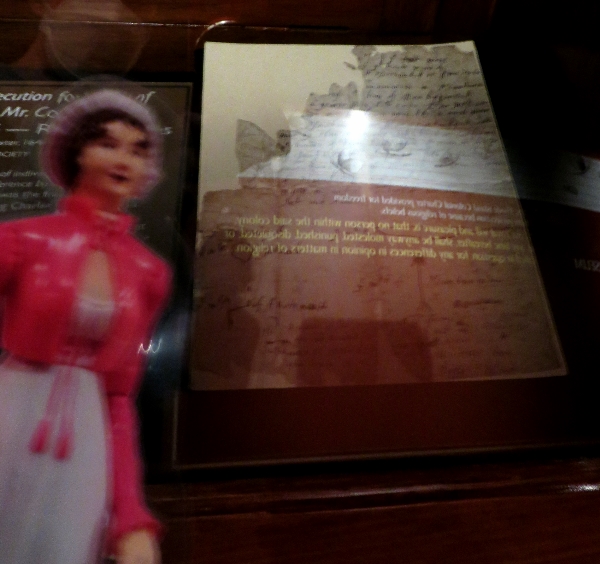
John Clarke's charter of 1663 guaranteed freedoms of speech, religion and other liberties to residents of Providence, Portsmouth, Newport and Warwick. 
Jane and the Royal Charter of 1663. It is too large for one case.
“Our royal will and pleasure is that no person within the said colony at any time hereafter shall be anyway molested, punished, disquieted or called in question, for any differences in opinion in matters of religion.”
Editor's note: Read the full and annotated text at the Rhode Island Secretary of State's office online
Once again I have much to contemplate. I must leave off now for the night for the hour grows late and my candle is burned low. I do have much more to tell you though so I shall write more tomorrow. 
Yours,
J.A.