Showing posts with label Stephen Hopkins. Show all posts

Monday, August 17, 2026

Susanna (and her Felicity doll) Explore the Revolutionary War in Rhode Island

More on Stephen Hopkins 

or 

Two Stories: One Nation 

Hopkins and Haskell

I sent my Felicity doll to the North Burial Ground in Providence to learn more about Stephen Hopkins. It was too hot and too far for me to walk. I will be back soon with more from the Revolutionary War. For now, please listen to Felicity. She learned a lot!


Sunday, August 2, 2026

Susanna (and her Mini Felicity doll) Explore the Revolutionary War in Rhode Island


 The Declaration of Independence!

21 July, 1776

July ye 21st Seventeen Hundred and Seventy-Six. Such news! Word has come from the government in Philadelphia of a declaration of Independence! (Two months since Rhode Island renounced the King on May ye 4th).

A photo of an original document from 1776 declaring Rhode Island free from allegiance to the King of England
Rhode Island's Act of Renunciation May 4, 1776


Picture of an 8 inch doll with red hair in a long, floral dress in front of a sign with a timeline of the path to independence
The Path to Independence

On 7 June Richard Henry Lee of Virginia presented the Second Continental Congress with a resolution for independence. This was a result of years of Britain imposing on the rights of the colonies to be self-governed. After the Boston Tea Party and other similar protests, King George III declared his North American subjects were in a state of open and avowed rebellion. In June some delegates still hoped for a peaceful solution. The vote for independence was delayed for three weeks.


A few days later, on 11 June, Congress took a break. They asked John Adams, Benjamin Franklin, Thomas Jefferson, Robert Livingston and Roger Sherman (known as the Committee of Five) to draft a statement for the delegates to consider when they returned to Congress. Mr. Jefferson wrote a draft. Mr. Adams and Mr. Franklin edited it. 
Picture of an 8 inch doll with red hair in a long, floral dress in front of a sign with a timeline of the path to independence


On 1 July, Jefferson's Declaration of Independence was presented to Congress. Next day, Lee's resolution was passed. John Adams thought this day, 2 July, would be a national day of celebration forevermore. 

One of our Rhode Island delegates, Stephen Hopkins, is very old. He has a palsy in his hand. His hand shakes as he signs the document. He declares "My hand trembles, but my heart does not.”

Susanna with Stephen Hopkins at his house


Not quite. Two days later on 4 July, the Declaration was adopted. Every colonial assembly received a copy. Other copies were sent to the Continental Army (General Washington), King George III and other countries like Poland and Florence in Italy. 

Two more days since 4 July, a copy was sent to the Governor of Rhode Island. (Governor Wanton was not in favor. Boo hiss!) 

Picture of an 8 inch doll with red hair and long floral print dress in front of a sign about the Southwick printing of the Declaration of Indpendence
Solomon Southwick's Declaration of Independence

Mr. Solomon Southwick of the Newport Mercury supervised the printing and publishing of multiple copies of the Declaration. One copy was read in Newport. Other copies were distributed throughout the state.


An original copy of the Declaration of Independence
The Southwick Printing


Now you must time travel forward to 31 January 1777. The only woman printer known to publish AND sign her name to the Declaration of Independence is Mary Katherine Goddard, a printer in Baltimore. (She used to live here in Providence). 

Picture of an 8 inch doll with red hair and long floral print dress in front of a sign about the Mary Katherine Goddard Declaration of Independence
The Goddard Printing

Miss Goddard was the official printer to the Continental Congress. She signed her copy "Baltimore, in Maryland: Printed by Mary Katharine Goddard." She took a big risk aligning herself with independence. This was an act of treason!

Picture of an 8 inch doll with red hair and long floral print dress in front of a copy of the Declaration of Independence
Mary Katherine Goddard's Declaration of Independence


Her name was crossed out!

On March ye 3rd, Miss Goddard's broadside was entered into the proceedings of the General Assembly.


The Goddard Broadside 1777

Time travel forward again to 1820 when Secretary of State John Quincy Adams hired William J. Stone to engrave a copy of the Declaration of Independence as the original is beginning to fade. This will be the copy everyone from hereon in remembers seeing. 


Jump ahead four more years to 1824 when Rhode Island receives four copies of the Southwick Declaration, along with a letter from John Quincy Adams! 

Picture of 8 inch doll with red hair and long floral print dress in front of a facsimile copy of the Declaration of Independence

That is all we have for you today but please return soon for there is much more to the story after independence has been declared!


Wednesday, June 8, 2022

Flat Jane Austen in Providence


Flat Jane Austen in Providence

May --, 1816 con't

We continue walking along Main Street and up a hill to Benefit Street. This one mile street features the original homes of the merchants and tradesmen of Providence. 

First, we walk along South Main Street to see the former home of 10-time colonial governor and signer of the Declaration of Independence, Stephen Hopkins. It was first built as a small, sort of shack, in 1707. Mr. Hopkins later enlarged the home. It is simple, in keeping with his Quaker faith but well enough for a colonial. 


He was a very important man in the colonies and supported the cause of Independence from the beginning. For some unusual reason, this man who espoused liberty and freedom for all enslaved a number of people in spite of opposition from his fellow Quakers.

 [Editor's note: Read a timeline of his life. Read more about the house. We were unable to go inside.]


Also on South Main Street we see the home of Mr. Joseph Brown, the architect and brother of Mr. John Brown. He designed a number of important buildings in the neighborhood including the Market House, the Baptist Meeting House and College edifice using English design books. This house was begun in 1774. He also taught mathematics at the University. Mr. Brown passed away in '85 and the home passed to his brothers. In 1791 Mr. John and Mr. Moses Brown opened the Providence Bank and used this building as their headquarters.


We pass by a few homes along this street likely belonging to merchants or mariners.


Early Federal style home Planet Street?

The very grand people are beginning to build their homes up the hill now, near to Mr. John Brown's house. I shall write to you about them soon. Now we walk up the hill and in the opposite direction away from Susanna's home.

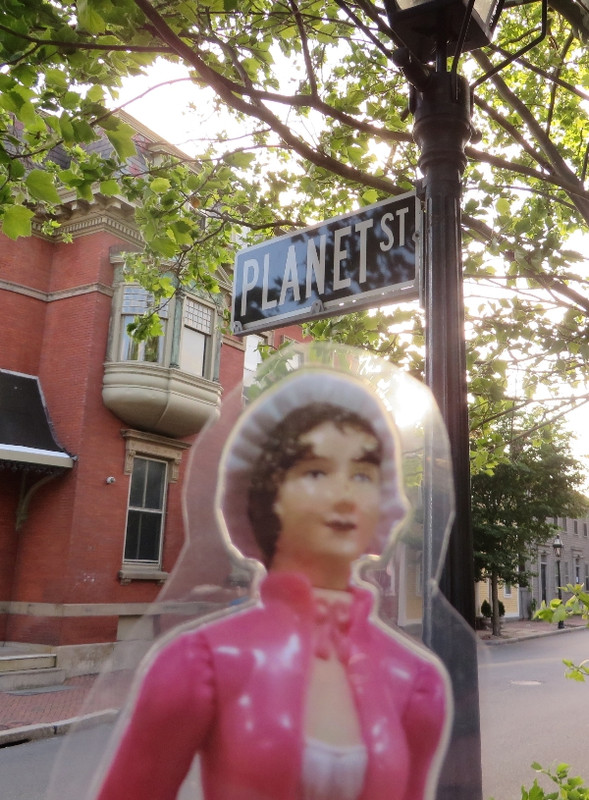
We walk up Planet Street, so-called for the Transit of Venus that occurred in June 1769. (There is also a Transit Street). Local scientists, including Mr. Joseph Brown,  placed an observation platform and installed equipment installation on the crest of the hill above the Town House, near the college edifice.

Flat Jane Planet St Providence, RI

They Observed the passage of the planet Venus between the earth and the sun occurring in a pattern of two December observations 8 years apart, followed some years later by two June observations 8 years apart. 243 years pass between one June observation pair and the next, and the same between each December observation pair.

Mr. John Brown's house is just up the hill on Benefit Street. We walk along the street paying calls and nodding to the neighbors.

Here is a map to help guide you.

A map of Benefit Street

At the foot of College Hill and Benefit Streets, at the opposite end from Roger Williams is the Town House, hosting offices of public officials. 

Old Town House c. 1850; built 1795, demolished 1860
The site of the Town House is now part of 
Brown University. All that is left
is this plaque to note what was once there.

                                      
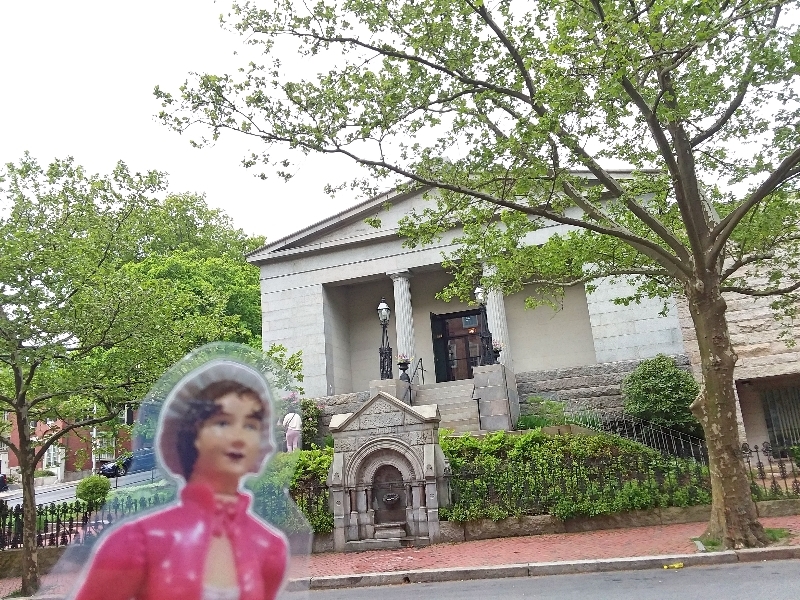
Next door is a charming subscription library. It is not open today so we must return.
Providence Athenaeum built 1838- more later

There are not many homes completed here at the South end of the street so we head North. Past the street where we saw Stephen Hopkins's home, past the street where we saw the Shakespeare's Head and brick schoolhouse, Old State House, St. John's...
                               
This house is said to be cursed!


Built between 1747-1784 by John Mawney, a physician, this was one of the first houses built on Benefit Street [now number 135] after that roadway was completed in 1758. Mr. Mawney may have used the basement entrance as his medical office. A store now occupies that space. It is the second owner, Stephen Harris, who is of primary interest to local lore. 

Local legend has it that Stephen Harris had the house built his home over the top of a Huguenot (French Protestant) burying ground. Shortly thereafter, Mr. Harris, a merchant, fell on hard financial times. He lost a number of his trading vessels at sea; several children; his wife went mad and was confined to the upper floor of the dwelling! According to the story, Mrs. Harris could be heard to rant tirades in French, a language she did not know. There is much potential for a Gothic story there.

Jane and the Shunned House


Editor's note:

This house is best known as "The Shunned House" from an H.P. Lovecraft story. His aunt lived next door and shared gossip with him that became the basis for the story about  I know for a fact the family suffered many misfortunes. Grandson-in-law misappropriated their finances; a granddaughter had mental health issues and was institutionalized off and on in Worcester. A granddaughter died in her 20s, a great-grandson almost died when a maid purchased the wrong medication and daughter-in-law Sarah Hawes Harris was forced to sell her family property to the railroad.

Here lives Thomas Holden at 118 Benefit Street, the first of the brick homes built here along Benefit Street, in 1809. The land was part of Major Jabez Gorham's estate, sold to the printers John and Amy Carter, then to the printer John Updike. A mariner, John Miller Noyes, owned the lot and sold it to Josiah Humphrey. Mr. Humphrey left his house and land to his wife. She then sold it to Thomas Holden who made improvements. He has put his home up for sale to pay war taxes. I believe Mr. Holden is a tailor.


Nathaniel Smith House, a small scale merchant lives at 58 [106] Benefit Street. His house is newer, [1795-1798] and is quite comfortable for an American home. It looks much like a cottage to me. The architecture is very different here than in Hampshire and Somerset or even Dorset. The neighbors are middle class families: reformers, politicians and businessmen.

Flat Jane Nathaniel Smith House
                                   

This is the home of the father of the free-school system, John Howland. A direct descendant of a servant upon a ship called The Mayflower, Mr. Howland of Providence is a barber and member of the Providence School Committee. His house was built in 1784 on land purchased from Gersham Jones, a pewterer. 

Flat Jane John Howland House


[The editor is also a descendant of the Mayflower John Howland and his wife, fellow Pilgrim Elizabeth Tilley]

Next door lives Col. James Burr and Mrs. Burr, on the corner of Church St., in the pink house.

Burr House and Snow House


William Snow House. Another typical dwelling of this place. Built in 1784 and restored in 1798. We pay a call on Mrs. Marcy Snow. Her husband served in the navy during the War for Independence.


The Providence Benevolent Congregational Society Parsonage, a ladies benevolent society.


This home, 56 Benefit Street, was built for a very important family of tradesmen. It was built in '93 for Jabez Gorham, now deceased, a cousin of John Howland. His family no longer lives on the property but his son and namesake has been making quite a name for himself here in town as a silversmith.

Jabez Gorham House

Jabez Gorham, silversmith is only 24 years of age and already has formed a partnership in business with four other young men to make jewelry.

Editor's note: in 1831 Jabez Gorham, Jr. formed the Gorham Manufacturing Company, once world famous for their silverware, castings, jewelry, tea sets, statuary, etc.

Samuel Staples built two houses. The small, narrow house squeezed in here was built in 1760 and moved to this spot more recently. 


Samuel Staples, a housewright, built 52 Benefit Street as well. It is a typical late 18th-century clapboard house with gable roof, two stories, five bay façade and pedimented centre entrance. It is built close to the street with an additional lower floor at the rear.

Elisha Angell's house, at 48 Benefit Street, is a newer house, completed in 1810. The Angells are one of the first families in Providence. 


There are many empty lots to be filled. Our carriage awaits us here to return home. 

I am saving the most delightful accounts of my visits with the elite of Providence for when my hosts are not around. I shall share my impressions with you soon. Until then I am 

ever yours,
Jane

Follow Susanna and her freind Felicity from Virginia to see more homes.