Flat Jane Austen in Providence, Rhode Island:
In which Jane pays calls on the elite
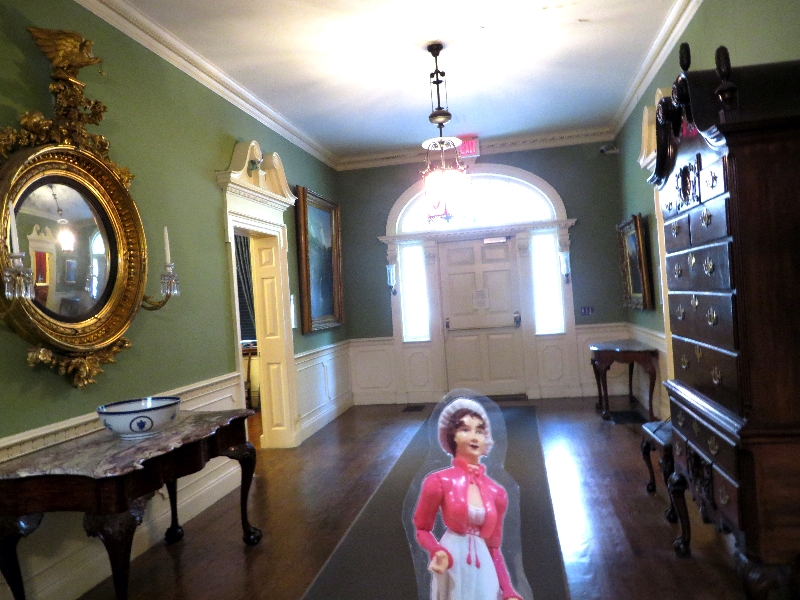
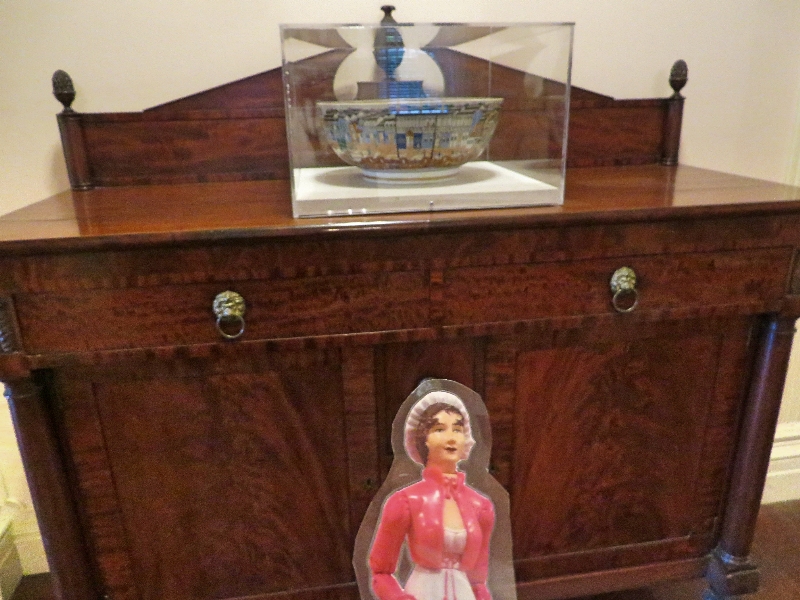
Editor's note: Apologies for any offensive images and scenes from 18th and 19th-centry life. I am attempting to try to accurately depict what Jane Austen might have seen if she had been a famous author travelling in America. All items on display at the Rhode Island School of Design Museum Charles Pendelton House.
I have been given leave to sketch some American homes for you. American homes are much more primitive than our noblemen's' seats or gentry class country homes yet larger than our London townhouses. The main difference as far as I can tell is Americans enjoy conspicuous displays of wealth.
They place their prized objects on display and proudly share what price they may have paid for it, as if bargain hunting were a competitive sport. They lack the inherited possessions and land of our gentry.
Perhaps one day they will pass their teapots and such on to their children. Will the popular designs of today one day be out of fashion and the tea sets and things thrown away? Or will they one day end up in a museum?
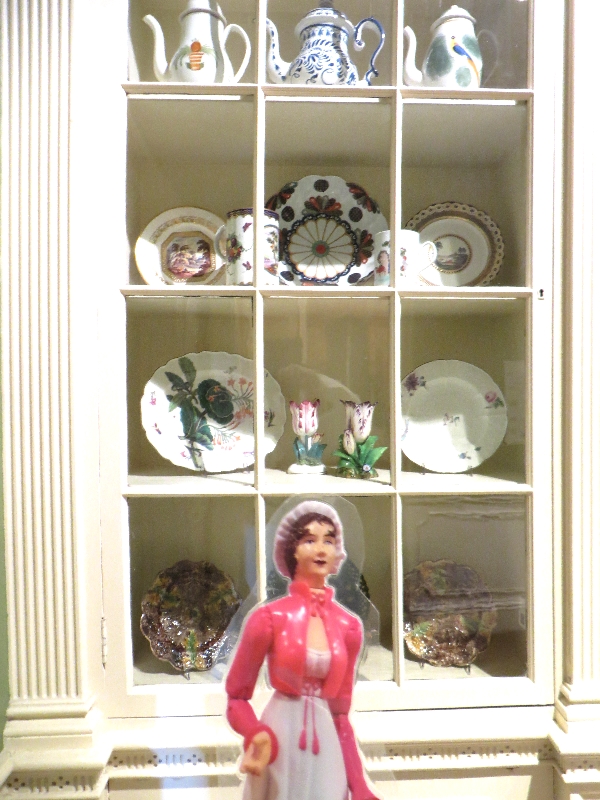
Inside, the Allins, the Doors, the Browns and others display their China prominently. There is porcelain from Germany and China, earthenware and transferware from England and Mexico; Chinese export coffee sets, chocolate sets.
These Americans seem to collect multiple tea sets. I am uncertain whether all of these serve a function or are purely decorative. Imagine having THAT great wealth to only display a tea service? That is America for you. They seem to do everything in spades here.
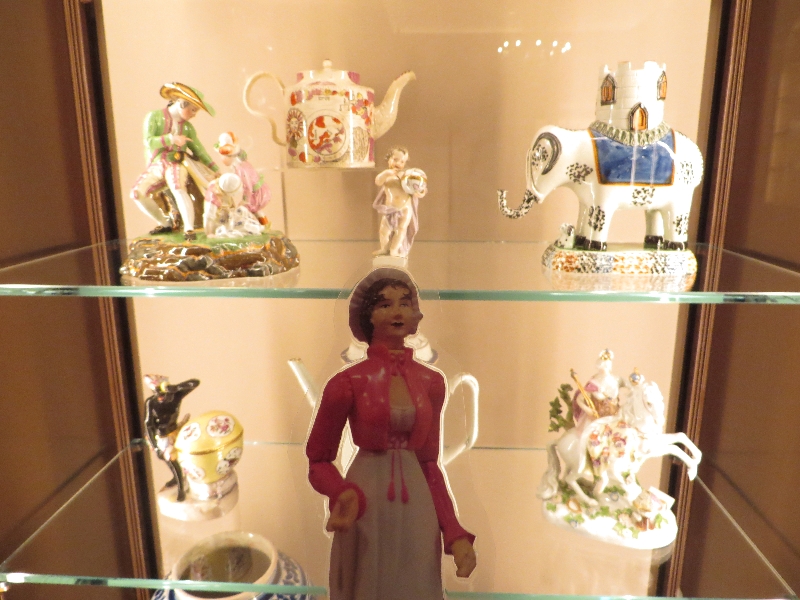 |
Johann Peter Melchior, modeler Map Seller and Two Children, ca. 1775; Creamware Teapot, 1770-1782 Earthenware with transfer print and glaze; Figure of man holding a globe; Pratt Ware Money Box in the collections of the Rhode Island School of Design Museum |
What charming figurines from Germany, a lovely creamware teapot from England and a good old English Prattware money box. The teapot has quite a unique design. It depicts the goddess Juno on the reverse.
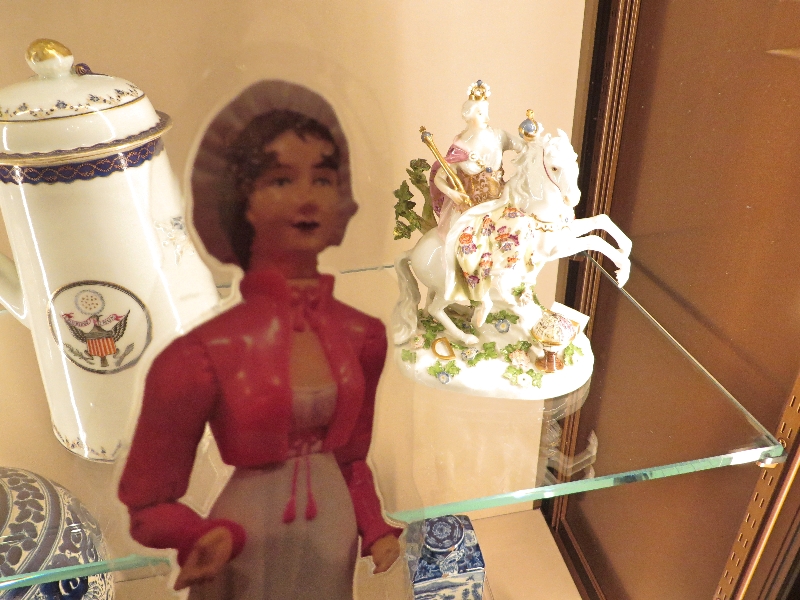 |
| Coffee pot, Chinese 1800; Europa on a Horse, 1745-1747, |
The coffee pot is very American yet made in China in the year 1800! I hear the Chinese are making objects for export now.
This German figurine of a lady on a horse depicts the story of Europa, consort of Zeus.
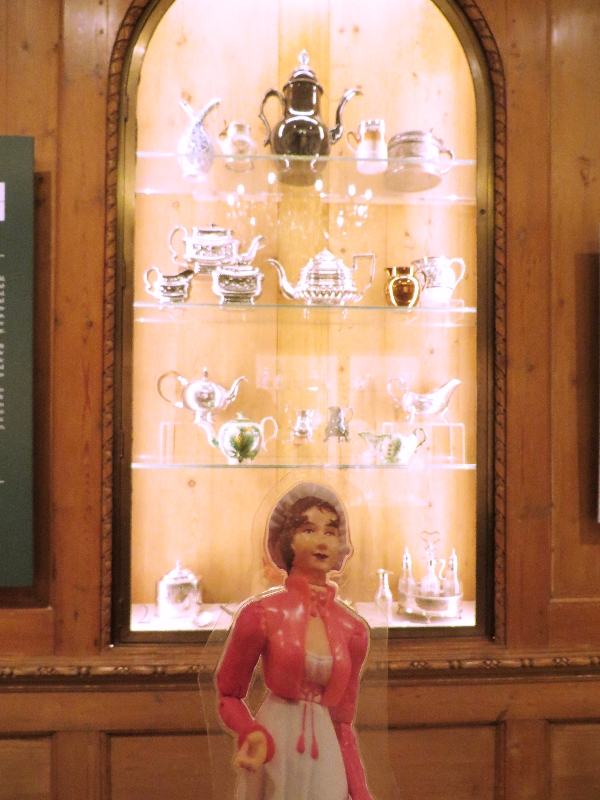 |
| from the collections of the Rhode Island School of Design Museum |
Many many teapots of all shapes, sizes and designs! The silver object on the top shelf above is a Dutch double necked vessel from the 1600s. Next to it is a stoneware and gilded silver mug from 1520-1550! For some reason, the family still displays an English coffeepot of earthenware made in the 1760s. This family also displays an English mug (1708) and German tankard (1650-1700) on the top shelf. The rest of the objects in the middle are good English pieces from different tea sets made in the middle of the last century. Finally, the bottom shelf showcases 18th-century English, Dutch and German silverware.
Now we get to the fine Chinese export porcelain.
 |
Batavia ware vase and bowl with cover c. 1740, Chinese;
pot, silver and ivory, Indian, 1800s; Batavia ware teacup and saucer, ca. 1720 and Batavia ware bowl
ca. 1740; Chinese for export in the collections of the Rhode Island School of Design Museum |
This bird design is quite nice. Susanna rather likes the little robins.
I saw such an unusual teapot shaped in the form of a pineapple. Though it is English, I do not recall ever seeing such a thing.
 |
Teapot in the shape of a pineapple, 1750-1770; This teapot's form underscores England's interest in and commercial connections to Eastern cultures. The pineapple was a costly import to Europe, and in social settings signified gracious hospitality and worldly knowledge.
To the right, a figurine by Johann Joachim Kändler, modelerThe Cherry Pickers, 1753 - 1765 |
An unusual and eclectic display of objects, both European and American.
object number 22.217; creamware custard cup with cover ca. 1780, earthenware with glaze, object number 24.512; Johann Wilhelm Lanz, German, Man Breaking Eggs, ca. 1757-1759, object number 55.181.1; Meissen, Adam Friedrich von Löwenfinck, 1714 - 1754, German, designer, Ice Cream Pail, 1727-1736, object 2020.09
In the middle we have marine ivory pie crimpers or jagging wheels. These objects reflect New England's maritime culture. Next to that is displayed a rather terrifying ice cream pail and a sweet little custard cup.
 |
| cup with cover Chinese for export ca. 1800 2014.4; Jasperware custard cup with cover, ca. 1800, 2002.59.9 |
I find implements for serving a fine dinner proudly on display.
Is that a GOOSE tureen? I see they also have a more traditional Wedgewood tureen.  |
Chinese export Goose Tureen and Cover, ca. 1760-1780, object number 2017.74.30ab; Josiah Wedgewood & Sons tureen with cover and stand, 1805-1815 (center object), object number 40.187; |
In this case, the Americans display implements for preparing and drinking beverages of alcohol. Rum made in Rhode Island is a major export, traded for African slaves who are sent to the West Indies to harvest the sugar cane to make molasses.
These tea seats are quite unusual.
and 04.202;
Teapot, Chinese intended for the Thai market, 1800s, object number 2004.12.15;
Samovar, Persian, brass and wood, 1800s, object 67.397ac; South American drinking straw with filter (bombilla) 1800s, objects 40.017.326, 1989.045.12.502, 1989 045.12.30;
mate cup with bombilla, 1800s, South American, silver, object 13.1504; far left on second shelf is
Mochaware teapot, English, late 1700s/early 1800s, object 29.187; next shelf: [1800s and 1600s Japanese tea paraphernalia and water jar. Jane wouldn't know about Japan.]; Fourth shelf: Tortoiseshell ware teapot
, and saucer, English, ca. 1750-1765, object 64.227; Agate ware teapot, English, ca. 1745; Meissen teapot, German,1735-1737, object 17.090.02Is that... a teapot? In the shape of a squirrel?! Squirrels represent industriousness and hard work. Mr. John Brown was quite fond of them and even had wallpaper made up depicting squirrels.
Please turn the page