Showing posts with label American furniture. Show all posts

Sunday, July 17, 2022

Flat Jane Austen in Providence, Rhode Island


Flat Jane Austen in Providence, Rhode Island:
In which Jane pays calls on the elite


Editor's Note: All photos taken inside the Rhode Island School of Design Museum's Pendelton House. Not all these objects belonged to one family or were displayed at the same time. The furniture in this room is in the neoclassical style built between 1785-1845. All pieces are by Rhode Island cabinetmakers.


My dearest friends,
Are you still reading? 

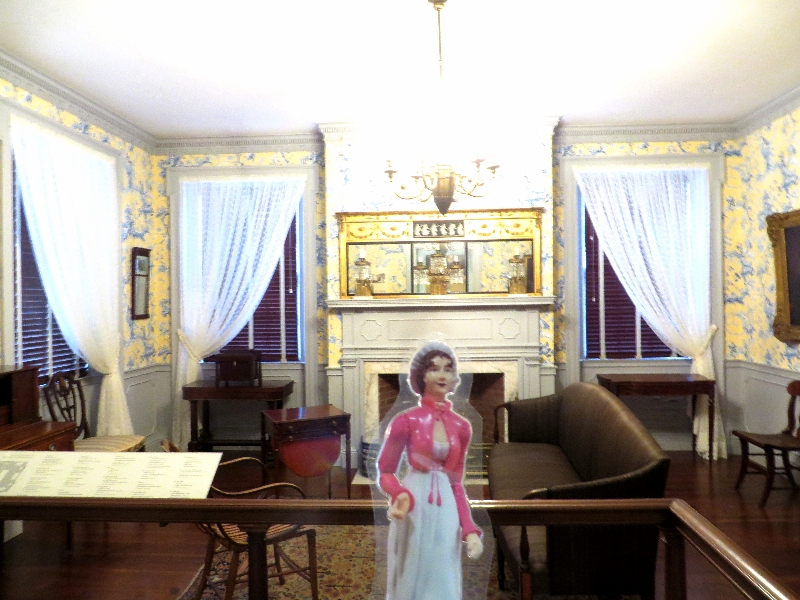
Neoclassical 18th/early 19th-century room


This is the home of Rev. Stephen Gano. He is quite elderly and their home is furnished in the Neoclassical style of the last century. Dr. Gano is a medical man, a Baptist minister and a freemason. Rumor has it his wife left him believing that as a Freemason, whatever that may be, he was a worshipper of the devil! 

His first wife left her mark on the home. Mrs. Allin, the girls and I sit in the ladies' sitting room and work. Behind me you see the sewing table. We do some tambour work while the men discuss theology in Dr. Gano's study. Back in '98 this type of work was new and fashionable, causing a young lady to declare it was "the handsomest thing of the kind" she "ever saw." The table was made by Simeon Hazard of Newport.

The armchair, made in the year '08 in Boston, features a new type of technology. The maker, Samuel Gregg of Boston, calls it "elastic". The chair features a bentwood seat and arms. 'Tis quite comfortable. 
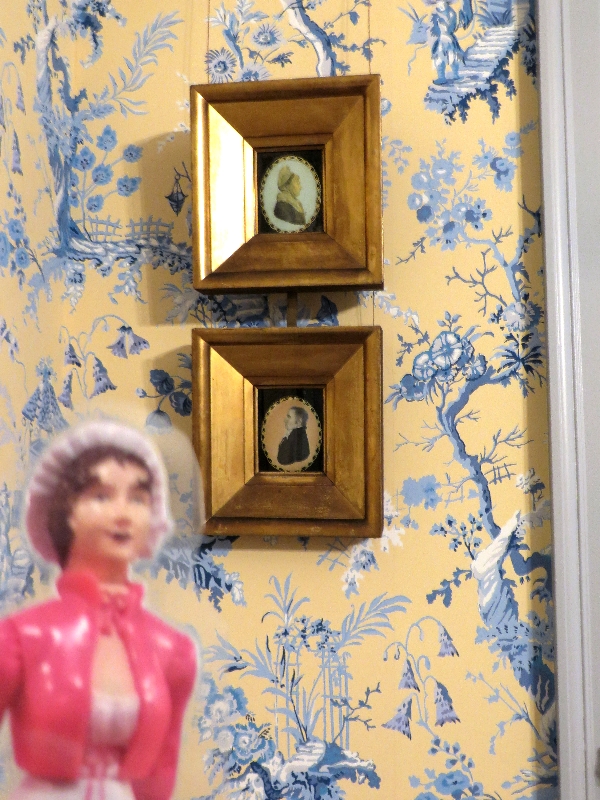

Rev. Stephen and Mary Brown Gano c. 1820; oil and pencil mounted on panel

Dr. Gano's desk-and-bookcase was made here in town (Providence) in 1785 by John Carlile, Jr. Dr. Gano purchased this new from the cabinetmaker, one of his first pieces. Providence has overtaken Newport as leader of manufacturing and trade.
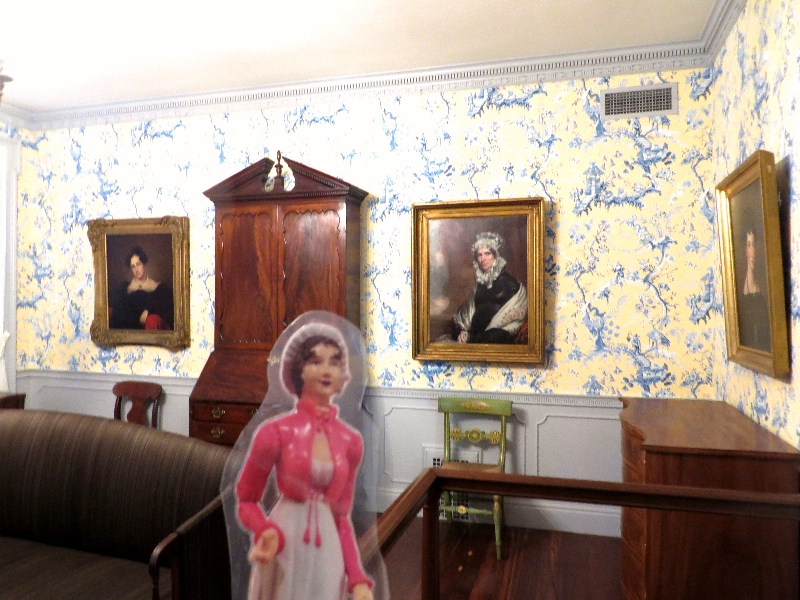
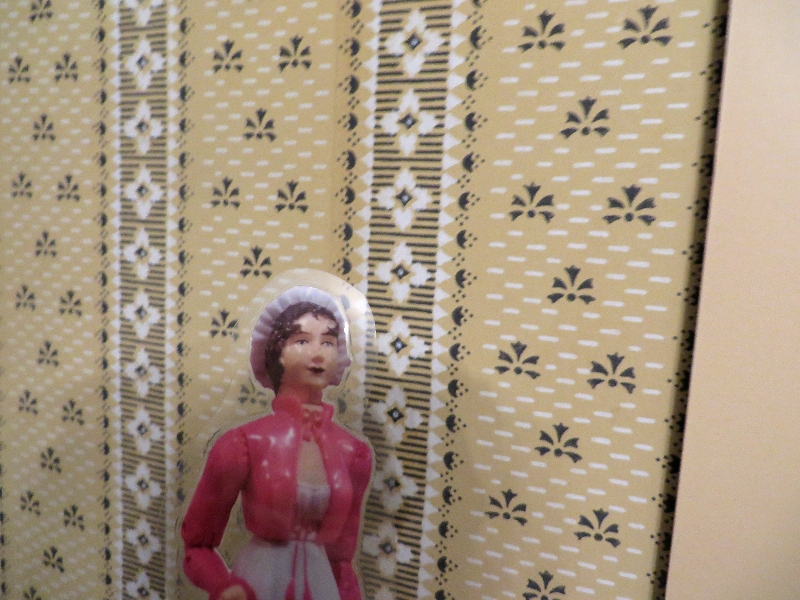
The wallpaper is a French pattern in Chinese taste. Quite surprising for a clergyman. 

Other rooms in the house are not so elegant. Dr. Gano's first wife, Mary, was the daughter of Joseph Brown. She brought with her many family pieces, antiques from the colonial period of the 17th-century.
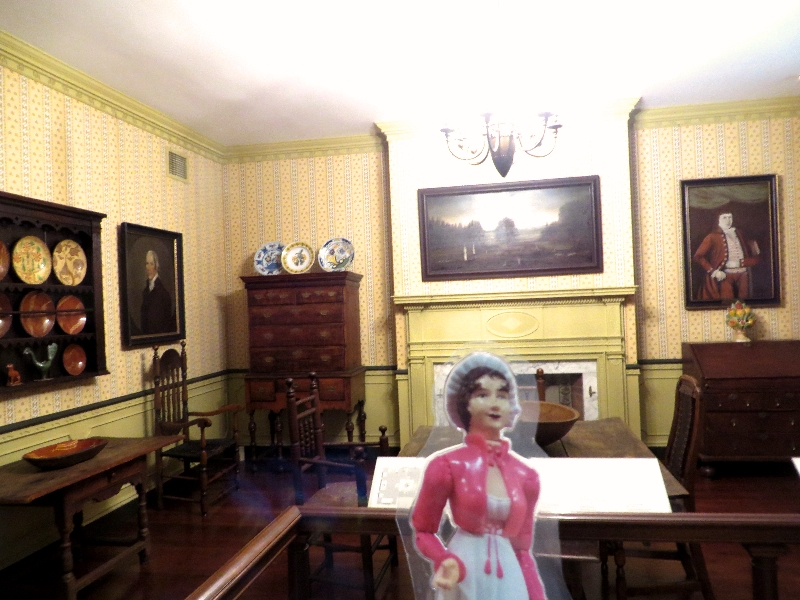
chest with drawer 1710-1740; ceramics from Pennsylvania and New England made from lead-glazed earthenware ca. 1800-1840 

Editor's note: The 17th-century objects were collected in the early 20th-century during a period of renewed interest in New England history and craftsmanship. The objects also reflect an increasing awareness of folk cultures and objects made by European craftsmen in America. Some collectors collected uniquely American art, folk art, made by people without formal training. 

My nieces would say this dining room is positively Gothic! The wallpaper is from the last century at least, while many of the objects are much older.
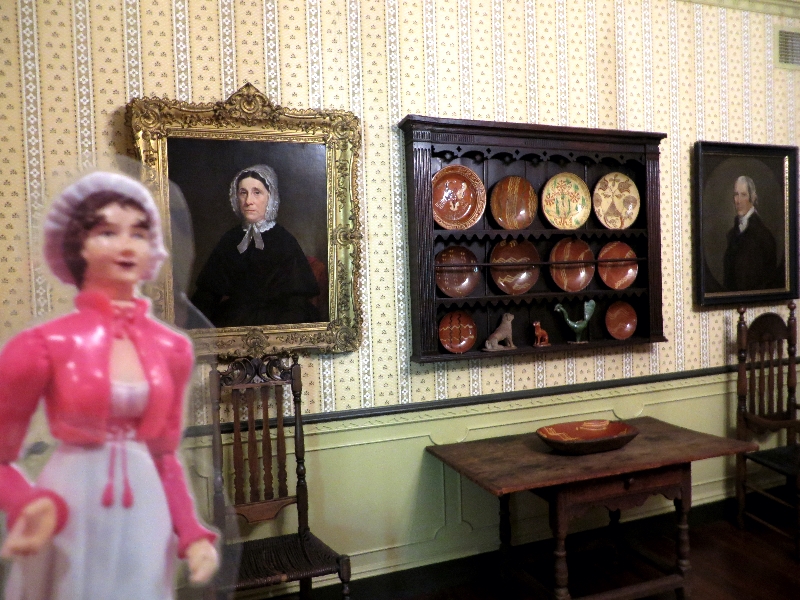
William Jennys, Portrait of Mrs. Israel Ashley ca. 1800; armchair 1730-1800; 18th-19th c. American ceramics; Portrait of Israel Ashley ca. 1800


18th century reproduction New England wallpaper

The kitchen is such I have never encountered before now.
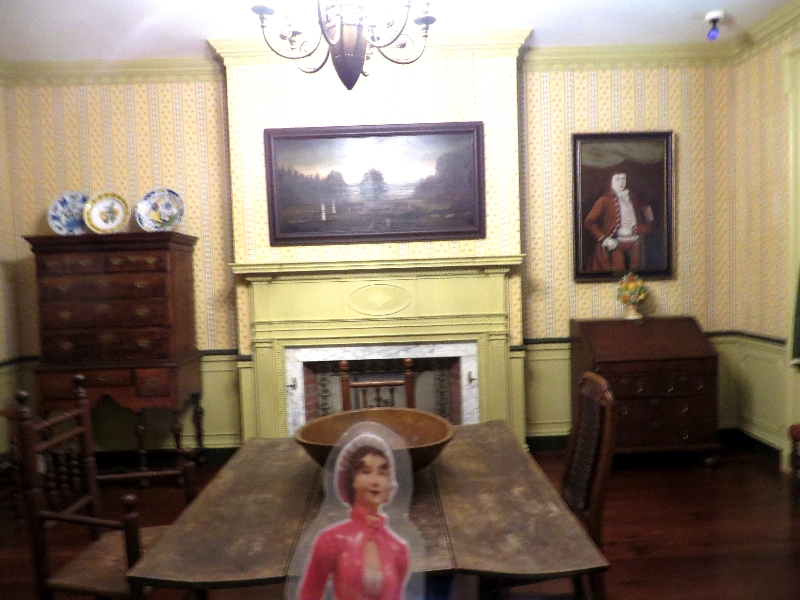
Rufus Hathaway, portrait of Seth Winsor ca. 1798; drop leaf table 1700-1735; bowl 19th c.; 
Great (Arm) chair ca. 1660-1720


Dr. Gano's study features the same wallpaper and period furnishings.
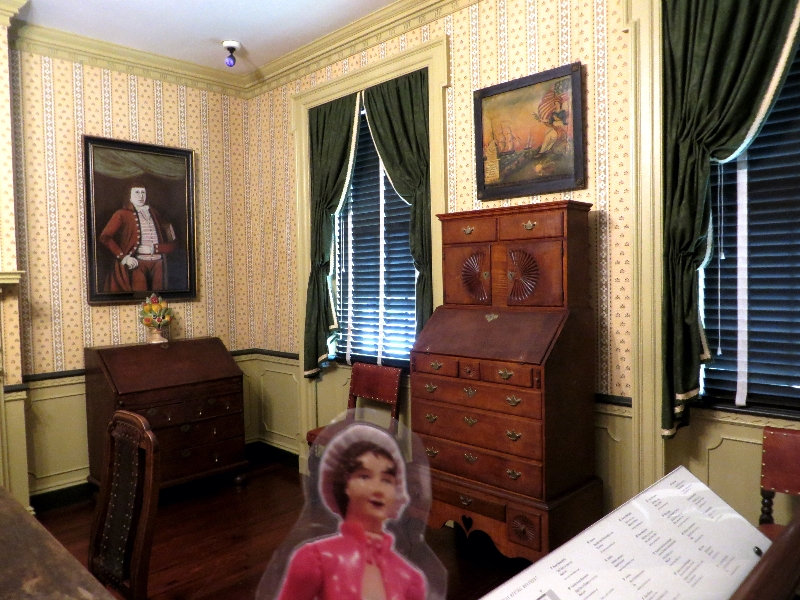
painted chalkware ornament of fruit and flowers 19th c.; desk ca. 1740; sidechair 1660-1700;
desk on stand ca. 1900

These colonial upstarts are quite proud and firmly believe they beat us in the late wars. They proudly show off their patriotism in their homes.
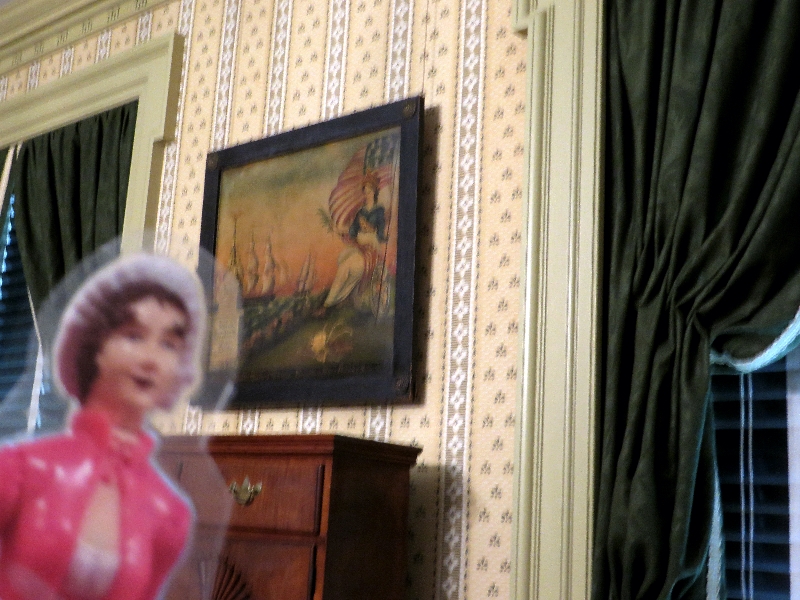
Emblem of the United States of America ca. 1800

Thus concludes my visits with the neighbors. I have a few other places of note to show you soon. 

Yours,
Jane

Flat Jane in Providence, Rhode Island


Flat Jane Austen in Providence, Rhode Island:
In which Jane pays calls on the elite


Editor's Note: All photos taken inside the Rhode Island School of Design Museum's Pendelton House. Not all these objects belonged to one family or were displayed at the same time. The objects in this room reflect the wealth of Rhode Islanders engaged in the China trade (between 1787-1840s). Funds from imported teas and silks helped build and furnish the elaborate homes in the neighborhood. 

"Here is the home of Mr. Sullivan Dorr and family- more China Trade wealth and another recent addition to the neighborhood. 


Built in '09, this is the most elaborate home in the neighborhood, boasting three stories, a service ell set back from the façade, and connected servants’ quarters and barn. The architect, Mr. John Holden Greene, built the home on the hill, turned the house to the side and developed terraces up the hill. It features Gothick trim on the front porch and just below the roofline. 

Mrs. Lydia Dorr was at home today so we stopped in to pay calls. Mrs. Dorr is a delightful lady. We spent considerable time viewing her China wares and passing a comfortable coze in her sitting room. 

The wallpaper is fashionable but French. 

French wallpaper ca. 1795


American furniture. Tall clock, 1816, William Stanton, Providence, 1816


Mrs. Door is delightful. An intelligent and charming woman of early middle years (34 in 1816). Her husband spent many years in China.


Lydia Door by Edward Green Malbone, unfinished, 1803
Federal mantlepiece, 1804, from the home of John H. Mason, Westminster St., Providence
removed in 1906

Lydia, as she has given me leave to call her, has had a remarkable and difficult life. She and her sister Candace were left to raise their little brothers after the deaths of their parents. She married in '04 and now there is also a hopeful Dorr family. The eldest, Thomas Wilson (currently a schoolboy of 11) is a bit rebellious. There are five younger children. Gossip has it that Mr. Sullivan Dorr is not good to his wife. 

I was tired from all this toing and froing and paying calls. Mrs. Allen was so kind as to allow me to rest.

Edward Carrington's bed with bed hangings and window curtains modeled after the interior photos of Edward Carrington's home. The bed was likely made in Boston in 1810 and is unusual for its ivory hardware.


Upon arising I admire my reflection in the glass and fix my cap.

Dressing bureau, Providence, featuring ivory; Dressing glass ca. 1800, Providence


Mr. Sullivan Dorr was engaged in the fur trade business early in life. At the age of 20 he went to Canton China to work for his brothers. He was one of the first Americans to live there for an extended time. He stayed there until 1803 when he returned and settled in Providence. Currently he is engaged in mercantile pursuits.

We drink tea from a Cantonese tea pot.

Settee, Chinese for export, early 19th c,. Asian hardwood and cane; porcelain tea and coffee service ca. 1790-1800

Please turn the page

Flat Jane Austen in Providence, Rhode Island

Flat Jane Austen Visits Providence, Rhode Island:
In which She Pays Calls on the Elite


Editor's Note: All photos taken inside the Rhode Island School of Design Museum's Pendelton House. Not all these objects belonged to one family or were displayed at the same time. 

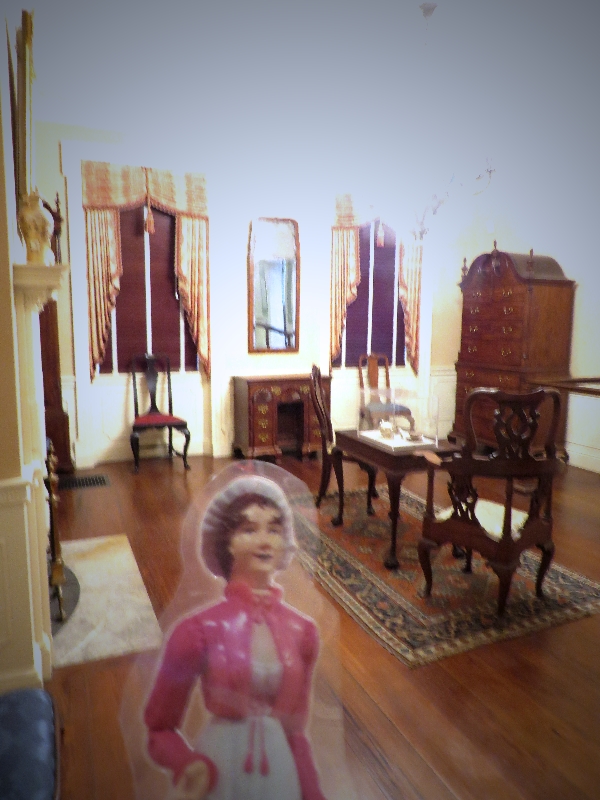
"On the way home the following day, we stop to call on another farm family in Providence. We call on Mrs. Prudence Dexter, a widow [ed: actually died July 1815, age 55 years], with five daughters and three sons. Her late husband, Mr. Jeremiah Dexter, was a farmer and "natural bone setter." The property originally belonged to Mr. Dexter's ancestor, Mr. Gregory Dexter, a printer and friend of Mr. Roger Williams.

This property is famous because the French army, led by General Comte de Rochambeau, camped here in 1782 during the War for American Independence on their return from Virginia. They stayed eight weeks while awaiting transportation back to France.

A monument marking the spot where the French encampment once stood

This bed looks quite comfortable. It fits me as Mr. Dexter was over six feet in height. The bed hangings are simple, yet elegant. Miss Anna Dexter, six-and-twenty years of age, made them just last year. 


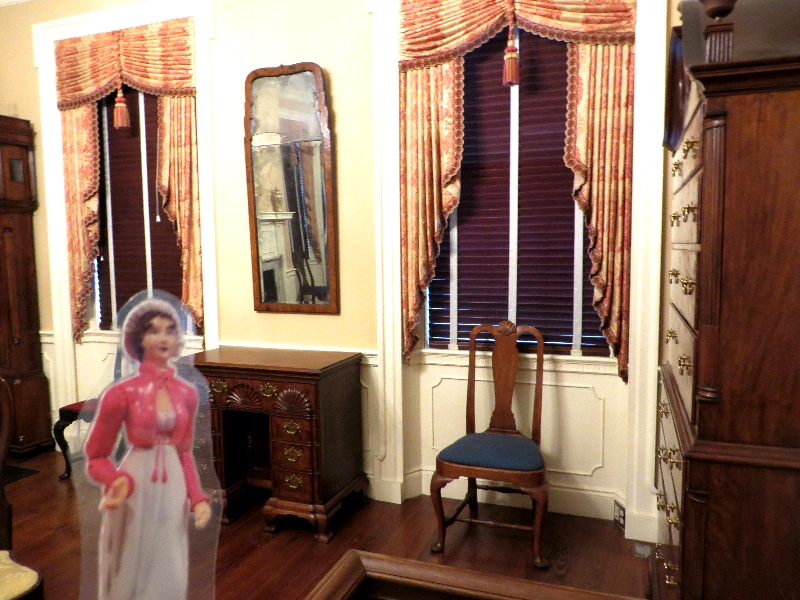
The fabric used for the room curtains is an adaptation of Indian palampore of the last century.

The tall chest of drawers has been handed down in the family since the house was built in 1754. I suspect they store extra linens inside.


The upholstered easy chair is a popular bedroom item. Used for entertaining guests, the wings of the chair retain the warmth of the fire and cradle the head of the sitter. Such chairs are costly, so the Americans say.


The Dexters also own shield back chairs with carved arms and swags in the Neoclassical style. 'Tis amazing how farmers can be so fashionable. This design is especially popular here in Providence and the chairs are made by cabinetmaker John Carlisle, Jr.

John Brewster, American, 1766-1854, Portrait of a Young Girl, 
c. 1801-1821, collections of the Rhode Island School of Design Museum

This portrait must be the youngest daughter of the family, Miss Freelove Dexter.

Much of the furniture is American, however the creamware obelisks (ca. 1790) and brass andirons (ca. 1760-80) are English and the pole screen is Irish. The mahogany Pembroke table is another example of Newport-made furniture.

We do not tarry long here and move on to call on one of the most grand families in the city.

Please turn the page

Flat Jane Austen in Providence, Rhode Island


Flat Jane Austen Visits Providence, Rhode Island:
In which she pays calls on the elite


Editor's Note: All photos taken inside the Rhode Island School of Design Museum's Pendelton House.

Not all these objects belonged to one family or were displayed at the same time. This room is set up to showcase furniture made in Newport by the Townsend and Goddard workshops. Several generations of craftsmen, related by marriage, created a distinctive furniture design with carved shells on projecting and receding panels. The mahogany desk and bookcase is one of 9 known to exist. Each one is unique, coming from a different cabinet making shop.


"This is the home of the Potter family. We had to travel a great distance to the southern part of the state to a town called South Kingston in the country. The Potters are what I know as gentry or large land owners in spite of the family fortune coming from trade. They are quite influential in their town, being involved in business, politics, and the criminal justice system. Mr. Elisha Reynolds Potter, the patriarch, was a blacksmith and farmer turned lawyer and statesman. He has served in the Rhode Island House of Representatives for several terms now (1796-1797, 1809-1815). Mrs. Potter is his second wife. She has small children including six year old Elisha, Jr. and one two-year-old Thomas Mawney. There is also a new baby, I believe it is another boy. 

American made furniture of the 18th-century


The large chest on chest is attributed to Mr. John Townsend. This was one of the most costly pieces of furniture in the previous century.

The desk-and-bookcase was acquired recently, in 1813 and constructed by Mr. John Goddard in 1761. 

The roundabout chair was designed for gentlemen to turn from side to side without moving the chair.


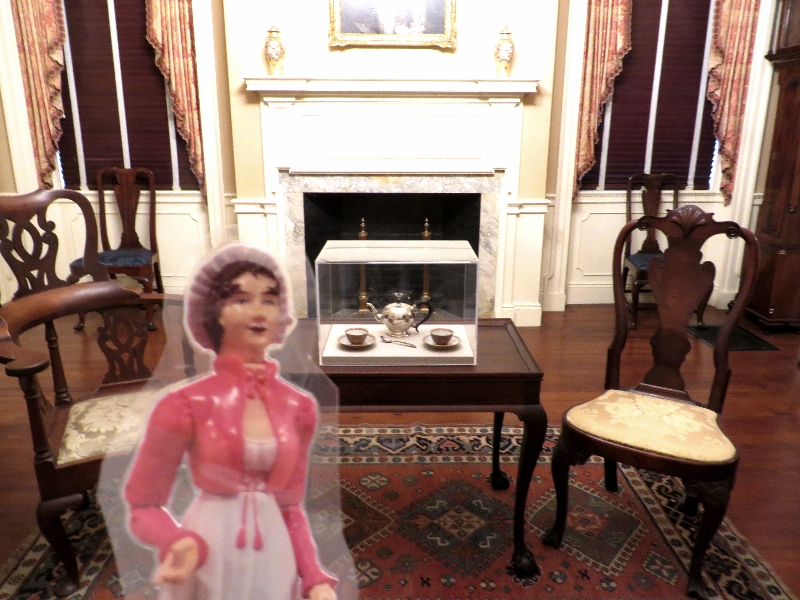
Here is a small desk in the form of a dressing table.


The side chairs were made in Newport as well (or perhaps Boston). The carved shell design is especially popular here in New England. 

silver and wood teapot,  American, ca. 1735


The curtains are at least English printed and quite new! (1815-1820).

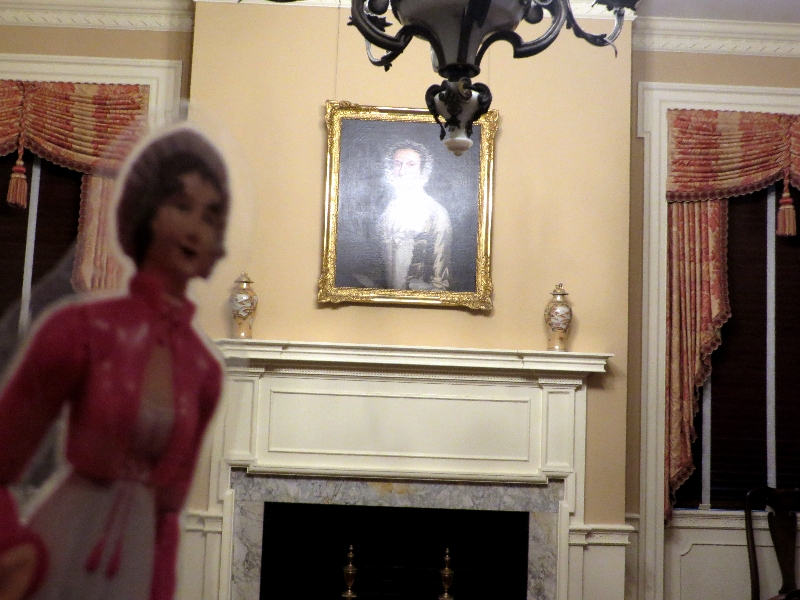
The Americans lack portrait galleries in their homes and are proud to display family portraits and other portraits around the house. Here is an ancestress of the last century.


John Wollaston, American, Mrs. Ebenezer Pemberton, ca. 1750


Please turn the page

Flat Jane Austen in Providence, Rhode Island

  Flat Jane Austen Visits Providence, Rhode Island:
In which she pays calls on the elite


Editor's Note: All photos taken inside the Rhode Island School of Design Museum's Pendelton House.

Not all these objects belonged to one family or were displayed at the same time. This room is set up to resemble the donor's library c. 1900. The Rococo furniture is period but window cornices, chandelier, overmantel mirror and settee date to 1900.


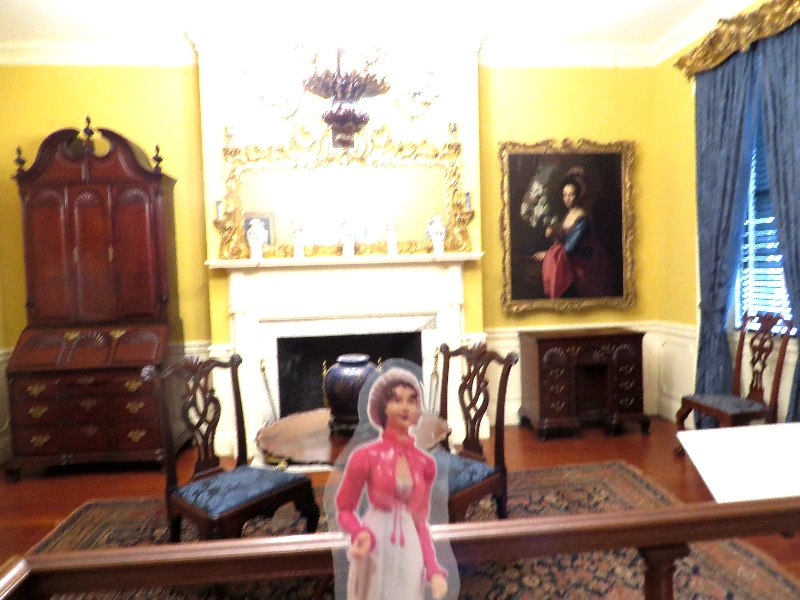
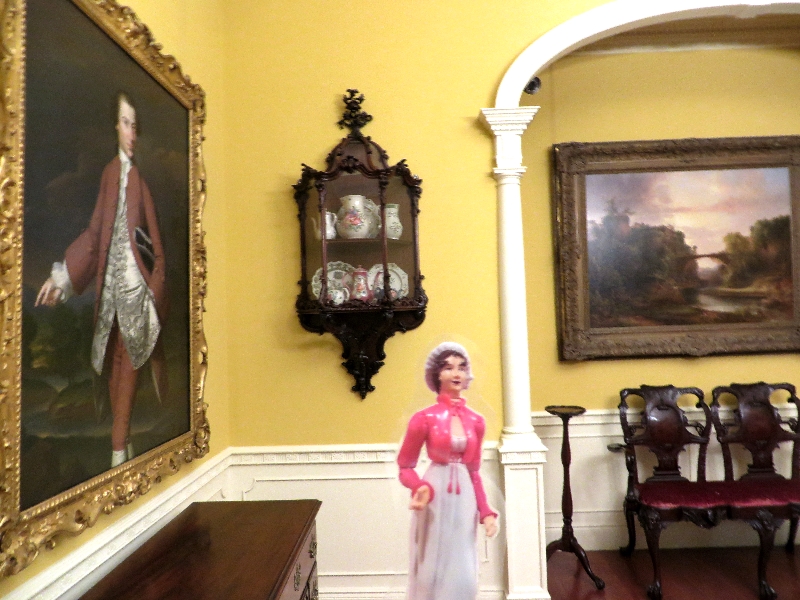
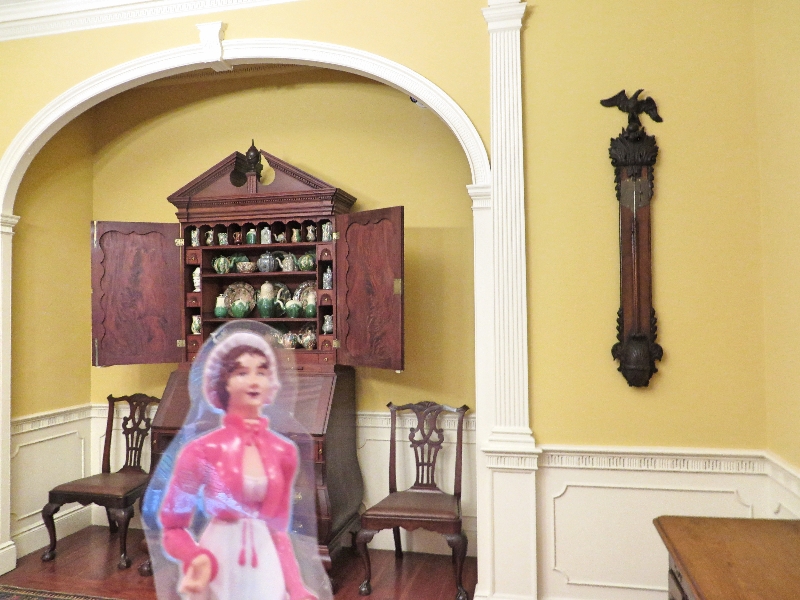
"Mr. Allin's library is furnished in the older Rococo style. The solid color walls and Oriental carpet mark this room as older in style, from the last century. 

 I see much furniture but no books! Most of the furniture is American made from the last century. The desk and bookcase was made in Newport, a city in the southern end of the state on the ocean. Mr. John Goddard built the case from mahogany, cedar, yellow poplar and pine. 

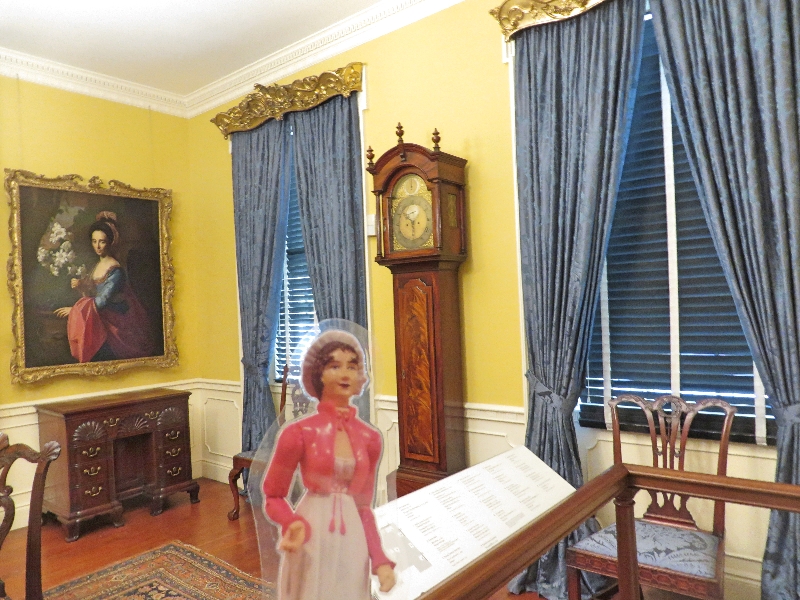
The bureau table and tall clock come from Newport as well. Some of the other furniture comes from Philadelphia. Newport and Philadelphia seem to have been centers of Chippendale style furniture making.

ignore the 1850s valances and look at the portrait of Sarah Prince Gill 
1764 by John Singleton Copley

Somehow Mr. Allin has managed to acquire some American portraits as well. Some are by John Singleton Copley. I have heard of him! He lived in London, near Henry and died but a year or so ago.

John Singleton Copley, Governor Moses Gill, 1764

This room also features some Chinese export porcelain! 
The barometer comes from Holland. What a peculiar mix of styles!

Please turn the page...