Friday, May 27, 2022

Flat Jane Austen in Providence

 Flat Jane Austen in Providence:
In which Jane learns something about the history of this town

"Oh brave new world. That has such people in it!" ~ Shakespeare, The Tempest; Act V, Scene I


May 16, 18__

My dearest friends,
Please excuse my long absence. I have been quite busy learning about this wondrous strange land of merchants, rebels and rogues. It seems that in the primitive backwater that is America, girls are educated to become bluestockings and on this visit I am becoming shockingly blue! Shall you recognize me when I return home? I take a trip with my host to visit an historian who regales me with tales of the early history of this fair city. 
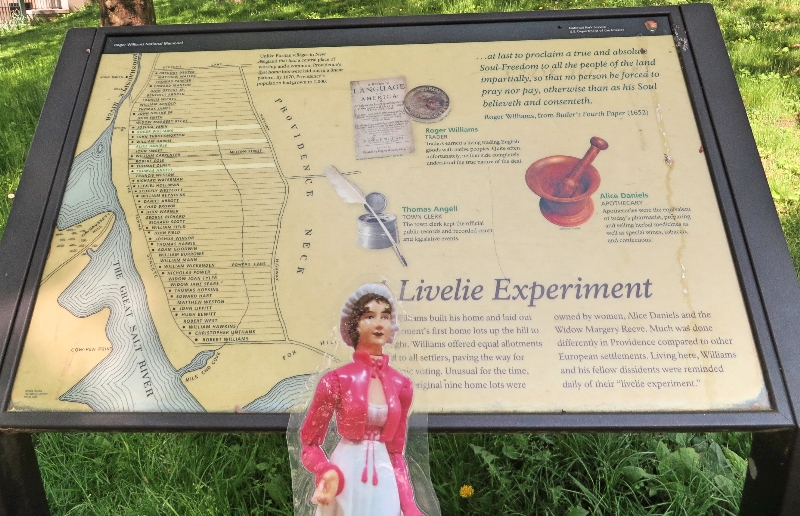
I learn about "livelie experiment" known as Providence and how it influenced American government.


This colony, state  (I am shockingly forgetful of the independence of the American colonies), Rhode Island and Providence Plantations (plantations being the word for estate or large farm) was founded by an English lawyer, minister and freethinker in 1636. Like my father, Mr. Williams was ordained as a minister in the established church. Unlike my father Mr. Williams became disaffected with the Church of England and allied himself with those detestable Puritans. In 1630 he joined the Puritans in Massachusetts. Not being satisfied with their firm commitment to their "purity", he migrated from Boston to another town called Salem. While in Salem, he preached separatist ideas about the state being completely separate from the church. Mr. Williams also suggested the land was not freely given by the King but belonged to the Indians and as such they should rewarded. 

"Williams fled to the colonies to escape religious persecution and imprisonment. Along with other Puritans, his goal was to practice a Christian worship more “pure” than the Church of England’s. The Puritans settled land gifted by the King, even though Native people had lived there for thousands of years. Williams asserted that the Native people should be compensated for their land while many Puritans believed that the deaths of Native people from European diseases indicated God's favor toward Christian settlement."

Mr. Williams believed that the first four of the Ten Commandments are matters of individual conscience and should not be enforced as laws by the government. In October of 1635, Mr. Williams was charged with "new and dangerous opinions against the authority of the magistrates." I should think so! The Puritan government banished Mr. Williams from Massachusetts Bay Colony.

After trying to settle in Plymouth Colony, across the Seekonk River, near where Susanna's mother resided in childhood, Mr. Williams spent a winter with the Wampanoag Indians learning their language.

"From his 1631 arrival in Boston, Williams infuriated local leaders with his dissent. They eventually exiled him for his dangerous ideas. He believed government lacked authority to enforce the first four of the Ten Commandments, the ones between an individual and God. His 1635 exile to England would likely have meant imprisonment or death. Williams escaped into the harsh New England winter and, only with the help of the Native people, survived to the spring."


He became a trader, trading sundries with the local Indians and in spring rowed across the river to Narragansett Indian territory. Mr. Williams negotiated a land deal with the chieftains (their word is "sachem") Cononicus and Miantonomo. The Narragansett could come and take whichever English goods they wished.

"The Royal Charter of 1663, granted by King Charles II, declared the entire colony of Rhode Island and Providence Plantations a “livelie experiment” where no person could be punished for what he or she believed. Settlers enjoyed freedoms and rights unknown in other colonies."


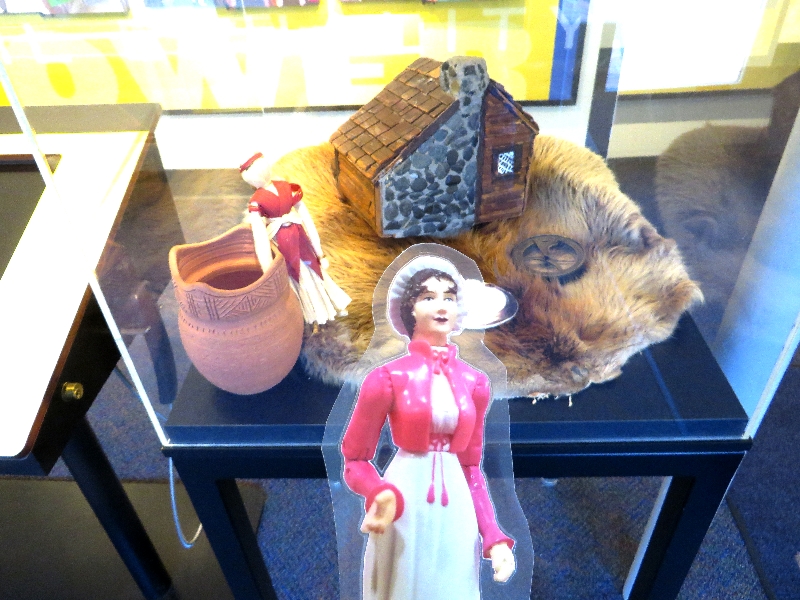
Some trade goods: pots, toys, furs and a house with
a giant stone chimney at one end. 


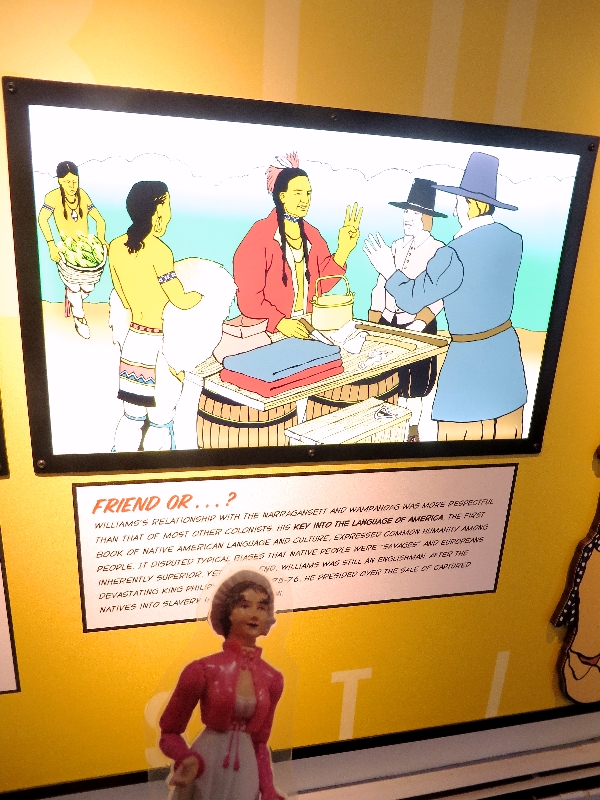
Mr. Williams treated the Indians with more respected than most Englishmen. He even wrote a book about their language and culture. He believed the Indians were NOT savages as most believe and tried to find common humanity among people. He thought, perhaps the Indians were of Jewish descent, one of the Seven Lost Tribes of Israel and as such, should be treated as humans worthy of salvation. All right... this I can understand.

The system of government was quite different from anywhere else, not having a formal charter (more on that later) or settled form of government.  Once a fortnight the heads of households, men AND women, gathered to consider issue. All decisions supported by the majority were binding in civil matters. The government never collected taxes to support the church and matters of religion were left up to individual conscience. Thus this colony became a haven for those seeking "soul liberty". 

Roger Williams carried this compass and sundial to help find his way both literally and spiritually.


Editor's Note: Jane wishes to acknowledge her visit took place on the ancestral homelands of the Narragansett Indians, who are still here. Jane is indebted to The Roger Williams National Memorial, (run by the National Park Service) website and visitor's center "New and Dangerous Opinions" exhibit for her education. 

Was this "livelie experiment" a failure or success?


Roger Williams National Memorial "New and Dangerous Opinions"
National Park Service, Providence, Rhode Island


Today we are grappling with the legacy of our hero. Roger Williams believed in compensating the natives for their land and wrote a book, Key into the Language of America, the first book of Native American language and culture, in which he expressed common humanity among people. He argued against the prevailing belief Native people were “savages” and Europeans inherently superior. 

Roger's ideas of civil equality, government by the people, and separation of church and state influenced Thomas Jefferson and the framers of the United States Constitution. The Bill of Rights is inspired by Roger Williams's beliefs. The government of the United States is supposed to derive authority from the people with the Constitution guaranteeing each person be free to follow his or her own conscience, regardless of religious belief.

However, following the catastrophic King Philip’s War of 1675–76, the Natives attempt to reclaim their land, Roger presided over the sale of captured Natives into slavery in the Caribbean.

There are many questions to consider. Was he a good guy, a bad guy or an Englishman of his time and place In 2020 Rhode Islanders voted to remove "Plantations" from the state name given the connotations it brings to mind of enslavement.

Sunday, May 22, 2022

Flat Jane Austen Arrives in Providence, Rhode Island

 Flat Jane Austen Arrives in Providence, Rhode Island


4 May 1816

My dearest friends,

I survived the Atlantic crossing and have arrived in Providence, the capital city in the colony, I mean the state, of Rhode Island, which is on the east coast, near the Boston harbor where the mad colonists dumped tea in the river! 

Providence is still a small rural village but growing larger and larger. Susanna promises to show me around as we call on the neighbors. 


Providence from Across the Cove. Oil on canvas by Alvin Fisher, 1818. RIHS 1905.2.1


Here I can see the whole town from across the cove. (another view)


I am all astonishment to learn from my host that the incident in Boston was not the first act of treason against our dear King George. She tells me that I have arrived on a very special anniversary. On this day, 4 May, in 1776, the colony of Rhode Island renounced allegiance to the king! I must remember not to faint. The colonists then ran mad and a group of wealthy merchants who did not want to pay taxes, ran one of our British custom ships aground, tied up the captain and set the ship on fire! I daresay the gentlemen were drunk. This day is cause for a large celebration in Rhode Island. I shall call this place Rogue’s Island! I hear there are pirates abroad as well. Oh my!

Our first stop was to call on Susanna's neighbors to catch up on the gossip. Our first stop was to visit the wealthiest, most prominent family in town. This house was built by the late Mr. John Brown (1736-1803). 

 an 1882 photograph

Editor's Note: This is how Jane would have seen the house if she had visited in her lifetime. . 

Here is what you see today if you visit the museum. 19th-century additions include the area from the rear of the house extending to the former wood shed. Landscaped grounds were added in the early 20th century by Marsden J. Perry, a wealthy industrialist and banker who purchased the home from the Brown heirs.


Mr. Brown, a descendant of one of the first English colonists in Providence, was a wealthy merchant and not the good kind either. He and his three brothers owned ships that sailed 'round the world trading goods and bringing them to Providence. Miss Susanna declared he "had his finger in every pie."  This colony, Rhode Island, was known for making rum and the merchants, like Mr. Brown,  enlarged the port "India Point" ("Did he trade in muslins?" I ask? [ed.: not sure! I will try to ask his daughters if I see them again.]) Mr. Brown participated in the slave trade with his brothers and uncle even after it was illegal! His brothers left the trade after a disastrous voyage in which the slaves died and rebelled against their captors. It was much like the Zong case but without the same ending. Mr. Moses Brown, who became a Quaker (!) sued his brother Mr. John Brown to give up slaving. John Brown agreed to give up one of his ships. He also traded goods with China, participated in the burning of one of our good English Coast Guard ships, sold the American navy their first ship, founded a bank, speculated in land, owned a furnace that made canons to fight for American independence (both times) and served in the American Congress for two years and was treasurer of Rhode Island College/Brown University, named for his family, for one and twenty years.

Mr. Brown's nephew lives next door in the yellow house.

John Brown had this house built between [17]86-88. 'Twas the first mansion on the hill and Mr. Brown could see his ships coming into port.  


The house is said to be as fine as any in Europe, however, it would fit inside either of dear Edward's homes with room to spare. It is very grand and the American Presidents have been to stay.


I

Mr. Brown died on September 20, 1803 at the age of 67 of dropsy of the breast. [ed. note: congestive heart failure.]

Now his widow Mrs. Sarah Brown (age 65); unmarried son Mr. James Brown (43), widowed daughter, Mrs. Abigail Francis; grandson John Brown Francis (age 12); daughter Mrs. Sally Herreshoff (30); her husband Mr. Charles F. Herreshoff (a Prussian! Hooray!); their children Miss Anne Herrehoff (14), Miss Sarah Herreshoff (13), Master John Brown Herreshoff (11), Miss Agnes Herreshoff (9), and Master Charles Herreshoff (7) all live here now. 

The daughters are quite delightful, being well-educated, accomplished and prolific letter writers. Mrs. Herreshoff has an interest in astronomy and is an accomplished pianoforte player.


There is a small but beautiful garden on the side as well.


I still do not understand this island which is not an island of rogues and rebels! I must learn some more about this ship burning incident. Until then, I remain,

Yours,
Jane


editor's note: The gorgeous grounds were designed for late 19th-century businessman Marsden J. Perry who had purchased the home from the Brown heirs. The grounds were planted with dozens of elm trees which have since succumbed to disease. The RI Historical Society, who now owns the mansion, recycled the wood into bowls and other products to purchase in support of the historical society.

Editor's note:  Follow Miss Flat Susanna and 3D Susanna to see the inside and/or read these blog entries to learn more!

To see George Washington's visit look at the entry on August 18. 2015

Thursday, May 19, 2022

Flat Jane Austen Attends the Theater

 Dear friends,

On our last evening in Bath, we attended the Theater Royal to see a musical comedy. We could not procure a box for this date and we were forced to sit in the stalls! This musical production was set 100 years in the future. The principal character is a flower girl who wishes to speak like a lady in order to work in a flower shop. It is quite amusing and charming. The writers have predicted any number of changes to Society in the future; a future in which middle class and shabby genteel mix in London and flower sellers can read. Dust men, alas, are still quite vulgar. Miss Eliza Doolittle is elevated above her station and fit for neither selling flowers on the street or in a shop. Her tutor is quite indifferent to her predicament and treats her as if she were the same as his slippers. What will she do? She has a gentleman wishing to marry her, however, he is rather more like Mr. Collins than Mr. Darcy. Should she marry him anyway? I am uncertain of her fate. If you have leave to visit the theatre this twelvemonth, I recommend attending this production known as "My Fair Lady." It was quite enjoyable.


Yours, 
Jane

My Fair Lady


Editor's note: Lincoln Center's 2018 revival of My Fair Lady is touring across the United States in 2022. Jane attended a matinee at the Providence Performing Arts Center.


This theatre boasts a lovely chandelier!

What manner of organ is this? 

Editor's note: The original pipe organ was lost but today Flat Jane and theatergoers can enjoy music from a 1927 Wurlitzer organ boasting 5 keyboards, 21 ranks and percussion to accompany silent films.

'Tis St. Paul's painted on the screen! 

Editor's note: The Providence Performing Arts Center was built in 1928 as a Loews movie palace. It remained popular and successful through the Depression, however, it was damaged by hurricanes in 1938 and 1954. 

Read more about the theater's history and see archival photos at https://www.ppacri.org/about/ppac-history

Wednesday, May 18, 2022

Flat Jane Austen in ... Bath? (Or is it?) : A Stroll in Sydney Gardens Part 2

Flat Jane Austen in ... Bath? (Or is it?) : A Stroll in Sydney Gardens


My dearest friends,

My sojourn in Bath is coming to an end, finally. I took one last walk around Sydney Gardens. Yesterday, my uncle drove us to Stoneleigh Abbey to view the beautiful grounds there. The prospect was delightful. The River Avon runs by the estate as you know. The trees have erupted in the most splendid colors and I walked and admired them. A quiet walk contemplating Humphry Repton's grounds concluded our visit. I think I spied deer frolicking in the distance! I do not tell them they are destined for the dinner table come fall.

Yours, 
Jane


Such brilliant pinks! They match my favourite Spencer.


I wonder how old this tree is?
Would the poets compose a sonnet to its great age?


I can almost see a face in this tree!


My dear friends,
Such is life in Bath that I must stop at a shop to purchase flowers and vegetables to grace our table. Lord preserve me from this wretched city. I hope to move on soon to the country. First though, I have been invited by my new friend Miss Susanna Allin to visit her home in America! Imagine that! I believe I half looking forward to the journey across the sea to the land where savages dump tea in the ocean! It shall be a novel experience or quite amusing. Until then, I remain,
Yours,
Jane


Flat Jane Austen in Bath (or is it...?) : Part 2

Flat Jane Austen in ... Bath? (Or is it?) Part 2


Editor's note: Once again Providence stands in for Bath. Jane WILL visit Providence soon, I promise! For now, enjoy the pictures of the parks and trails and library in the more suburban part of Providence. Jane's letters have been transcribed for clarity by Flat Susanna's 3D counterpart. 

My dearest friends, 
Farmers must bring their produce to market. 'Tis early in the season greens and flowers. There are tempting buns and pastries tho'. Do they sell Bath buns? The farmers also sell meat, dairy, honey, jams, apothecary salves, lotions, and potions made in stillrooms and - oddly enough - biscuits for dogs. Pug Bertram would be most pleased.
Yours,
Jane


I see French pastries, German pastries and English bread


Dear friends,
I visited the apothecary for some herbs for a tisane as we haven't a garden here in Bath. 
Sincerely yours,
Jane
Farmacy Herbs, Providence, RI 

A lion guards the apothecary


My dearest friends,

Today I took a trip to the circulating library. Imagine my astonishment at seeing my own name in print! I wished for my name not to appear on my books. It looks as if someone has ignored my wishes. There also seem to be some books professing to be my journals! How can this be? I am perplexed.


Jane's own novels


Jane Austen mysteries by Stephanie Barron


Next day- The circulating library played host to a musical event. I listened to a band play what appears to be Jewish music. (Klezmer music). 'Tis different from our usual orchestras but not all together displeasing. I rather enjoyed it. However, the event promised a food wagon with Jewish deli food and another with sweet treats. No food was forthcoming. I had so looked forward to disordering my stomach with [cup]cake[s]. This was most displeasing. I chuckled to myself as I thought about what Lady Catherine would say. 

Yours, 

Jane

Library


 Yarmulkazi

editor's note: Yarmulkazi, based out of Brown University, performs European Jewish folk songs, both original songs and traditional. Food trucks were promised and not delivered. The originator of the food truck, the horse-drawn lunch wagon, was started in Providence in 1872.