Showing posts with label historic chocolate making. Show all posts

Friday, June 17, 2022

Flat Jane Austen in Rhode Island

 Flat Jane Austen in Rhode Island :
In Which She Learns of the Industrial Revolution


After our visit with Mr. Slater, we journey up the road to another nearby village. Susanna says Americans do drink tea but sometimes they drink chocolate. As I do enjoy a good cup of chocolate in the morning, I ask to visit the village of Chocolateville where I presume there is a chocolate mill.

Alas we find the chocolate mill is long gone and instead there sits another cotton mill.  We tour the site and learn more about the former chocolate mill and current textile mill.

Flat Jane and Flat Susanna learn about Chocolateville


Back in '82, a confectioner named William Wheat erected a mill to process cacao beans into chocolate. Like Mr. Slater, Mr. Wheat used the power of the Blackstone River to grind the beans. It only lasted two years before it fell into disuse.

We learn how the Jencks family owned this land. By the '70s it had been sold to a Mr. Charles Keene who hired Mr. Sylvanus Brown to build a stone and earthen dam across the Blackstone River below a bend in the river which would form a mill pond. Mr. Keene built a mill to manufacture scythes and other farm implements using water power much in the same way as Mr. Slater and Mr. Wilkinson use it in their mill today. The land along the river here in the neighborhood began to be used for industrial purposes. 

Flat Jane and Flat Susanna learn about the Sylvanus Brown dam


Not long after, Mr. Wheat erected his chocolate mill. In '84 Mr. Wheat sold off part of his land to Mr. Levi Hall, who turned part of the mill into a manufactory of leather goods. This structure was two storeys high, 20-30 feet in width. The mill was grievously injured in a flood in '07. The mill fell into disrepair and was known as the "Quail's Trap."


Mr. Wheat imported dried cacao from the West Indies. The mill roasted, winnowed and ground the beans into chocolate paste. Sugar and spices were added and the paste was then poured into molds to make the bars we scape for drinking or baking. Mr. Wheat's chocolate was consumed locally. He also produced chocolate for military rations as it has medicinal purposes. Some chocolate may have been sold as shipboard provisions.

Mr. Keene's widow, Mrs. Anne Keene, sold the land back to the Jencks family in '96 and '06. Mrs. Keene and Mrs. Hall owned the water rights as well until '06 when the ladies sold to the Smithfield Manufacturing Co., owned by Mr. Stephen Jencks, Mr. Elisha Waterman,  Mr. Rufus Waterman and Mr. Benjamin Walcott. The new owners ceased chocolate production and have outfitted the mill to produce cotton goods.

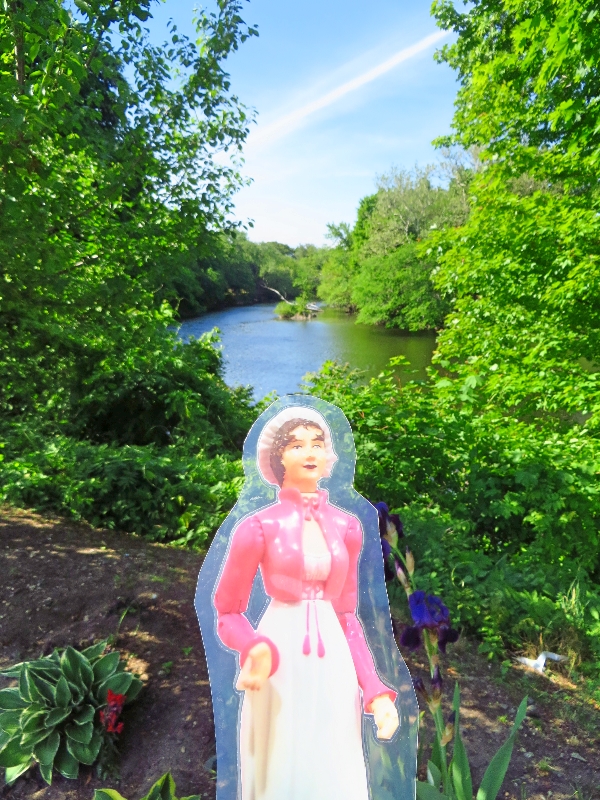
We survey the river and dam and try to imagine how it must have looked before the mills were built. Perhaps one day the mill will be gone and there will be a park here instead. 

Roosevelt Avenue Bridge built 1910


The Blackstone River

Blackstone River


Susanna imagines a garden with purple flowers blooming here one day


I have crossed my lines, turned my paper and crossed until I am unable to cross any more. I shall leave you here for now and promise to write more soon.

Yours affectionately,

Jane

Friday, March 6, 2020

Mini Felicity Learns How to Make Chocolate

Meet Felicity! This is my doll Felicity. I named her Felicity because she looks very much like my friend Felicity in 1774. I even got her the same dress as Felicity. A few weekends ago I sent her on an adventure in colonial Boston! She learned how to make hot chocolate! No sillies, in 1774 cocoa powder was not invented yet. No microwaves either. You had to make drinking chocolate from scratch. It is soooooo good and worth the effort. I will let Felicity tell you all about it.

"Good day from Boston! I am here at Captain Jackson's Chocolate Shop learning where my favorite drink comes from. Chocolate has been made in Boston since 1682.


Chocolate comes from the cocoa tree (cacao). About 3000 years ago (or 1500 BCE Susanna's/your time) the cocoa tree was domesticated in the Amazon region of South America.

The Aztec king Montezuma drank chocolate many times a day in a show of strength and power.


This chocolate was made from ground cocoa beans, chile pepper and water.The Spanish sent the recipe back home to Spain where they added honey, or possibly cane sugar, and the newly discovered vanilla plus some cinnamon and black pepper. This is basically how we make it today in the 1770s! Watch how it's done.

First you need a rainforest and the cocoa pod.
chocolate in rawest form from Wikipedia


Inside the pod are beans.

chocolate beans  Chocolatier NestlĂ© of Broc , Switzerland, Canton of Fribourg. (Wikpedia)


The beans are sent from Central and South America to chocolate mills in the colonies.

The beans are roasted like coffee beans in a long handled pan over the open fire. This takes 45 minutes to one hour plus cooling time. The chocolate maker does this in his mill.

From beans to drink. Chocolate making tools

The shells are sifted off. This is called winnowing. It's done in a winnowing basket. You want to get off the indigestible chaff.  This is done outside on a windy day.

That gives you cocoa nibs. The chocolate maker says they are very, very bitter.

Then you grind the cocoa nibs in a  mortar and pestle.

Next you put the ground cocoa nibs on a mano and rub and rub. This creates heat and friction to grind the cocoa nibs into a paste.

Then the chocolate is placed into a mold. That is allowed to set and then turned out. You have a brick of 100% pure dark chocolate. This is sent to the consumer. The real Felicity's father sells chocolate in his shop.

It isn't tasty yet. You must add things to it to make it taste good.

Your/your cook/your mother/your slave/ grinds or shaves the chocolate brick and mixes it with hot water. Then she adds the tasty parts.

We add some of this thing wrapped in blue paper. It's not salt but... sugar. You knew that right? My namesake has one of those.

The peel of a fruit that's also a color. (Hmm can't taste that at all) cinnamon, nutmeg, anise (a spice used in Italian cooking that tastes like licorice) and a tiny pinch of cayenne pepper. (Mrs. Washington's cook uses annatto for color).

All that goes in a special chocolate pot. The pot has a stirring stick to stir up the spices and make the chocolate frothy. It is then served in small chocolate cups, something like the ones Italians use to drink their strong, bitter coffee they call espresso. The servants/moms then serve the chocolate to the family and guests for breakfast or any time coffee or tea was served.

Try making chocolate yourself. Use a stone ground chocolate or heritage chocolate.

Hot Milk Chocolate 
1 quart milk
4 ounces chocolate without sugar
1/8 ounce fine sugar
1/8 ounce flour or starch
Salt to taste
The Cooks and Confectioners Dictionary, Or, The Accomplish’d Housewifes Companion By John Nott, cook John Nott

While edible chocolate is not yet available in my time, it is sometimes used in cooking. Mr. Nott has a good recipe for chocolate biscuits.


Scrape a little Chocolate upon the Whites of Eggs, so much as will give it the Taste and Colour of the Chocolate. Then mingle with it powder Sugar, till it becomes a pliable Paste. Then dress your Biskets upon Sheets of Paper in what Form you please and set them into the Oven to be bak'd with a gentle Fire both at top and underneath.
You can reuse the shells. Mrs. Washington loves to drink cocoa shell "tea". In your time people sometimes use these shells for mulch for their gardens.

Watch a video from George Washington's Mount Vernon about the process