Friday, March 6, 2020

Mini Felicity Learns How to Make Chocolate

Meet Felicity! This is my doll Felicity. I named her Felicity because she looks very much like my friend Felicity in 1774. I even got her the same dress as Felicity. A few weekends ago I sent her on an adventure in colonial Boston! She learned how to make hot chocolate! No sillies, in 1774 cocoa powder was not invented yet. No microwaves either. You had to make drinking chocolate from scratch. It is soooooo good and worth the effort. I will let Felicity tell you all about it.

"Good day from Boston! I am here at Captain Jackson's Chocolate Shop learning where my favorite drink comes from. Chocolate has been made in Boston since 1682.


Chocolate comes from the cocoa tree (cacao). About 3000 years ago (or 1500 BCE Susanna's/your time) the cocoa tree was domesticated in the Amazon region of South America.

The Aztec king Montezuma drank chocolate many times a day in a show of strength and power.


This chocolate was made from ground cocoa beans, chile pepper and water.The Spanish sent the recipe back home to Spain where they added honey, or possibly cane sugar, and the newly discovered vanilla plus some cinnamon and black pepper. This is basically how we make it today in the 1770s! Watch how it's done.

First you need a rainforest and the cocoa pod.
chocolate in rawest form from Wikipedia


Inside the pod are beans.

chocolate beans  Chocolatier NestlĂ© of Broc , Switzerland, Canton of Fribourg. (Wikpedia)


The beans are sent from Central and South America to chocolate mills in the colonies.

The beans are roasted like coffee beans in a long handled pan over the open fire. This takes 45 minutes to one hour plus cooling time. The chocolate maker does this in his mill.

From beans to drink. Chocolate making tools

The shells are sifted off. This is called winnowing. It's done in a winnowing basket. You want to get off the indigestible chaff.  This is done outside on a windy day.

That gives you cocoa nibs. The chocolate maker says they are very, very bitter.

Then you grind the cocoa nibs in a  mortar and pestle.

Next you put the ground cocoa nibs on a mano and rub and rub. This creates heat and friction to grind the cocoa nibs into a paste.

Then the chocolate is placed into a mold. That is allowed to set and then turned out. You have a brick of 100% pure dark chocolate. This is sent to the consumer. The real Felicity's father sells chocolate in his shop.

It isn't tasty yet. You must add things to it to make it taste good.

Your/your cook/your mother/your slave/ grinds or shaves the chocolate brick and mixes it with hot water. Then she adds the tasty parts.

We add some of this thing wrapped in blue paper. It's not salt but... sugar. You knew that right? My namesake has one of those.

The peel of a fruit that's also a color. (Hmm can't taste that at all) cinnamon, nutmeg, anise (a spice used in Italian cooking that tastes like licorice) and a tiny pinch of cayenne pepper. (Mrs. Washington's cook uses annatto for color).

All that goes in a special chocolate pot. The pot has a stirring stick to stir up the spices and make the chocolate frothy. It is then served in small chocolate cups, something like the ones Italians use to drink their strong, bitter coffee they call espresso. The servants/moms then serve the chocolate to the family and guests for breakfast or any time coffee or tea was served.

Try making chocolate yourself. Use a stone ground chocolate or heritage chocolate.

Hot Milk Chocolate 
1 quart milk
4 ounces chocolate without sugar
1/8 ounce fine sugar
1/8 ounce flour or starch
Salt to taste
The Cooks and Confectioners Dictionary, Or, The Accomplish’d Housewifes Companion By John Nott, cook John Nott

While edible chocolate is not yet available in my time, it is sometimes used in cooking. Mr. Nott has a good recipe for chocolate biscuits.


Scrape a little Chocolate upon the Whites of Eggs, so much as will give it the Taste and Colour of the Chocolate. Then mingle with it powder Sugar, till it becomes a pliable Paste. Then dress your Biskets upon Sheets of Paper in what Form you please and set them into the Oven to be bak'd with a gentle Fire both at top and underneath.
You can reuse the shells. Mrs. Washington loves to drink cocoa shell "tea". In your time people sometimes use these shells for mulch for their gardens.

Watch a video from George Washington's Mount Vernon about the process

Saturday, February 29, 2020

Searching for Pocahontas: A Visit to a Powhatan Indian Village

In which I continue my adventures in 17th -century Virginia.

I venture into the Powhatan Indian village looking for a young Pamunkey girl named Pocahontas. I heard she was very lively and fun. She is gone now but her people are still here. Let's walk through the village and learn about Powhatan life.
The Indians burned and hollowed out canoes for water travel

When the English settlers arrived (before my family came here), there were thousands of Eastern Woodland Indians occupying the coastal plain of Virginia. Their ancestors had lived on the land for centuries before that. There are 32 loosely related tribes. Pocahontas's father, Wahunsonacock, or Powhatan was a powerful chieftain. Each tribe is led by a man (werowance) or woman (weowanquas). They live separately but share religious beliefs and cultural traditions.

Powhatan Village

Women farm and raise children. The Powhatan, as we English call them, are a matrilineal tribe. This means women pass on the traditions to children along with kinship and inheritance. When the children marry, their mothers and aunties go over the family tree to make sure the couple are not related.

Everyone paid a tribute tax to the local rules and the local ruler paid tribute to Powhatan (or other chieftain). Tributes can be skins, shell beads, copper or corn. In return for the tribute, the people get protection from the ruler.
Skins piled up 

This is a Powhatan house like the one Pocahontas lived in as a girl. It is called a yehakin. It is made from saplings of local trees like red maples, locusts and red cedar. The frames are covered with bark or marsh reed mats.

Inside a yehakin

yehakin walls

Houses were built along the banks of large rivers and major tributaries. Like our villages, houses are near planting fields. The Powhatan move whenever the fields don't grow food anymore. The Powhatan plant, hunt, fish and gathering according to the seasons. They raise vegetables like corn, beans and squash.
Powhatan village

Corn is a common food. They grind the corn to make into flat cakes or boil it in a stew with beans, squash, wild game or fish. In summer and fall they eat fresh vegetables; in spring fish, berries and stored nuts make up the main diet. They can gather oysters and clams when food is scarce during winter. In winter they also hunt and eat game including raccoon, deer, opossum, turkey, squirrel and rabbit.

common foods include corn, beans, oysters, clams, and nuts
                                         
Deer are used not just for food but also clothing and tools.

Preparing deerskin

Reusing the deerskin
                                     
Opossum? Raccoon? What is THAT? How strange. I heard many English people were starving before we arrived. I suppose eating such game would taste fine if one were starving but I do not wish to eat such odd New World creatures.

What did children do? While men hunted, fished, made tools and cleared land and grown women farmed, gathered firewood, made clothing, prepared and served meals, the children helped their parents. Girls had to weed gardens. Nothing different from our village! I help my mother weed the garden, prepare and serve meals too. Indian children like Pocahontas also play games. She was said to be a prodigious runner. Some children may also be put in the middle of the corn fields to act as a scarecrow to keep animals from eating the corn.

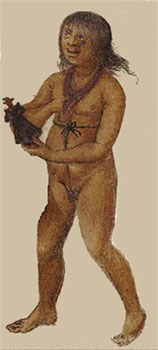
These Indians are scarcely dressed. I blush when I see them. The children run naked until they are my age or a bit older!

How a Powhatan girl might have looked based John White's watercolors of other Algonquian-speaking people.
Young native child
 from the British Museum
                                                           
The Indians have a curious custom of painting their bodies and piercing their skin to make designs. They smell oddly of bear fat. The women chieftains and other wealthy women wear ornaments around their necks and in their ears.

This is the life Pocahontas knew.

Saturday, February 15, 2020

A Visit to 17th -century Jamestown, Virginia

Jamestown Fort
                                             
I am exploring the 17th-century again to see what life was like for people outside of New England. In the future, the story of Pocahontas will shape the story of Jamestown. The true story was very different.


Jamestown was founded in 1607 by a bunch of men. They arrived on three ships like the ones you see behind me. The ships were called The Susan Constant, Godspeed and Discovery . (Anya, do you remember seeing the Godspeed with my guardian WITHOUT ME when you came to visit?).


104 men landed in April 1607. They were gentlemen, laborers, sailors, a preacher and other assorted men.

Jamestown ship


This land was occupied by 14,000 Indians. Their leader was Powhatan, father of Pocahontas. She was a little girl not much older than me at the time. More about the Powhatan a little later.

Indians burned and hollowed logs to make canoes
The English settlers built a fort to protect themselves from Spanish raiders and local Indians. The fort is a triangle shape with walls of planks and posts. Each corner has a raised area to support cannons and guns.

Follow me back to the 1600s and visit the fort.

"Good day! I am Mary Peirsey. I am ten years of age. I was born in England. My parents have brought my elder sister Elizabeth and me to the new world to this strange place called James Towne. I do not understand why. 'Tis an unusual place of wilderness and hard work.

Pray, come join me in exploring my new home.


Good day! Welcome to Jamestown!


These fort buildings have wattle-and-daub buildings with thatch roofs. They are supported by wooden posts set into the ground. After the frames were built, horizontal pieces of split wood were woven into the frames. Clay mixed with water, sand and straw was put on the wood panels. The thatched roofs were made from marsh reeds or split clapboard. This is very different from our homes in England. 
Here you can see the construction of the church roof

After the men set up their fort they learned to trade with the Indians.

They built a storehouse first to hold supplies and exports, an Anglican church, and a guardhouse as headquarters for military activities. Later they added a cape merchant’s office and a governor’s house.
Welcome to the Jamestown fort
The storehouse


The first order of business is survival. All activities in the fort are done to survive. The soldiers hold military drills every day.

The men try different businesses to keep the colony going. They have glassmaking, a woodshop, pitch and tar and potash manufacturing and a blacksmith.

Kidskin leather used for gloves. It's very soft. 

Everyone goes to church. It is the law. Just because we are in a savage land does not mean we must abandon our faith.
This is a fancy Anglican church

I sit quietly in my family's pew waiting for the service to begin

The church is much fancier than New England meetinghouses

church pews


The first women arrived in 1608 and more came after that. In July 1609 a fleet of nine ships left England to bring more people and supplies.
I survived a long voyage across the sea. I am now here in the wilderness of this place called Virginia.
                                                   

The few women in the fort cook, garden and sew for the men.

Here, chicken, chicken

Come chicken! I need to cook you for my supper. 


Finally catching the chicken, now I can cook her in the fireplace.

Baking bread in an outdoor oven
picking herbs (say that h) in the garden

The sun is strong and beats down on my head as I pick mustard

 Parnsips.

Leeks 

picking chives

My work is never done
This rooster wants to chase me away
Do not be afeared to join us in James Towne. Although we are currently at war with the Indians our militia will take care of them. 

Be ye willing to work ye will survive.  God willing, I shall survive and have my choice of husband. Perhaps one day I will be mistress of a grand house with fine furniture as grand as any in England!"

Friday, January 17, 2020

A Visit to Felicity's Williamsburg Day 3: A Final Farewell

Before I leave Williamsbug and the 18th-century behind, I must pay a call on the Royal Governor and his family.

The Governor's Palace was built new in 1722 after 16 years! It was renovated in the 1750s.

The first Governor to live here was Alexander Spotswood. When the entrance hall was completed in October of '11, Governor Spotswood had it decorated with a display of bayonet-tipped muskets.

Governor's Palace entrance hall with weapons display


The word "Palace" was first used for the governor's house about 1714.

Lord John Murray, Earl of Dunmore is the current Royal Governor. His wife and children live here too. As you know from speaking with Felicity, the people are not happy with the governor. He was appointed by the King as the King's representative in Virginia. The people are becoming unhappy with the King's strict laws. I think Lord Dunmore will not be governor for long!

The Palace hosts the finest entertainments for the most fashionable people, like the Coles. This is their ballroom. 

Practicing dance steps in the Governor's Palace ballroom under the eye of King Charles II.
                                                    
I'm tired from practicing my dancing! I think I will sit down over here. *

Resting after dancing 

*Susanna was given exclusive access to the historic chairs from one of the interpreters on duty in the ballroom, who again, thought Susanna was Felicity. 

Off the ballroom is a supper room where one can take refreshments. 

Governor's Palace ballroom refreshment room
After relaxing, a servant gives me a tour of the Palace.
Governess's bed
I like this little camp bed and doll. Surely this must be the youngest daughter's bed? (Actually, the youngest daughter is but an infant, but Lady Susan is 7 years old like Felicity's sister Nan.) The servant informs me that this is the bed for the French Governess! That must be Lady Susan's doll. 

Lady Catherine and Lady Augusta's dressing table
The eldest daughters, Lady Catherine and Lady Augusta are quite grand at 14 and 13 years of age. 


Looking in Lady Dunmore's mirror
When I look out the window I see the sun has come out again, just before sunset.
                                

Looking out the window of the Governor's Palace
The household requires approximately 25 servants and slaves to tend. Some of these servants and slaves live and work in the outbuildings, while some live and work in the main house. 
Palace back entrance

Outside on the grounds there is a formal garden (where I went through the maze), a large naturalistic park, stable, carriage house, kitchen, scullery, laundry, and an octagonal bathhouse!
Resting on a bench in the gravel walk

Palace grounds
If you want to peek at the rest of the Palace, come with me back inside. (Be sure to look at each picture individually and read the captions).

I will leave you here and say "Farewell from Williamsburg!" I'm not done having adventures so look for me again soon in another time. 

If you want to know more about Williamsburg in-depth, follow my guardian over to her nerdy world -she's very boring but you can look at the pictures!

See you soon on my Jamestown advernture!