Showing posts with label George Washington. Show all posts

Saturday, July 23, 2022

Flat Jane Austen in Providence, Rhode Island

 Flat Jane Austen in Providence, Rhode Island:
A Visit to the Circulating Library 
(and a peek into the future)


Editor's Note: All photos taken at the Providence Athenaeum (1836, close enough to Jane's time) one of the oldest subscription libraries in the count
ry. All are welcome to stop in for a tour and browse. Jane had to view the brand new bust of Mary Wollstonecraft! While she was there, she got a peek into the future, in the later 19th-century and 20th-century as novels became more popular and literary criticism of HER novels became a thing. 

All are welcome to come take a tour and browse. 

June 18--

My dear friends,

At last! A visit to the circulating library! There are many volumes to browse, artwork to peruse and people to meet. 


I am a bit surprised to learn that the former colonists have received a classical education. The building resembles a Greek temple such as the ones that have recently been discovered. There are even statues and busts of classical poets, gods and goddesses! Of course they also have busts and sculptures of Benjamin Franklin. 
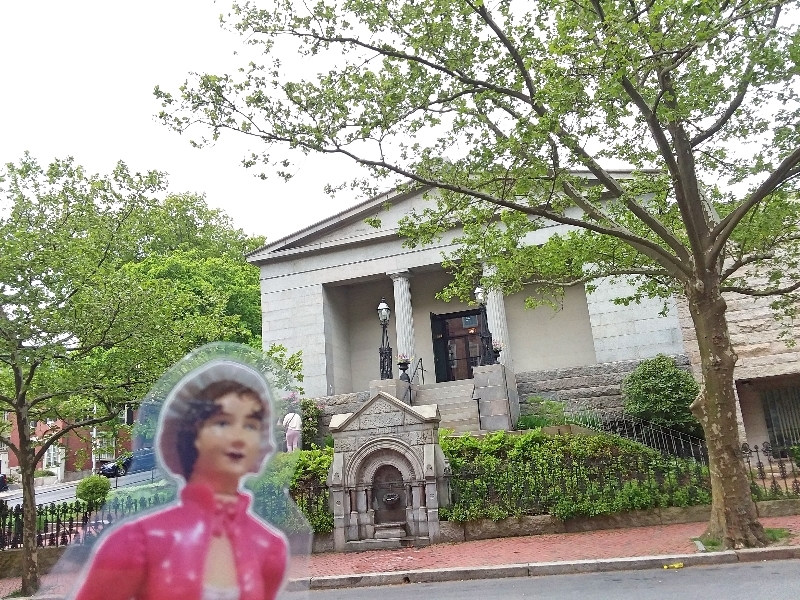
Providence Athenaeum 1836

Richmond Fountain built to provide clean drinking water in 1873 
recently refurbished and still drinkable! 
 “Come Hither Every One That Thirsteth.” A longtime LEGEND claims that all those who drink from it are bound to always return to Providence


A view of the circulation desk, virtually unchanged in over a century 
Behind the desk, above Jane's head, is a beautiful painting known as The Hours painted by Edward Greene Malbone, a Royal Academy artist in London. It depicts three female figures represent the Greek horae, goddesses that personify the orderly passage of time.


Minerva or Athena, perhaps? Athena Lemnia. Lord Elgin must have rescued this one from the Parthenon. She's missing an arm! That dreadful man! No appreciation for art. 
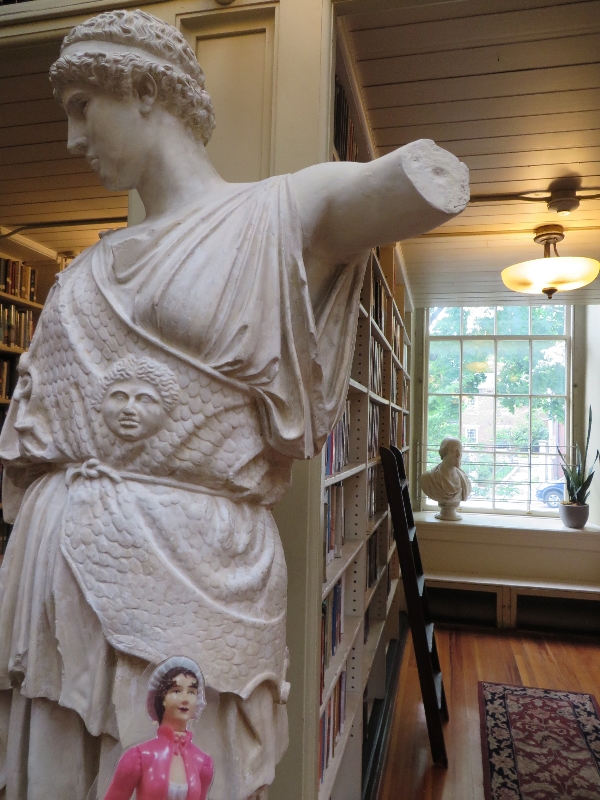
Plaster statue of Athena Lemnia 1913. Read the story at the Ath website.

Is this who I think it must be? Mary Wollstonecraft? I am uncertain why there is a bust of her but I approve. 
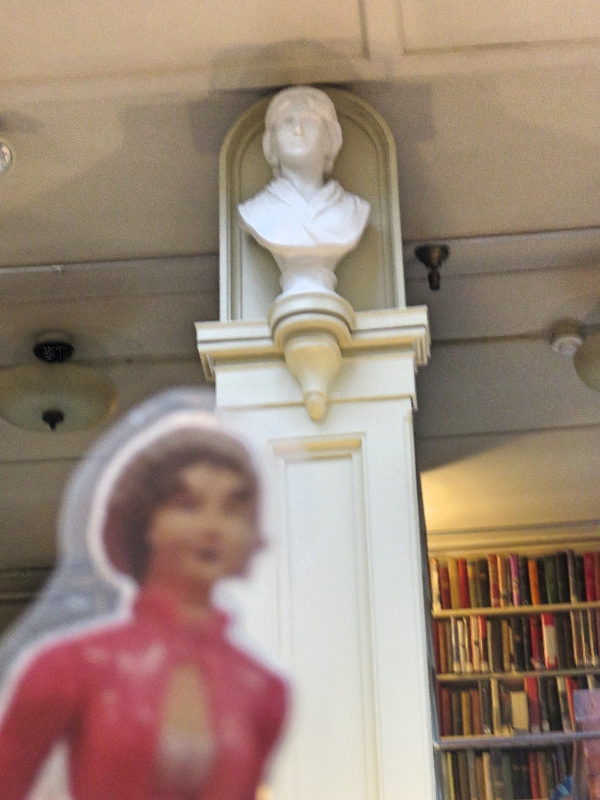
New in 2020, a plaster bust of Mary Wollstonecraft!
The editor- and Jane- were quite exited to see her on display at last. 


There are busts of good English writers as well: Shakespeare, Milton, Lord Byron (good writer, deplorable conduct). Even the Scottish poet Robert Burns is represented. Another one wanting conduct.

L-R : John Keats, Mary Wollstonecraft, John Milton

Another view of Mary and John Milton


On the other side we see the later mezzanine addition with busts of more writers.
Upper level L-R: Socrates, Demosthenes, George Washington, Benjamin Franklin, William Ellery Channing and...
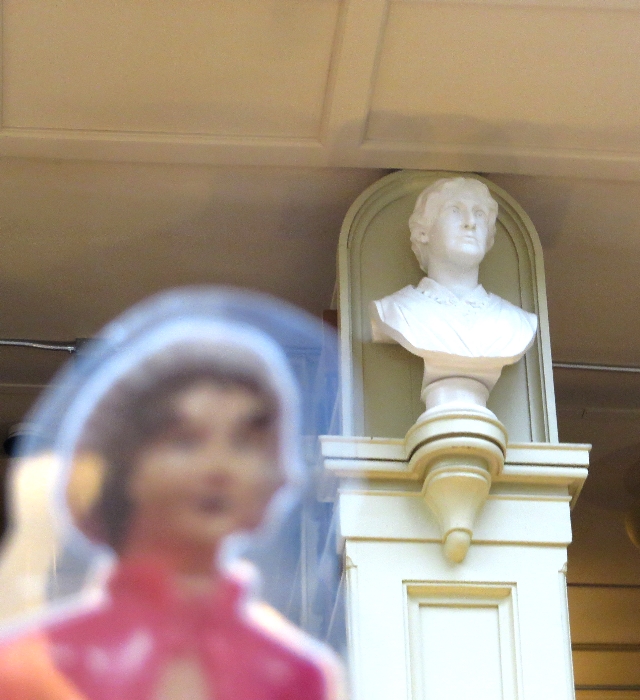


(and also Frederick Douglass who didn't make it into the picture). Miss Alcott is a bluestocking writer for children and Mr. Douglass is a former slave, orator, writer and abolitionist. I have never heard of either of them, of course. I shall no longer be alive 50 years hence, else in my dotage! 

Also on the opposite side of the main room is Benjamin Franklin.
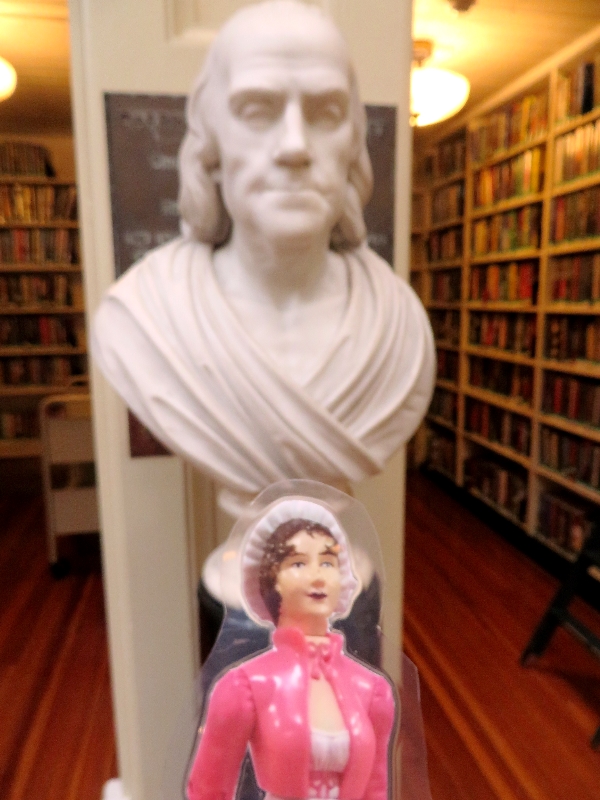


Mr. Benjamin Franklin, once an Englishman, then a traitor, now dead. He was quite witty and charming in his day though. We do miss his wit and charm and perhaps one day he will be forgiven for betraying  the British government. 

Another Englishman turned traitor, their American hero, Mr. George Washington. Pity he was such an English country gentleman. I think he too will one day be forgiven for turning against King and country. 
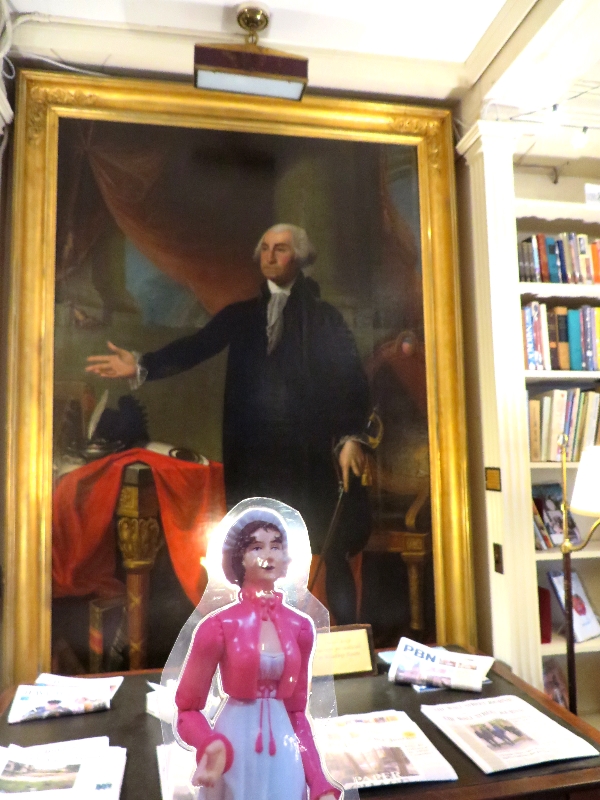
George Washington, ca. 1830s, anonymous, after Gilbert Stuart (1755-1828)


An extra large portrait of the late President hangs in the reading room [downstairs].

This portrait is a copy of one of the most well-known 18th-century American paintings. The painting was painted by American artist Gilbert Stuart for William Petty, first Marquis of Lansdowne, who helped shape the 1783 peace with America following the war for American independence. This copy of the Lansdowne portrait that hangs in the Athenaeum was painted by an unnamed "accomplished Italian artist." It was donated by merchant Samuel Larned (1788–1846), the Chargé d'Affaires to Chile and Peru, on the occasion of the opening of the Benefit Street building. The placement in the public halls of the library is to encourage the virtuous and patriotic character of Providence’s youth.

Belowstairs is the headquarters of the Franklin Society, a scientific and philosophic club (1838-1848). 

They say the Franklin Society reading room has been built into a hill and the building is being held up by the shelves. One day it may just sink! 

Look at this curiosity! What could it be?

They tell me this cabinet was built to house the Description de L'Égypte published between 1809-1828 by Napoleon’s Imperial Press ( Napoleon again!) It was designed by Ameican book collector John Russell Bartlett and English architect Frederick Catherwood in the manner of an Egyptian temple 
with exterior decoration based on plates in the Description. I see the plates behind the cabinet. Napoleon ordered this book published in 1802 to share the discovered of the french expedition to Egypt. This particular copy belonged to French statesman and ultra-royalist Jules Armand, Prince de Polignac. Read more in the Athenaeum's self-guided tour brochure.

Please turn the page...


Tuesday, August 18, 2015

George Washington Visits Providence

George Washington Visits Providence


It's August 1790 and George Washington has come to Providence to recognize that we have (finally) ratified the Constitution, becoming the 13th state. Huzzah! (hoo-zay) He visited with local notables such as John Brown and toured Providence. This is what Providence looks like. He stayed at Rhode Island College, which you in your time know as Brown University. The students were so eager to welcome him, they placed candles in the windows of University Hall. Washington said he never went out at night but he was readying for bed when Rev. Manning, the College President, told him about the illumination. Mr. Washington had to go out and see it. He was very pleased by the warm welcome. The townspeople of Providence gather at John Brown's fine mansion on the top of the hill to welcome the President.
John Brown and son 
John Brown and Son


While we wait for Mr. Washington to arrive, we mingle on the lawn of John Brown's mansion.
                                                  
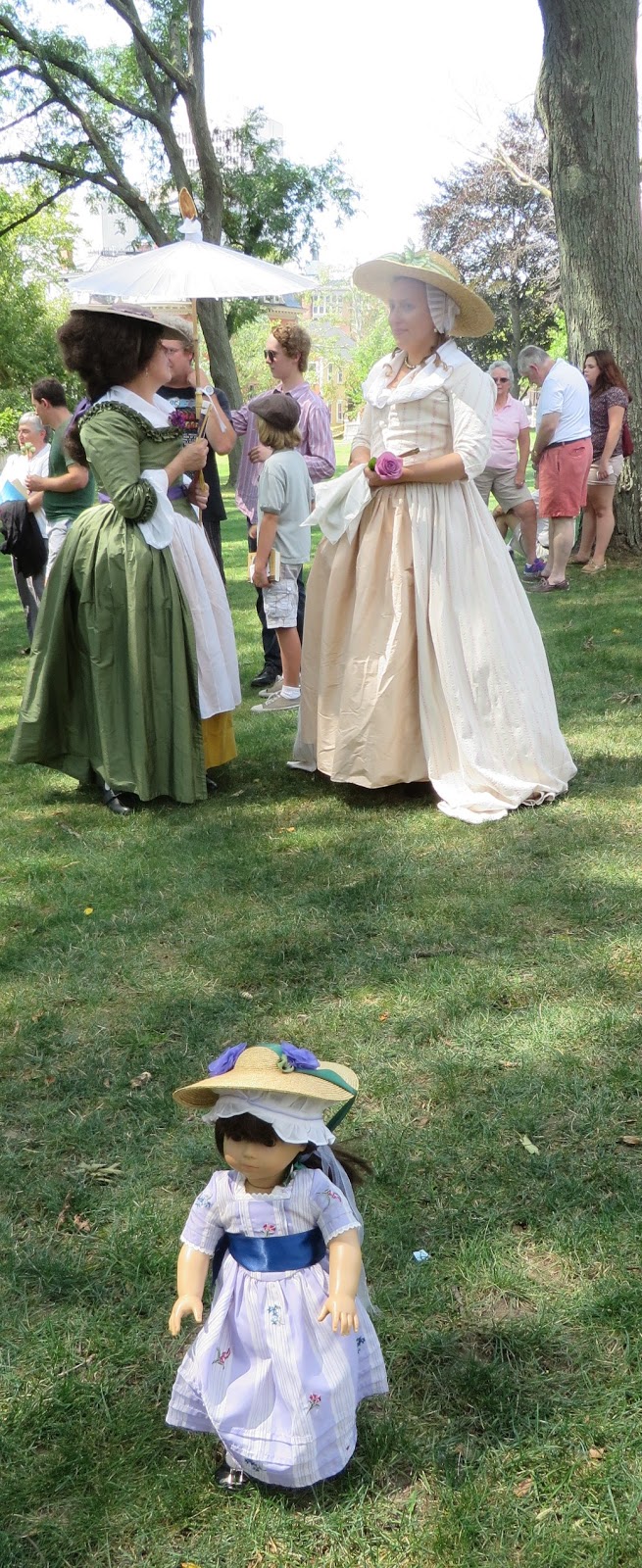
I met a lady who wore a gown that would match my hat. I told her so and she liked how I updated my gown by adding a sash. She did the same thing! She said "One can not forever be buying new clothes." "No indeed!" said my guardian. "Especially when one is a growing child. She has growth pleats in her skirt to let out as she grows." Of course I had to wear my very best gown to greet the President, even if it is a trifle out of date. (Felicity let me keep the dress. It looks better on me than on her).


Miss Estelle was strolling along selling flowers. She said my gown was very charming. Her flowers looked like the flowers on my gown.


 I met several other kind townspeople who were very interested in me. Some ladies promised to call on me [visit my blog].
                                                                    

President Washington was welcomed by a delegation.
They speechified for some time, encouraging the education of our young people. By young people they mean BOYS!
John Brown Welcomes President Washington
Rev. Manning, President of Rhode Island College

They speechified for some time, talking about the education of our young people. By young people, they mean young men, of course.


We had a toast to Washington and then he began to tell us of his life.


He did not mention his early years but he started his career at the age of one and twenty in the militia. He quit after the Seven Years' War because he fell in love with the lovely widow Martha Dandridge Custis. She became Mrs. Washington!


The Washington wedding was a grand affair. They celebrated all night. George and Martha danced the minuet together. This young lass volunteered to dance with Mr. Washington! I already know how to dance the minuet. It goes like this:

First make your Virginia courtesy, which you in your time have shortened to curtsy. (Dearest Felicity, you need not sink so low in your courtesy. 'Tis just a slight bob. Methinks you can learn this easily). The gentleman bows. (The gentleman always puts his best foot forward. If he has not shapely calves, he may purchase a carved wooden piece to wear over his leg).
Then it goes like this in a square: (can you see the slideshow?)

After the Washingtons married they set up housekeeping at Mount Vernon together. Mr. Washington changed his crops after much research. He diversified so he could make more money and it was easier on the slaves.

They were married only six short years before the King in England visited his counting house and discovered the counting house was empty! The King spent all his money fighting the French. The King sent troops to stay in America in our homes. Those troops did not have much to do so they took other jobs - they took jobs away from good Americans! Many Americans were unhappy about that. The King decided since the war was fought mainly in North America, he would tax the colonists to replenish his treasury. He taxed things that were never taxed before: £10 was placed on attorney licenses and other taxes on land, playing cards, dice, newspapers, pamphlets, diplomas, etc.


The people of Boston town protested in the streets and that led to what Sam Adams called (he is always putting a colorful spin on things), "The Boston Massacre." Then the King taxed tea (which one could only buy from the East India Company at whatever rate they charged). The Americans boycotted British goods. There were protests up and down the east coast - the largest was in Boston.


Do you know what happened on the 18th of April in 1775? I know and I was not alive yet. 'You in your time always seem to know about Paul Revere," says Mr. Washington. "Did you know Mr. Revere was captured? William Dawes was also captured and only Samuel Prescott made it to Concord.

Then the colonists met in Philadelphia at the Philadelphia Congress. Mr. Washington said, "This is critical for understanding your history. We came together as 13 separate countries. (My country is Virginia, yours is Rhode Island. What really happened at that First Continental Congress is we came together as Americans for the first time."

George Washington was appointed General and Commander-in-Chief of the Continental Army. General Washington was terrified. He promised his Martha he would be home by Christmas Eve. He didn't say which Christmas Eve! He finally walked in the door at Mount Vernon on Christmas Eve eight years and a half later. Mr. Washington said one of the successes of the Revolution was "we created a better life for most - but not all - the inhabitants of this land."

Washington talked about slavery. When he first inherited slaves at the age of 11, he did not refine too much upon it. His slave was nothing more than property, however, he has thought on this a long time and "a man of 50 can no longer wear the same clothes he did at 15." He saw men of color fight alongside white troops and die the same death. He now feels slavery is an abomination. He can not free Martha's slaves, they do not belong to him. He has decided not to free his own slaves because many married Martha's slaves and had families. (He did not say why he did not ask the slaves what they wanted). He has made provisions to free his slaves after Mrs. Washington's death.


You know the rest of the story! (Or you can read about it in history books).

Washington answered some questions from the townspeople. Here are some things you may not know. His favorite color is green! He's a farmer so he likes green because green means things are growing. His favorite occupation? Farmer.  His teeth are not made of wood. He started to lose his teeth at one-and-twenty. He has a dentist who made dentures for him. They are all made out of animal teeth and have a space for his one remaining natural tooth. I heard tell they fit his mouth ill and he had difficulty speaking, but today he spoke just fine.


 He left us with some excellent advice and parting words. [Washington's Farewell Address].
He also adjured us to follow his rules of civility
.

I purchased a miniature of President Washington as a souvenir.


Then Mr. Brown invited us inside to see his fine portraits of President and Mrs. Washington, lately done in Philadelphia.


We were also invited to partake of the electricity machine, for fun!


You may call on Mr. Washington at this portal.

Bonus: